
Meet Your Meat, Part 1
Easter’s coming. Time for dead pig on a plate!
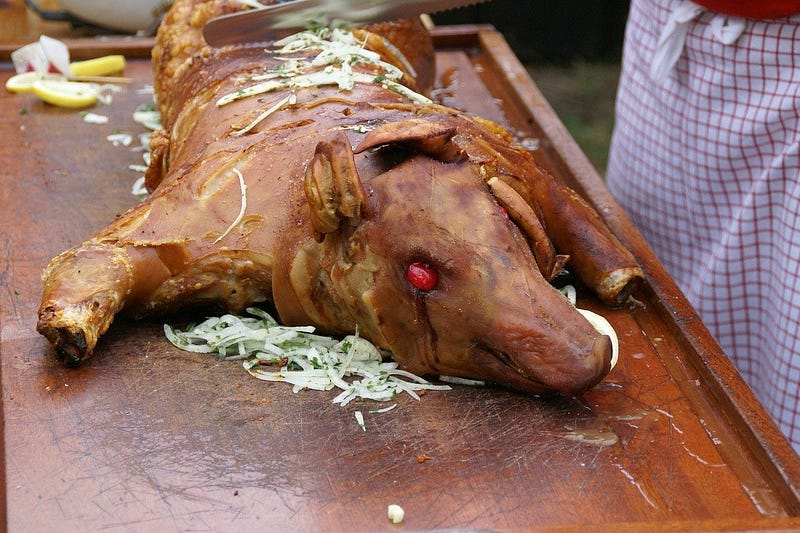
I am writing this with the full knowledge that those of you who are committed, voracious eaters of meat…of dead animal flesh, will quickly scroll to another story.
But I’m hoping that there are at least a few of you who are on the fence about the ethical and moral ramifications of eating animals.
As it turns out, I’m writing this for my own edification, as well as yours. Although I haven’t touched any form of red meat or pork in years — and do not miss it — I still occasionally eat chicken. Birds. That said, my plan is to switch to a one hundred percent plant-based diet. I am almost there and I know it’s the right thing to do.
This is the first of what will be a three, or perhaps four-part series. You can probably guess what the other two will cover but for now, I’ll respectably, leave you hanging.
I’m not here to beat anyone up, but I refuse to pretty things up. Animals are routinely tortured and live short, miserable existences so that we can have our Whoppers, our T-Bones, our barbecued ribs and of course…our bacon.
This is not the food we need, mind you. It’s the food we want. Because we are an inherently selfish society. Now, more so than ever.
As the subtitle of this piece clearly states, the focus for today is dead pig on a plate, more commonly referred to as ham or bacon or pork.
Whatever your preference of monikers, pork is the flesh of a dead pig. Dead. Animal. Flesh.
YUM.
It’s easier to ask for ham and eggs, or bacon and eggs for breakfast, isn’t it? You’ll never hear anyone at a diner ask for “extra crispy pig.” That’s called avoidance. Something we Americans are expert at.
Did you know that pigs are more intelligent than dogs? They’re smart, sensitive and emotionally complex creatures. They display a wide range of emotions and love to play.
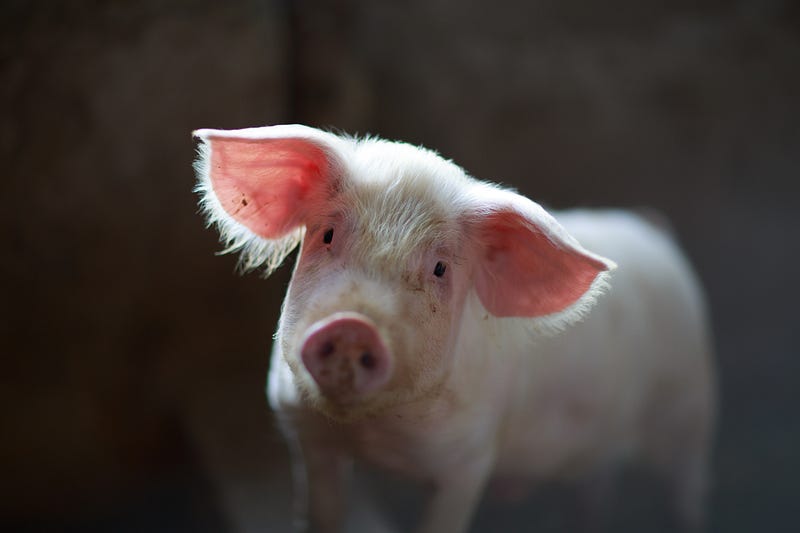
Yet, we don’t give a shit. Because we want to eat pig. And, because we Americans want what we want when we want it, on any given day in the U.S., there are more than 75 million pigs on factory farms, and 121 million are killed for food each year.
The above statistic comes from PETA, an organization which I happen to respect because if I was on the front lines every day, and witnessed the atrocities that these people witness, I’d have to blow my brains out.
We consume more meat per capita than any nation in the world.
We’re also one of the fattest nations in the world. We just can’t seem to get it right. Our president sucks. Our environment sucks. And the way we treat farm animals is abhorrent.
Eating pig is not a healthy choice. You can call it “the other white meat” until that orange asshole in Washington finally keels over from his McDonald’s jones, but, unhealthy it is.
Dr. Axe, who knows damn near everything, lays it out like this:
Meat from pigs is more saturated with toxins because of their digestive systems. Whatever a pig eats is digested quickly, in less than four hours. That’s not enough time for the animal to rid itself of toxins that ultimately get stored in the fatty tissues — in other words, the part you eat.
Also, pigs barely sweat as they have few functional sweat glands, meaning they have even more toxic buildup. Does that whet your appetite? The thought of ingesting even more toxins than we already take in from other foods, the environment, our health and beauty products?
Bacon and other processed pork like sausage, ham, hot dogs and deli meat is carcinogenic, leading to an increased risk of cancer. Mmmmm, boy.
Studies have shown that consuming 50 grams of processed meat each day raises your risk of colorectal cancer by a very significant 18 percent.
Is a side of pig with your eggs really worth that?
Having had breast cancer, I’ve re-examined my eating habits and have learned that a primarily plant-based diet is the way to go overall health and longevity. But that’s another story.
Parasites are another concern as pigs carry a variety in their bodies. The most common infection is Trichinosis. This is an infection that humans get from eating undercooked or raw pork that contains the larvae of the trichinella worm.
Basically, you are ingesting the larvae, which is encased in a cyst. When your digestive juices dissolve the cyst, they release the parasite into your bloodstream. The larvae then penetrate your small intestine, which is the perfect environment for them to mature into adults and mate!
This is some very dangerous shit. At this point, you may experience abdominal pain, diarrhea, fatigue, nausea, and vomiting.
It gets worse: Soon after eating the infected pork, the adult female worms now inside your body produce even more larvae that enter your bloodstream and eventually burrow into muscle or other tissue. Once this tissue invasion occurs, symptoms of trichinosis include:
- Headache
- High fever
- General weakness
- Muscle pain and tenderness
- Pink eye (conjunctivitis)
- Sensitivity to light
- Swelling of the eyelids or face
This is all pretty disgusting, no? But here’s the thing. I didn’t write this to drive home the fact that eating pork — pig — is unhealthy. Instead, I want to discuss the ethical ramifications of how these animals are forced to live and die.
There is no fantasy scenario I can offer up to assuage whatever guilt consumers of meat products might feel as they tuck into their Sunday roasts. There’s only the harsh reality: Factory farms are the devil.
In the event that you give a damn, and I hope you do, Factory farming is the practice of breeding and raising vast numbers of animals in cramped, unnatural conditions while subjecting them to objectionable and undeniably miserable conditions in order to harvest their meat, milk, and eggs (among other body parts).
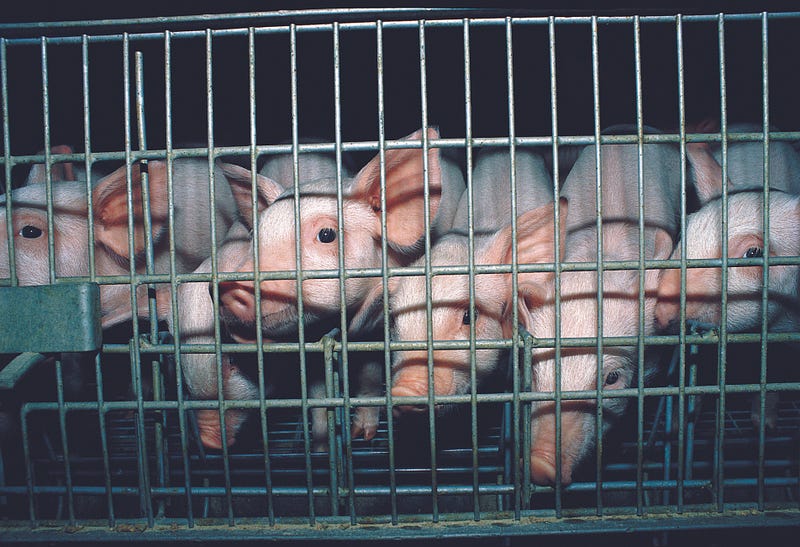
Animals aren’t “raised” or “nurtured,” they’re “processed” And yes, some farmers are less cruel than others but the end result is the same. Animals die horrific deaths so we can eat them.
Typically, pigs on factory farms live in tiny, barred kennels where they are unable to stand up or turn around. This type of “life” often makes them go crazy. Yes. Crazy. They squeal plaintively, bite the bars of their cages and often hurt themselves.
Do you still want that bacon? If so, stop reading this and check out “Twelve Ways to Masturbate in Public.” That’s probably more your style.
If you’re still with me, then please read on.
When these highly intelligent and affectionate creatures “misbehave,” they are often punished with beatings and shockings.
I’ve often wondered what caliber of an individual could work in an environment where such cruelty is not only encouraged, but treated as sport.
“The kind who needs a job,” you might answer. I’m sorry, but there are other ways of making a living that don’t involve “sodomizing” pigs with poles and pipes in order to get a laugh.
On factory farms, pigs often get their tails cut off, their teeth clipped and their testicles ripped out. Without the benefit of an anesthetic. We’re talking immediate and lasting pain.
But who gives a fuck, right? They’re just pigs!
Pregnant mother pigs have to endure even more misery. Crammed into tiny cages, or “gestation crates,” they experience extreme discomfort and stress.
After they give birth, there is no respite. The mother pigs are then moved into steel cages called “farrowing crates,” which also restrict their movement and means they can see, but not reach their piglets to care for them properly.
And piglets who are too sick or are not growing quickly enough are gruesomely killed by being slammed headfirst onto concrete floors or tossed into overcrowded gassing carts where they slowly suffocate from CO2.
If that doesn’t break your heart, you don’t have one.
These animals suffer at every stage of their lives, so if you think the end would be welcome, you’d be half right. That’s because pigs, like other animals, experience fear. They know that they’re going to die and die horribly.
Fear causes their stress hormones to kick into gear, so think of it like this: When you eat a pig, you’re also ingesting its fear.
Finally, when the end comes, it’s not quick. And it’s anything but painless.
A typical slaughterhouse kills up to 1,100 pigs every hour. The sheer number of animals killed makes it impossible for them to be given humane, painless deaths.
In the U.S., the process goes like this: Normally, pigs are first rendered unconscious using one of the following means: stunning using electric current applied with electrodes, or stunning using captive bolt pistol and inhalation of CO2, then in some cases a .22 pistol/rifle which is shot directly into the brain.
They are then hoisted on a rail, after which they are exsanguinated, or drained of blood, usually via the carotid artery and the jugular vein. After the animal is drained of all blood, the carcass is drenched in hot water in a device called a pig scalder, to help remove its hair, which is subsequently completed by using scissor-like devices and then a torch, if necessary.
Because of improper stunning, many pigs are alive when they reach the scalding tank. But who cares, right? They’re just pigs!
Now, there are all manner of gruesome images and videos I can include with this story, but, if you care enough, you can look them up for yourself. I don’t want to completely turn you away, even though I’m fairly certain this piece won’t win me many fans.
When we are presented with the ugly truth, be it about factory farming, our crooked politicians, or the collapsing climate, we tend to look elsewhere.
Well, screw your unicorns because they’re aren’t any. I haven’t seen one. Have you, fellow editor-in-crime, Stephen Sovie?
This publication is called The Militant for a reason and the fact that most people don’t care to know where their food comes from infuriates me. “Humanity,” is the oxymoron of all time.
If you’ve made it this far, this is all I ask: The next time you go to the supermarket and peruse the meat counter…the next time you purchase a ham or a family pack of pork chops, neatly wrapped in plastic and ready for your slavish ministrations, consider this: An animal lived its entire life in a virtual hell, so you can experience fifteen minutes of self-gratification.
Bon Appétit.
Sherry McGuinn is a slightly-twisted, longtime Chicago-area writer and award-winning screenwriter. Her work has appeared in The Chicago Tribune, Chicago Sun-Times, and numerous other publications. Sherry’s manager is currently pitching her newest screenplay, a drama with dark, comedic overtones and inspired by a true story.
Thanks very much for reading. I hope this story inspired you to learn more. If you do, I highly recommend reading the book, Eating Animals by Jonathan Safran Foer and viewing the documentary Forks Over Knives which is available via the streaming networks. Meanwhile, if you’re up for it, please check out the following.


