
Meet the Woman Who Just Changed Instagram’s Racist & Sexist Censorship Policies
Nyome Nicholas-Williams has gotten us one step closer to freeing the nipple
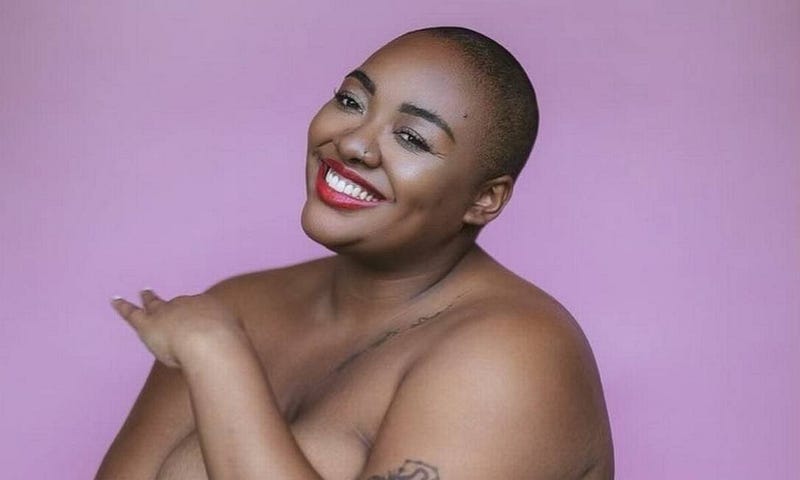
In the summer of 2019, I did something unthinkable: I started posting nude photographs on Instagram. Not pornographic, mind you. (Though who defines that?) And not particularly revealing, for that matter. My naked back featured in most of them, my naked arms, a little flash of my naked rear end in one of them, and side boob (no nipple) in others.
I was shocked when these were removed from my account. They weren’t the slightest bit sexual (in my opinion) and were images that were very important in my journey to make peace with my body.
In one, I’m defiantly showing off my underarm hair, something that scared the crap out of me to make public. In another, I’m curled up in a ball, expressing the love and trepidation I was feeling for and in my body as I was, for the very first time, starting to see myself as a sexual being after my ex left me for a younger woman. And in another, I was standing at a window, topless (nothing visible but my back and side boob), a symbolic image of my willingness to bear my heart and sexuality to the world again after hiding away for such a long time.
Having them removed for “sexual content” was not just jarring, but honestly, infuriating. What was sexual about them? Inappropriate? Pornographic?
I admit, I don’t have children, which maybe makes my next statement invalid, but if I did have a kid, I wouldn’t be at all worried about them stumbling upon these images. I hardly think they’d corrupt an innocent child or lead them into a pornographic rabbit hole.
What really upset me was that — not once, but three times — Instagram removed all the content from my entire account. Every single picture and all my followers were wiped on three separate occasions. I was told my account had been deleted. And then it was restored at a later time for reasons that were never explained to me.
I decided to be a good little girl and follow their meaningless, sexist rules and I very carefully avoided posting nude photographs after that (except for things I thought I could get away with — and so far, have). I learned that it didn’t matter if something was sexual or not — that it only mattered that I was wearing clothing.
I posted a couple of photos of side boob peeking out of a cardigan — yes, the same side boob that got my nude photos removed — that were very obviously sexual, and those were never flagged, never removed. I kept pushing the envelope and posted several extremely provocative photographs in which I was wearing a slip and posing in blatantly sexual poses. None of those were removed.
Obviously, this was less about banning sexual images and more about defining the undressed female body as pornographic.
As you can imagine, this is an issue I’ve come to follow very closely. Through my observations over the past year, I’ve noticed that censorship of the female body happens all the time. I know dozens of women who posted a tasteful nude (or even semi-nude) and had the photo removed by Instagram, including my dear friend, Demeter deLune.
I’ve also become aware that this happens to Black women even more often than it happens to White women — and Black, plus-size women, in particular.
A friend of mine recently sent me an article about plus-size model Nyome Nicholas-Williams whose topless photo, taken by Alexandra Cameron, was repeatedly taken down by Instagram for violating community guidelines about nudity.
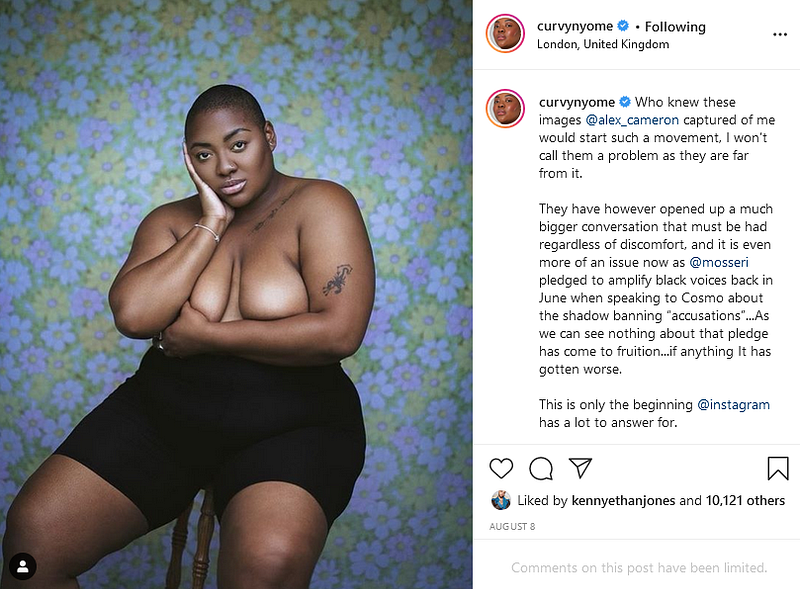
Why did this happen? Instagram’s story is that it’s because they have very specific policies about the female breast. For one thing, it’s only allowed in very particular circumstances, like breastfeeding or photos of mastectomy scars. And apparently, any implication of grabbing the breasts is forbidden. That, Instagram says, crosses the line.
To set aside, momentarily, the notion that breast-grabbing is obscene, let’s focus on the other issue: that these rules appear to be inconsistent with people’s experiences. I have very few friends whose breastfeeding photos weren’t removed from Instagram at least once. It’s commonplace for mastectomy photos to be removed. And the list of photos that have been removed when an arm or other object is obstructing the full view of the breasts (no grabbing involved) is endless.
No, there’s more to the story. And in Nicholas-Williams’ case, something very specific. Racist censorship happens every day on social media.
USA Today wrote a story about it in 2019, detailing how algorithms often target people of color:
Black activists say hate speech policies and content moderation systems formulated by a company built by and dominated by white men fail the very people Facebook claims it’s trying to protect. Not only are the voices of marginalized groups disproportionately stifled, Facebook rarely takes action on repeated reports of racial slurs, violent threats and harassment campaigns targeting black users, they say.
…They call …[this] getting ‘Zucked’ and black activists say these bans have serious repercussions, not just cutting people off from their friends and family for hours, days or weeks at a time, but often from the Facebook pages they operate for their small businesses and nonprofits.
Adam Mosseri, head of Instagram, conceded to this fact in his June 2020 statement:
Some technologies risk repeating the patterns developed by our biased societies. While we do a lot of work to help prevent subconscious bias in our products, we need to take a harder look at the underlying systems we’ve built, and where we need to do more to keep bias out of these decisions.
So what are they going to do about it?
That’s the question Nyome asked — and Instagram is finally answering.
Nyome has over 73,000 followers, many of whom responded to the removal of her photo with a hashtag campaign #iwanttoseenyome.
She kept asking questions. She kept going. She insisted on taking up space in a world that didn’t want her to.
I am in the @guardian online and in print today and while I am happy the images @alex_cameron took of me are now being seen, what I am not happy with is the reason why they were taken down in the first place and why they are STILL being taken down today…
Why is it that every day is a battle for black women/fat black women to be shown a slither of respect and decency? Why does it take a slim white women with a huge platform and verification to start up a hashtag and speak up for my images to not be continually removed from my page?
I have said this before and I will say it again black women are the most disrespected within society, and it just screams that the racial biases are very alive and well when it comes to black women in bigger bodies.
It shouldn’t take a media storm for my images to stay up or for me to talk to @instagram and get an apology. My images and my body should be respected enough to stay up on a platform that is for the use of “ALL” people.
Respect black women always, Period.
Finally, Instagram responded. Nyome’s insistence on holding the line to create space for Black, plus-sized bodies instilled change. She and Gina Martin worked with Instagram to create major policy changes around nudity, specifically related to Black, plus-sized bodies.
Unfortunately, Facebook/Instagram is denying any racial discrimination, despite previously acknowledging the inherent bias of algorithms that were created in a culture infected with systemic racism.
But they have acknowledged that their policies around “breast grabbing” are too vague and are working to correct the issue. Current clarifying details that would cause them to remove a photo include: dimpling of the breast tissue, curling of the fingers, or poses that elevate the breast tissue.
I’m still disappointed with Instagram’s response (holding one’s breasts in an effort to cover them hardly makes for pornography). But this is a huge step forward, thanks to this woman whose Instagram bio now reads: “Changed Instagram policy.”
Currently, Nyome is asking Black, plus-size women to post on Instagram and begin testing the new policy. This is an incredibly important step in the journey to creating the policy change. Without this active testing phase, there will be no way to know if the new changes are working and sustainable.
You can read more of her request here.
And if you are a Black, plus-size woman who has recently had a nude or semi-nude photograph removed from your Instagram account, please fill out this form (which is the current course of action, but check if you are reading this well after it has been published, in case there are updated instructions).
If you are not Black, please do not use this form and clog up the stream of data.
It’s important to mention that during the long months of these negotiations for change, several white women experienced the removal of their own nude photographs, inspiring similar campaigns by supporters, who then assumed the policy changes were accomplished by those women, when it was Nyome’s efforts that created this incredible policy change.
I’m not going to mention their names, in an effort to keep the spotlight on Nyome and her work, but I mention it with the hope that anyone who is under the misapprehension will give credit where credit is due.
So when you post the next nude or semi-nude photo of yourself and it doesn’t get removed for the first time since you started your Instagram account, you’ll know that that’s because of Nyome Nicholas-Williams and you’ll whisper (or yell), “Thank you, Nyome!”
© Yael Wolfe 2020
More on the censorship of the female body:


