
Meet Daniel Lambert — An Unusually Large Man in the 1700s Who “Exhibited” His Weight for A living
And yes, he thoroughly enjoyed his life
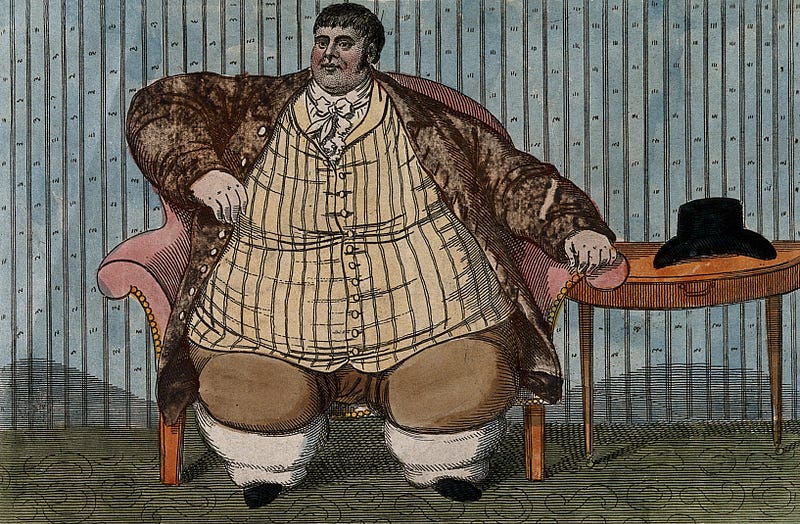

The heaviest person ever recorded in the history was Jon Brower Minnoch, who weighed 1,400 lb (635 kg). However, he has a chance to blame the contemporary lifestyle of fast food and binge.
Here I’ll tell you about the fattest person alive in the early modern period, who only had himself (reportedly) to blame.
Brief description for your curiosity:
He is Mr. Daniel Lambert (1770–1809) renowned as the fattest man in England in his era.
He weighed 700 lbs (320 kg) when he received the title ‘The fattest man in England’ in 1805 surpassing the previous guy Edward Bright. And he still gained weight till his death.
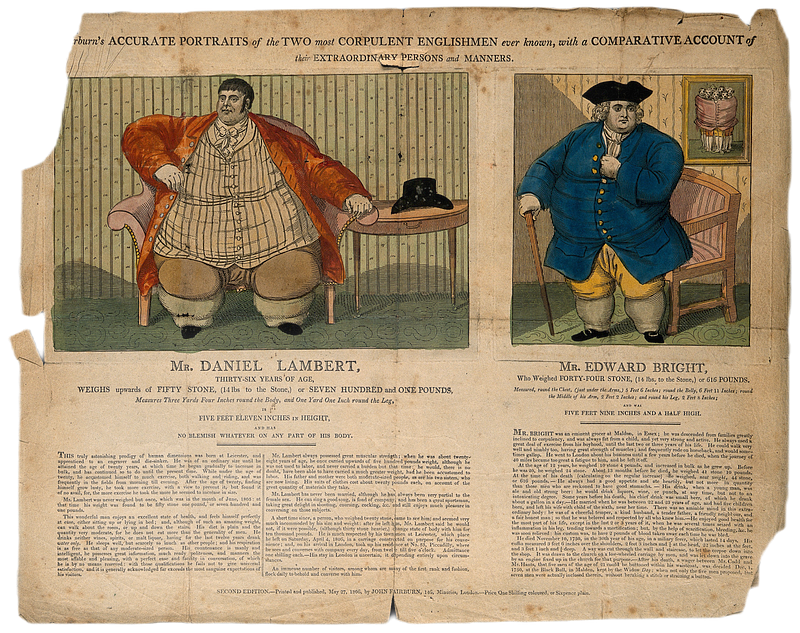

Who was Daniel Lambert?
Born in Leicester in 1770, he was the eldest of four children. His father was a gaol keeper. (*Not a typo for goal. ‘Gaol’ was predominantly ‘jail’ in British English).
He built up strong interest in the fields of sports (especially swimming and horse riding) and animal breeding. Since he was eight years old, he started teaching swimming to local children, and much of his childhood passed so. He was exceptionally well in his abilities.
Employment:
He worked for a die casting company from 1784 to 1788 and returned back to Leicester after the business declined. Thereafter he succeeded his father as the local gaol keeper. He earned much respect with his kind manners, from the prisoners and officers.
Lambert’s unusual weight gain:
Lambert was of an ordinary size until he attained twenty, at which time he gradually started gaining bulk. Precisely, after his return back to Leicester in 1788.
By his own claim, he did not eat large quantities of food. He was also concerned for his fitness. He devoted himself to exercise everyday. He has built up his strength to the point where he once lifted up a 560 lbs wood log (250 kg). Yet, he kept on bulking up for no reported reason.
Lambert was a fitness freak:
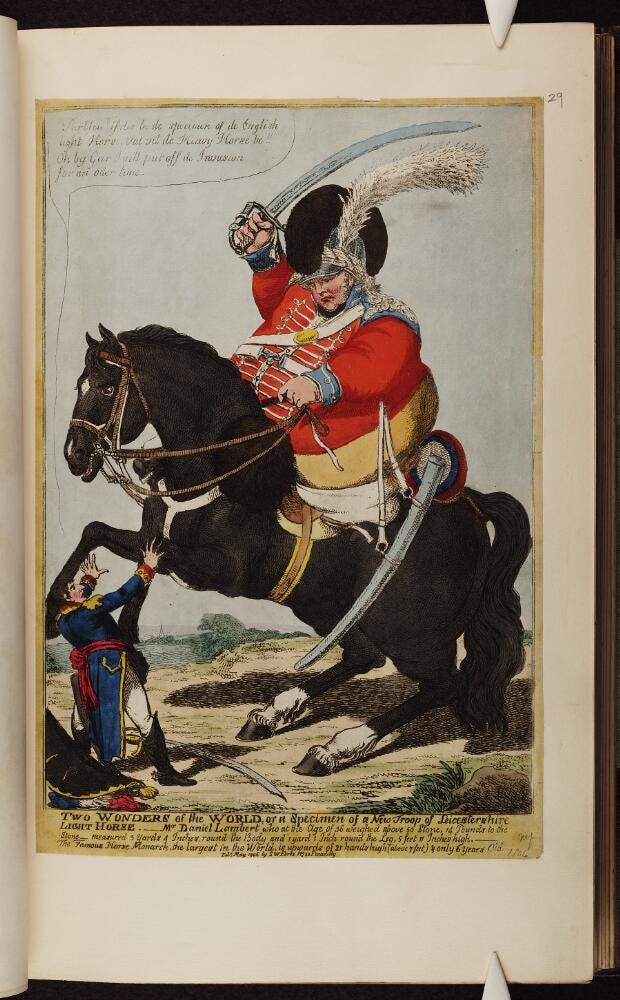

By 1793, he weighed 450 lbs (200 kg). However, he wasn’t significantly restricted by his weight. His regular exercise kept him fitter and more active than his ordinary-sized peers of same height (5'11).
One day in a bear dance show, Lambert’s dog escaped its rope and bit the bear, and the bear injured the dog severely and knocked it out. Lambert reportedly ran up to the bear, punched on its head and knocked it down to allow his dog to escape.
He once walked seven miles from Woolwich to London with much lower fatigue than men of his party. The 450 lbs man was able to stand on one leg and kick the other to a height of 7 feet, and was able to float on water with two men on his shoulders!
Lambert got unemployed and reached poverty:
In 1805, His Majesty’s Government decided to replace gaol keepers with forced laborers. Lambert lost his job, but was granted £50 for his excellent service.
‘Out of the blue’ Income plan:
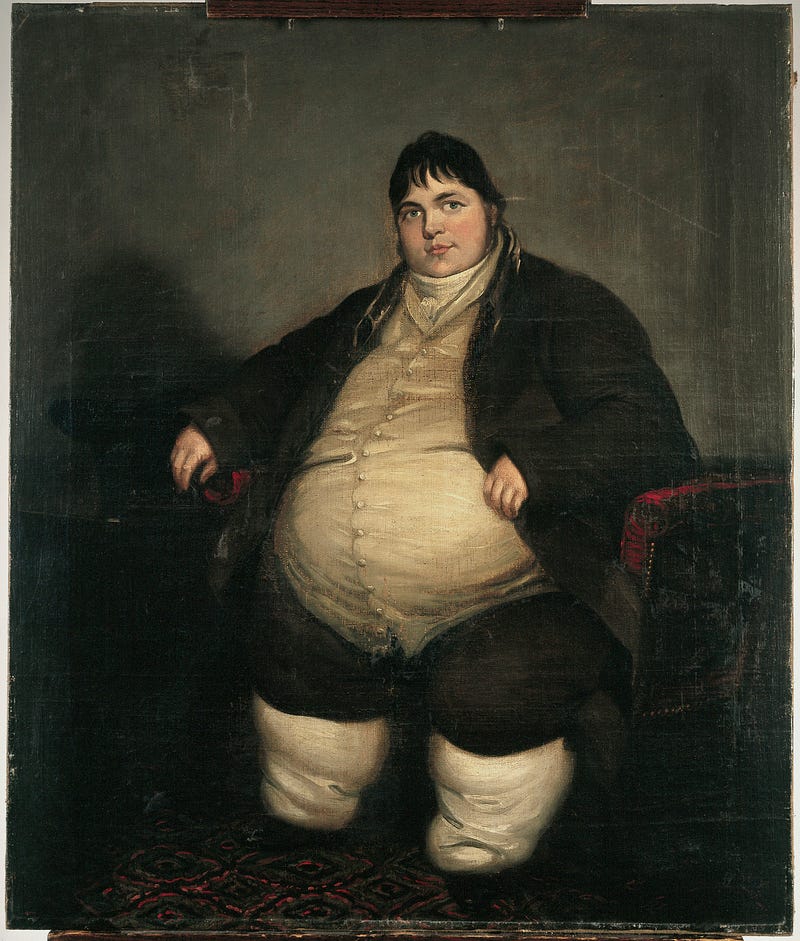

Lambert’s size was so large that six ordinary sized men could fit inside together in his waistcoat. The £50 annuity wasn’t able to make his both ends meet.
Stories about his obesity spread widely and people who visited Leicester never left without visiting him. He saw no alternative to income than putting his unusual appearance on display and charging his spectators.
Lambert’s successful income:
People knew Lambert was heavy, but Lambert was too shy to allow himself to be weighed. Someday in 1805, his friends persuaded to ride a horse and let it pass over a weigh bridge.
They managed to estimate Lambert’s weight by deducting the weight of horse from the total weight. It came around 700 lbs (320 kg), giving Lambert the title ‘The Heaviest Authenticated Man in the Recorded History’.
Despite his shyness, he took the best advantage of his title. He advertised himself as the fattest man. And invited people to visit him.

E̲ ̲X̲ ̲H̲ ̲I̲ ̲B̲ ̲I̲ ̲T̲ ̲I̲ ̲O̲ ̲N̲
Mr. Lambert
Of LEICESTER The heaviest Man that ever lived, ᴡᴇɪɢʜɪɴɢ ᴜᴘᴡᴀʀᴅs ᴏғ
50 Stone
14 POUND TO THE STONE, Or more than 87 Stone London Weight.
Mr. LAMBERT will see Company at his Apartments,
№4, Leicester Square,
ғʀᴏᴍ 11 ᴏ’ᴄʟᴏᴄᴋ ᴛɪʟʟ ғɪᴠᴇ. Admission ONE SHILLING each.

In 1806, he moved to London. In London, he welcomed visitors to his home five hours each day, charging each person a shilling. His business was instantly successful. Over 400 visitors came to his house everyday.
He was treated with respect by his visitors, which he never expected. He was pleased to talk to them. Some were his regular visitors. He became so popular in London that on one formal occasion, he met King George III.
Some visitors were rude and Lambert could retort:
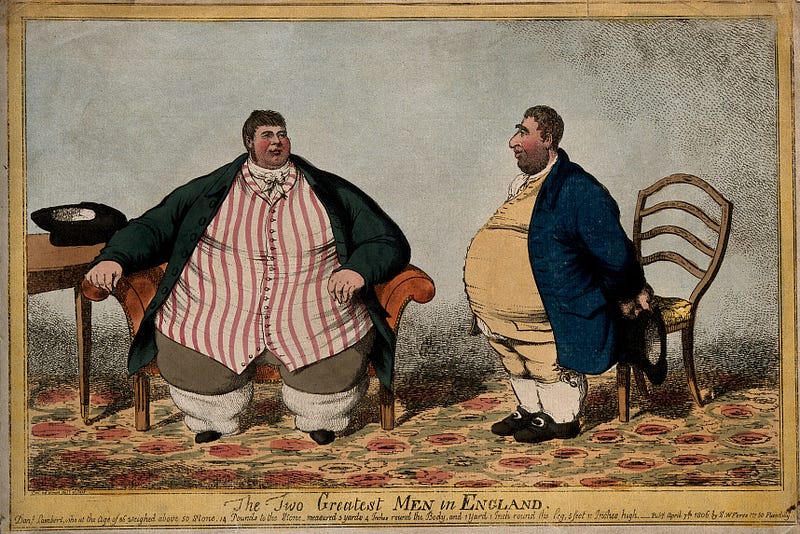

People were visiting him under his gentle rule of removing their hats in his house. One visitor refused, and Lambert replied, “Sir, you must instantly quit this room, as I do not consider it a mark of respect due to myself, but to the ladies and gentlemen who honour me with their company.”
One rudely moaned that his fee was paying for Lambert’s coats and he wanted to know their cost. Lambert swiftly retorted, “Sir, if I knew what part of my next coat your shilling would pay for, I can assure you I would cut out the piece.”
Medical examination to quest the root cause for his bulk:
The fattest, yet fit man soon came to the attention of scientists and doctors. An article was published about him by the Medical and Physical Journal. They were deeply intrigued by Lambert’s anatomy. They found:
Lambert was active, alert, and possesses excellent memory. He had a normal voice that showed no pressure on his lungs. He ate ordinary quantities of food regularly, took enough water, never drank wine, slept 8 hours a day, never snored, never napped in the noon, and rarely got ill. He was able to walk 400m without any difficulty.
They who studied him finally reported that his sedentary lifestyle at the local gaol, overeating, and insufficient exercise after twenty led him to weight gain. Although, some found it implausible.
After Lambert became sufficiently rich and famous:
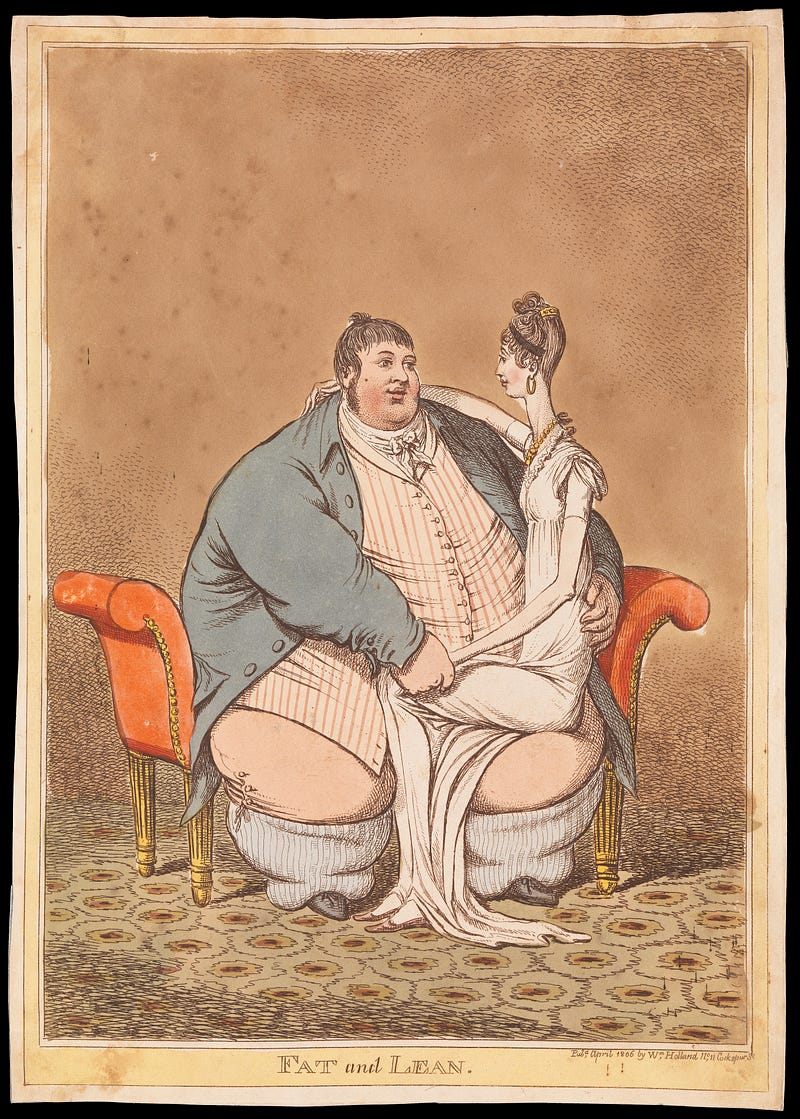

In the same year 1806, Lambert felt he was sufficiently rich to retire and return to his pleasant pastimes. He returned to Leicester as a rich man, and bred his dogs and horses at his house.
Over the next three years, he went on to places for fundraising tours. He exhibited himself in Birmingham, Coventry, and London. In 1809, he felt severely ill. His physician felt it could be due to pollution at London.
Lambert’s death and burial:
Consequently, he reached a weight of 739 lbs (335 kg), and he wasn’t able to properly walk and use stairs.
He admitted feeling tired often. In the morning of 21st June 1809, while shaving his beard, he collapsed and died. Sources say it was from difficulty in breathing. He was just 39 when he died.
The next day, in the midst of mourning, his body was kept in an elm wooden coffin 6'4 feet long, 4'4 feet wide, and 2'4 feet deep. It was built on wheels for easy movement. It took almost half-an-hour for twenty men to drag his very large coffin into the grave.
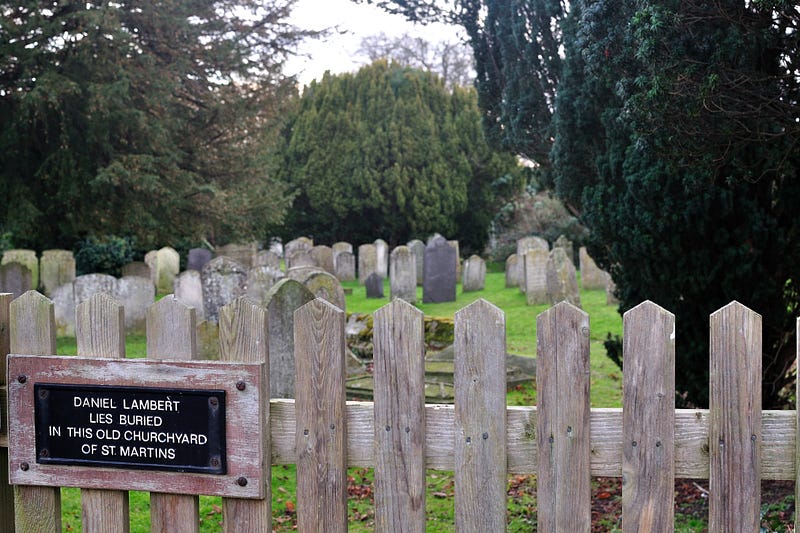

Lambert’s clothes, walking sticks, armchair, wax statues, and other possessions were auctioned and many of them were preserved in museums till today.
Final words:
Although ‘Daniel Lambert’ and his history was largely forgotten, his name continued to be commonly used in English, referring to any fat man.
Many popular authors like Charles Dickens named their book characters after Lambert. Many public houses and inns in England were named after Lambert, and the names continue till today.
A valuable lesson:
It’s truly a difficult job to stay well-mannered and friendly with people when you know you’re obese and people make fun at your back. Lambert didn’t heed the laughs. Rather he did things he liked, and earned much respect.
Reference: Daniel Lambert — Wikipedia
More related stories by me: