
Medium Tags Competition Ratios: FREE List of 90+ Tags Ranked From Least to Most Competitive
Least and most competitive topics to write about on Medium

Using the right tags on Medium can help your stories reach more readers. People follow tags (topics) they are interested in, and the algorithm should show them stories under this tag. If you don’t use them, or use the wrong ones, your story could stay buried in no-man’s-land.
But there is more to tags than this.
You can also see which tags are more popular on Medium. We can also deduce how competitive each of these tags is.
Some topics have “Top Writers” which are shown to users when they click on that topic. We don’t know how Medium chooses those top writers.
There are three important bits of information we need to know about tags in order to identify the competition ratios.
Followers
You can find this using the Medium app on your phone. Head to the search box, type your topic and choose the tab “Topics”. As you can see, there are half a million people following the topic of “Marketing”. If you chose “Marketing strategies” instead, you will only reach 1900 followers!

Number of published stories
You can see this when you search for “Marketing” both on your phone or on the website. Click on the tag on the right and you can see the number of published stories so far. In this case: 360K.
Writers
You can also see, on the website, the number of writers contributing to this tag. 130K people write about marketing.
Medium Tags Competition Ratios
I use this to get an idea of how competitive a topic is. To continue using Marketing as an example, we divide the number of published stories to followers = 360K/526900 = 0.68. Convert to a percentage and you get 68%.
As a very rough measure, this is how much competition is happening for this tag. The number of articles is less than that of followers which is still good, but it is close!
To get things into perspective, the number for the “Personal Development” tag is 826%! The rough translation is that there are 8 articles for each follower, competing for that follower.
On the other hand, the ratio for the “virtual reality” tag is 9%. There are only 46K articles published, but the topic is followed by almost 500K users!
The lower the ratio, the better.
You can use this to manually calculate the competition ratios and compare them. But I’ve already done all this manually for myself, and you, for FREE.
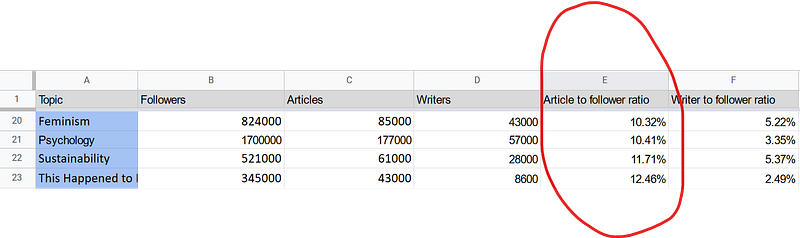
I created a FREE Excel sheet containing the 90+ most popular tags on Medium with their competition ratios. The tags are ranked from the least competitive to the most competitive. I’ve also added the number of writers for the most competitive tags, as well as the “writer to follower” ratio.
I have also highlighted in blue the tags which have “Top Writer” status.
P.S. I don’t think the (writer to followe) ratio is that relevant. Why? because most of those writers won’t be consistently writing about the topic. But, it gives you an idea about how many writers are competing for followers. Again, the smaller the percentage, the less competitive the topic is.
👉 Download the FREE Excel sheet to get a list of the most popular topics on medium, ranked by difficulty and competition ratio.
What Those Ratios Mean: A Word of Caution

There are many factors that affect how competitive a topic is. Some writers have a thousands of followers. They can write about competitive subjects and still get thousands of views. Publications, curation and social media also help get more readers.
It is also worth noting that these numbers are as of September 2022. The numbers and ratios will change with time! I started collecting this data for myself a few weeks ago. In those few weeks, the number of published articles for some topics increased by about 10K!
I have manually added all the tags and numbers to this file, one by one. I am not a programmer so I don’t know if it is doable, but there maybe a web developer out there who could use the API to fetch this data automatically. An idea for a web app!
I hope this helps. For more about using tags the right way, check my other articles: