
Medium Just Came Out With Its Own Writing Challenge But Is It Better Than Vocal’s Challenges?
Both platforms seem to have upset their writers for very different reasons, but who committed the worse offense?

Medium Vs. Vocal Media, Which Platform Is More Beneficial To Writers?
I’m fairly new to the Medium platform. I actually started on Vocal Media first back in April, when Facebook kept filling my feed with their ads. I knew it was a sign and so I eventually signed up. What I didn’t realize until just recently is that because I signed up through Facebook ads, my monthly Vocal membership was reduced to $4.99 a month for the first three months, rather than its regular price of $9.99. Originally I thought five bucks that’s not so bad. Now I have to pay $10, which still isn’t a significant amount of money, but it still hurts a little.
What drew me to Vocal was the Little Black Book challenge that had a prize of $20,000 for first the place winner. Did you say $20,000? Of course, I was aware that my chances were small but my chances would be zero if I didn’t enter at all. At least that was the idea, but the timing wasn’t right. I was getting ready for my first vacation in years and just didn’t have the time to finish my story. I knew there’d be other challenges though. That’s the thing about Vocal, there are always challenges going on. Some of them I was excited to enter, like their Dream Date challenge, because romantic fiction is right up my alley. Others such as their non-fiction challenges like the Zen Playlist, Thrift Finds, and Stray To Stay just didn’t resonate with me and so I didn’t bother trying to enter into them.
Since I started with Vocal, I’ve participated in seven challenges and getting ready to submit my 8th. I’ve won none of them and made a total of 77 cents from reads alone, but have accumulated $30 from random bonuses that the Vocal team sends my way. Of course, those random notifications that I got a five-dollar bonus or a ten-dollar bonus are much appreciated, but it has been a struggle to get people to read my stories and poems and give me feedback.
To date my Poem entitled, Beauty In My Hair (which was submitted as part of the True Colors challenge and was my second post on Vocal) is in the lead with 41 reads and 2 hearts. My first story, Unexpected Romance, for Vocal comes in at 2nd place with 26 reads and 1 heart. Those two stories got a fair amount of support after posting the links on my personal Facebook page, but everything else I’ve shared seems to have gotten less and less support. My other stories range from 2–15 views and 1–3 hearts.
While I was struggling to figure out a way to get organic reads on Vocal, I came across Zulie Rane’s video on YouTube, in which she compares Vocal Media, Medium, and News Break. I was highly intrigued and had never heard of Medium (or News Break) at that point. She spoke about the curation aspect of Medium, which is something that is significantly lacking with Vocal because with Vocal you are in charge of promoting your own work. That along with her discussing her own personal success on the platform is what prompted me to do more research into Medium. I didn’t care much about News Break because I didn’t think my content and writing style were a match for them.
The thing that drew me to Medium was the potential to get reads and actually get paid a nice amount without having to flood my Facebook with my links and beg my friends to read. That route clearly hadn’t been working for me with Vocal, so I thought okay let’s try Medium.
Medium has allowed me to write about personal topics that I’m not ready to share with people I know. Unless they outright google my name, they’d probably never come across my article about why I quit my job and the article about why I’m choosing to keep it a secret. Those articles can be solely for Medium members to read.
Right now I split my time writing on both platforms. I’ve written mostly non-fiction personal essays on Medium and have decided to use Vocal for my fiction writing. I have accumulated a lot of unfinished stories over the years, so I appreciate that Vocal’s prompts forced me to not only come up with fresh ideas but to actually finish a story. The thing that has been the most frustrating about Vocal’s challenges is adhering to what appeared to be a strict 2,000-word limit. This has forced me to edit some of my stories in a way that felt like I didn’t do the story justice. In one story, I had to submit it as a part-one because there was no way for me to give it a conclusion within the 2,000-word limit.
The Real Issue With Vocal’s Challenge
Recently Vocal has come under attack because they chose a second-place winner for one of their recent challenges whose story was nearly 2,800 words. The Vocal community was in an uproar and rightly so. People spoke about how it was unfair that they made this exception to the word count when they, like myself, have had to significantly edit their stories to make them fit within 2,000 words. Many members sent emails to the Vocal team telling them how they felt. Vocal’s response did not make matters better for them.
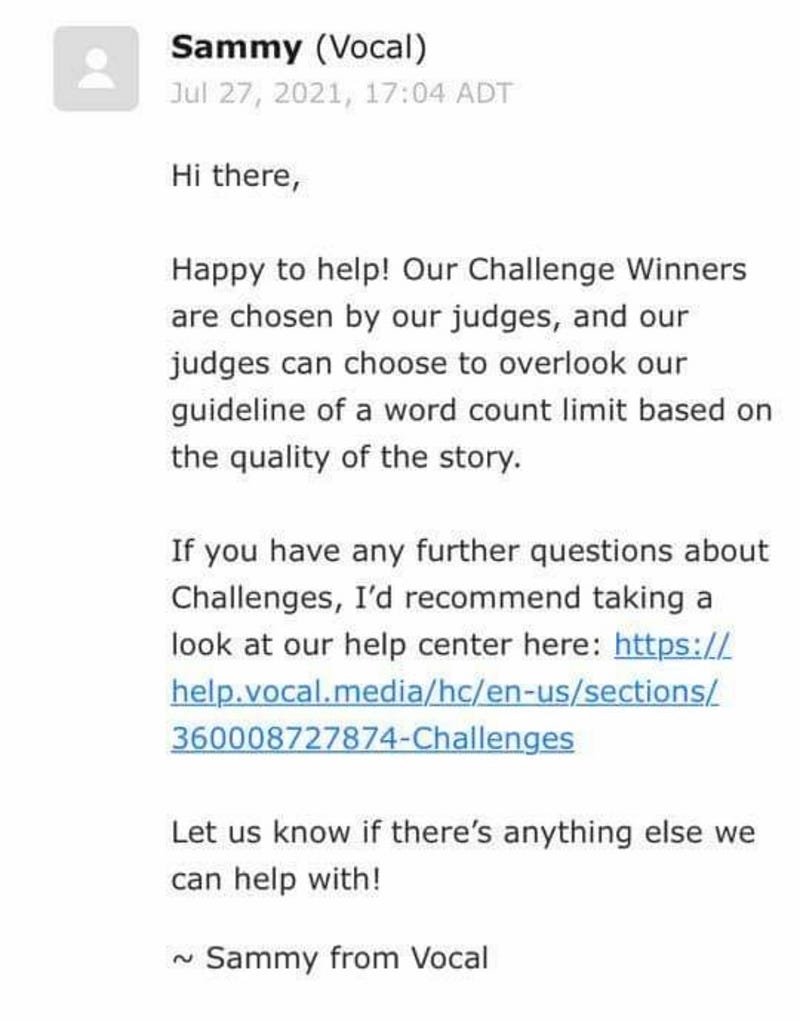
Their response was to say that the “judges can choose to overlook our guideline of a word count limit based on the quality of the story...” This really didn’t sit well with the members of the Vocal community, because as many members pointed out, nowhere in their guidelines is it mentioned that the 2k word limit is a preference and not a strict rule.
In fact, in the section labeled as How To Enter the rules clearly state “for your story to be eligible, it must be between 600–2,000…”
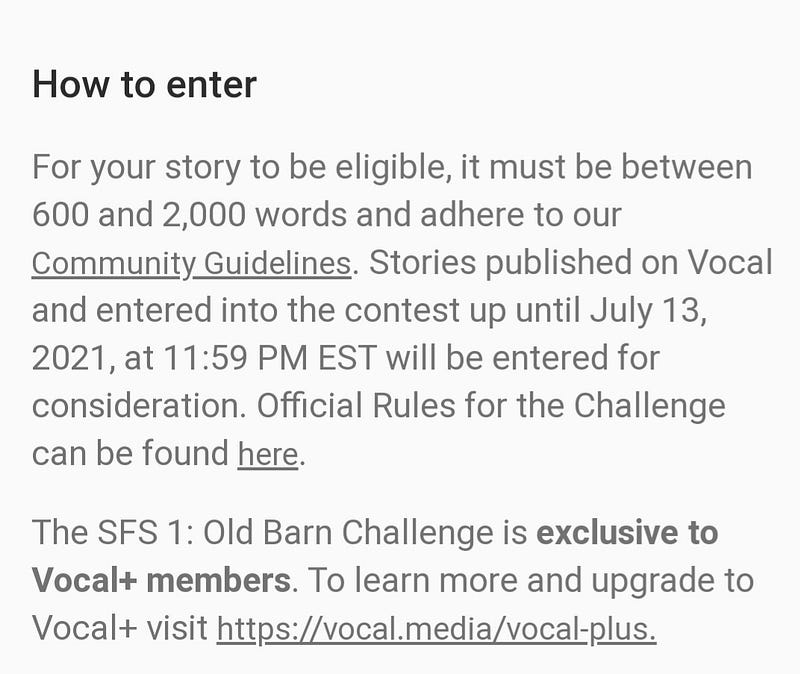
Yet, Vocal chose to break their own rule, choosing a winner that clearly went over the word count. To add salt to the wound, the frustration of the Vocal community is even more heightened considering the $9.99 that Vocal plus members must pay monthly to be able to enter these challenges.
In a devil’s advocate type of manner, another member pointed out the official rules, which can be found in a link in the How To Enter section.
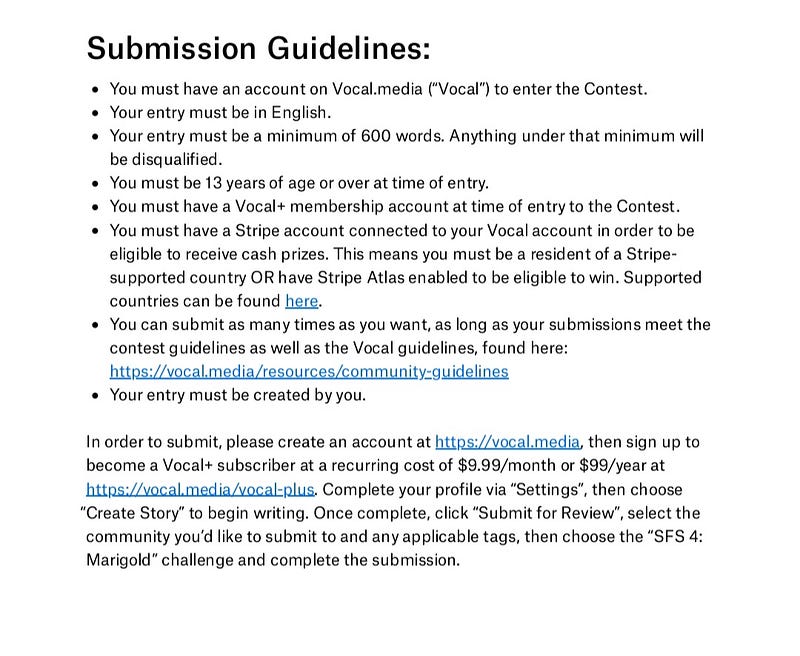
Upon clicking that link, another set of rules are stated, this time including the minimum age to enter and the requirement of a Stripe account. Yet, with regards to word count, this section only states that “your entry much be a minimum of 600 words,” with no mention of a max word count.
Interestingly enough, through all the debates and back and forths concerning this word count situation on Vocal, Medium conveniently chimes in with a contest of their own. The rules and guidelines seem to be clearly stated and there’s no confusion or room for misinterpretation. The transparency of Medium’s contest guidelines is what has many Vocal members excited and ready to enter without a second thought. There have definitely been talks of people leaving Vocal or at least reducing their status down to a regular member rather than a paying Vocal plus member.
The Issue With Medium’s Challenge
Yet, as I read articles from Zulie Rane and David Majister, it seems like through all this uproar with Vocal perhaps we’re jumping the gun entering a contest with Medium simply because it popped up at exactly the right time. It’s like when you’re fighting with your boyfriend and you go to your guy friend for comfort. Suddenly he seems to understand you more and you’re thinking about leaving your boyfriend.
The issue with Medium’s contest is far more concerning, as the fine print seems to suggest they’d have full rights and control over our work (for a year) upon entering the challenge, whether you win or not. That’s a huge red flag right there. What do you mean you’re going to have full rights to my work just because I’ve submitted to a challenge? That seems absolutely insane and I’m actually glad it was brought to my attention. Does this mean I won’t enter Medium’s contest as planned? I haven’t decided yet, but I did go back and read the fine print more clearly.
I’m no lawyer but after reading the fine print for myself, from what I can gather Medium is trying to explain that they simply want to be able to distribute the work from the challenges across all its platforms, including web and mobile. It clearly states that they do not claim ownership of our work and will not be using any of our materials to develop “books, film, television shows, or other media.” I do urge you to read the fine print for yourself and interpret as you wish.
It’s a lot of information to take in, but I’ll say this to anyone considering entering the Medium contest, go back and read Zulie Rane and David Majister’s articles. Also, be sure to read the original article about the contest here as well as the full guidelines for the contest here. Don’t make any rash decisions because you’re in a fight with your boyfriend. Take a moment to really understand what you’re signing up for and then make a decision from there.


