
May Your Journey With Gender & Pregnancy Be As Fluid As Arnold Schwarzenegger’s
HR-T-800; TRANS MODEL 101
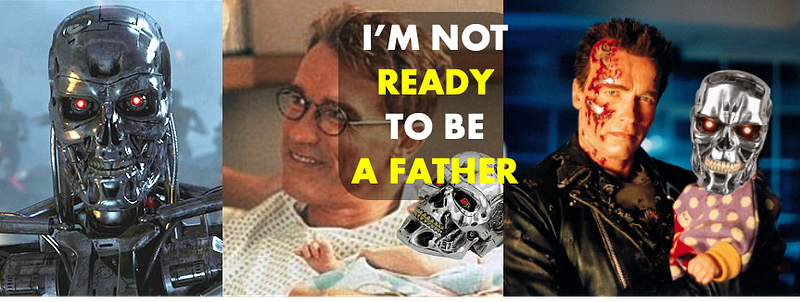
Guess what? This is a real movie! Just three years after Arnold Schwarzenegger stunned audiences with the blockbuster Terminator 2: Judgment Day (1991), he returned to subvert just about every idea about gender we had.
The movie was Junior (1994) and reteamed Arnold with Danny DeVito (Twins, It’s Always Sunny in Philidelpha) and director Ivan Reitman (Ghostbusters, Beethoven, Space Jam). The movie also includes powerhouse performances from Emma Thompson (legendary in that funny-as-heck romantic comedy that’s unfortunately about various men pursuing inappropriate relationships until they succeed and get told the damn thing by Emma; AKA Love, Actually) and Frank Langella (Frost/Nixon, Superman Returns, Good Night and Good Luck).
Now just keep in mind, Junior was made in the 90s.

JUNIOR (1994)
LOWER YOUR EXPECTANES
As an actor with big muscles and a balky Austrian accent, you’d think [Arnold] would be limited, and yet he knows himself so well that it gives him freedom: Is a pregnant Arnold any harder to believe, really, than Arnold as Conan the Barbarian? — Roger Ebert, Chicago Sun Times, Review of “Junior”
Arnold Schwarzenegger made a career out of leaning into any role that subverted our perception of him as an indestructible Terminator. He always showed up as himself — an Austrian of culture and intellect with impeccable pecs — but subverted new aspects of his masculinity as often as he subverted someone else’s.
“Franco is pretty smart, but Franco’s a child, and when it comes to the day of the contest, I am his father. He comes to me for advices. So it’s not that hard for me to give him the wrong advices.” — Arnold Schwarzenegger, from the documentary Pumping Iron
In Twins (1988), he was in better shape than ever. But the character came from an isolated island where he’d never met a woman. Arnold is the last person the audience expected to blush at the thought of kissing a girl. He can’t even bring himself to make the first move. And yet it’s his seemingly utter confidence in his masculinity throughout any subversion of that masculinity that gives his performances such power.
I know this sounds odd, but Schwarzenegger is perfect for the role. Observe his acting carefully in “Junior,” and you’ll see skills that many “serious” actors could only envy. He never reaches for an effect. He never grabs for a joke. He never wrings an emotion out of reluctant material. He plays the role absolutely straight, trusting the material to make the points and get the laughs. This is probably the only way this story could have worked, but not every actor would have known that. — Roger Ebert, Chicago Sun Times, Review of “Junior”

WHY DO I KEEP COMING BACK TO JUNIOR (1994)?
The more trans men and non-binary people I connect with, the more I yearn for all of us to have more stories that represent the experiences particular to each queer identity.
There may be a lot of roles Arnold Schwarzenegger could not play. But there are also roles no one else could play, and they don’t all involve a guy firing missiles at a skyscraper. A lot of actors can hold big machineguns and stand convincingly in front of special effects and explosions. Not many can stand in front of a camera and be nine months pregnant, and actually make us care. — Roger Ebert, Chicago Sun Times, Review of “Junior”
A few years ago, a non-binary publishing friend told me how much they wanted a kid.
They didn’t want to adopt. They didn’t want to — just as Chighur had ribbed the gas station attendant before flipping a coin — “marry into it.” They wanted to get pregnant. The problem? They were afraid to face the judgement of people — including themselves — for doing something that felt almost inescapably tied to being female.
But this person was not a woman. They are a non-binary person.
I am a woman, not a non-binary person. But I faced similar questions about my identity vs external manifestation of that identity. I’d been raised to feel ashamed about letting anyone see I was a woman. I went to extraordinary lengths to hide my gender.
I found my greatest freedom from self-imprisonment by completing the Gender Identity Workbook by Dara Hoffman-Fox. In it, Dara posits: what would you accept about yourself if it had nothing to do with your gender?
Think about the things that you assume make others perceive you as a particular gender. Think about the thing that you assume will always make you perceive yourself as that same gender.
Men can wear dresses. Men can have genitals with the shape and function of a lot of women’s genitals. And some men — cis men and trans women, too, if Expectane is ever made into a real thing —some men can get pregnant.
We just don’t see enough of it.
We need more representation for the many varieties of people who can and do get pregnant. We need more representation because being seen expands our imaginations for who we are and who we can be. We need more representation because fluid visibility is as important for queer people as a fluid exploration of the things cis people may find otherwise immovable.
IT IS A TRUTH UNIVERSALLY ACKNOWLEDGED THAT A TRANS MOM WANTS MORE STORIES ABOUT TRANS PREGNANCIES
We will almost certainly get new stories that speak to what trans men and non-binary people experience specifically with pregnancy. And what bold stories those will be with actual queer people playing the roles.
And while those movies are in production…I can’t help but keep going back to old stories. Movies like Junior where with a slight shift in the premise, the story can expand the audience’s imagination to embrace a man as iconic as Arnold Schwarzenegger also being able to get pregnant.
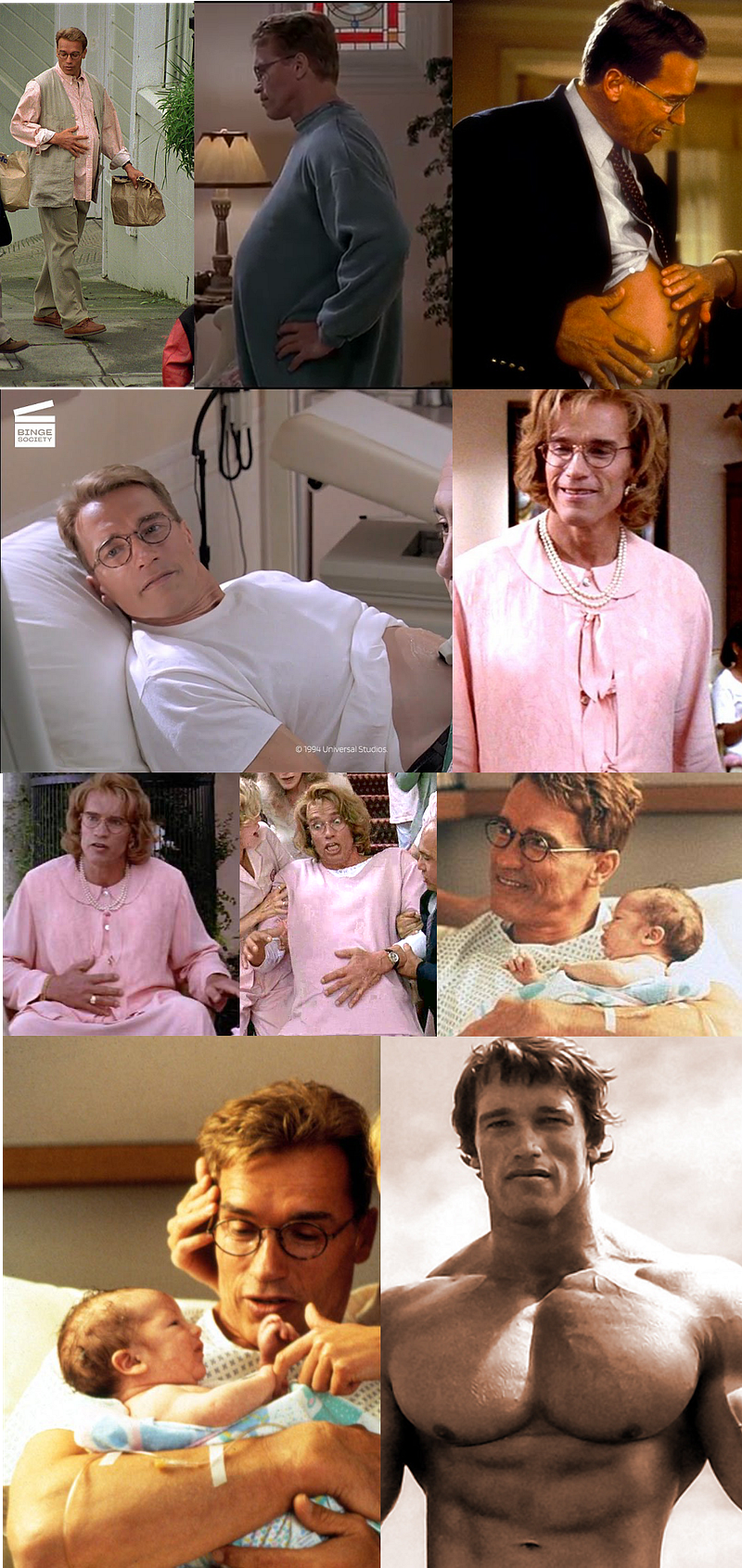
A research scientist becomes the world’s first pregnant man in order to test a drug he and a colleague have designed for expectant women. To carry out the trial, he has an embryo implant, believing that he will only carry the baby for three months — hardly expecting to face the prospect of giving birth. — Plot summary for Junior (1994) from Wikipedia (https://en.wikipedia.org/wiki/Junior_(1994_film)
NO MOVIE IS PERFECT (BUT SOME GET BETTER OVER TIME)
One scene from later in the movie sticks with me for different reasons.
Arnold is settling into pregnancy. He finds himself consumed with all of the instinctive love for that unborn child that Danny DeVito told him he’d feel. After watching Terminator 2 a few times, Arnold should have known that if a robot can learn to cry, so can an Austrian research geneticist when he’s suddenly confronted by the specific bigotry men face when identified as pregnant by cisgender women.
When the director of an expectant moms’ center (Judy Collins) finds it odd that her newest client is a muscle-bound 6-footer, Arnold haltingly reveals that he is an East German athlete, victimized by illegal hormone treatments. — Roger Ebert, Chicago Sun Times, Review of “Junior”
There is no way to go back and make this scene into what I want. It would take not just a tweak, but a trans…formation.
When possible and appropriate, I believe it’s important for us to craft goodness even out of our most painful experiences.
But just because we can take something good from something bad doesn’t mean I believe stuff happens for a reason. The bad things that happen to us aren’t gifts. The people who hurt us were doing us no favors.
So no thanks to the things about this scene that makes me go LADIES NO!!!! But in trying to take something good from it, what I take away is that this scene illustrates the bigotry pregnant men face. The instantaneous need to mask their gender. The almost insurmountable rejection they face from the very people they would have thought their fiercest allies.
FINAL THOUGHTS
There will never be a good argument for limiting the reproductive rights of people based on whether they have had transgender experiences.
Just like there will probably never be a good argument for watching Junior.
Junior really didn’t do very well when it came out. I guess it hasn’t done very well since then, either.
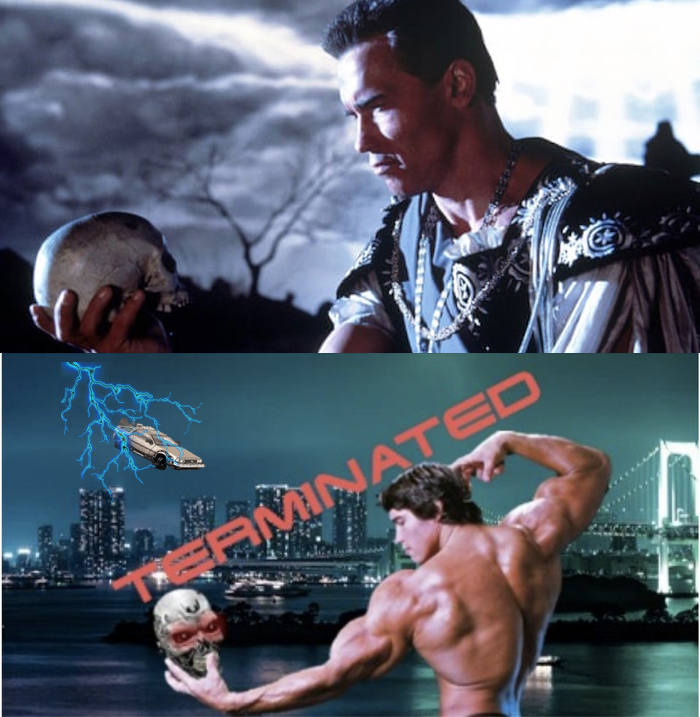
Here’s your chance to decide for yourself about this genderqueer movie that tried to be ahead of its time, but just couldn’t get up to 88 miles per hour. Alas, poor Junior, it may be forever trapped in the 90s.
Its only hope is a bolt of lighting.
NEXT: May Your Journey With Gender-Affirming Hormones Be As Fruitful As Henry Cavill’s
COMING SOON: Wait…Sarah Connor Was Trans??

AND NOW FOR…
SOMETHING SERIOUS: I Was Today Years Old When I Understood My Family Sent Me to Trans Conversion Therapy
SOMETHING FUN: Wait…Doctor Strange is non-binary?? (SPECIAL GUEST: non-binary literary agent Naomi Davis)
THE END (DAMN GIRL, THAT’S DARK)
Hi, it’s Stephenie!
Believe it or not, I do this for a living.
If any of my content brings you a moment of comfort, hope, and confidence, consider all these different ways to practice Good Patronage.
FREE PATRONAGE: Hold that CLAP button until it reaches your max (each person can add +50 claps). Subscribe to me and your other favorite authors. Click that Newsletter icon so you get notified every time I publish something new (I hope you like a lot of content muahahahahahahahaha).
PAID PATRONAGE: If you sign up for a subscription at Medium and/or Audible, you help support me providing more content like this.
TIPS: Or you can just buy me a Ko-Fi :)
| SUPPORT ME FOR FREE | SUPPORT ME FOR $5 | SUPPORT ME BY TELLING YOUR STORY (offsite link)| SUBSCRIBE TO AUDIBLE (offsite link)| BUY ME A COFFEE (offsite link)
THE ADS
Links above contain affiliate links with commissions for me from products or services you purchase.


