avatarDouglas Pilarski

Free AI web copilot to create summaries, insights and extended knowledge, download it at here

3084

Abstract

6b39">Yet, no one could foresee the events of the next decade. The imaginations of icons like Gerald Genta and Jean Claude Biver pushed the status quo. Two key players who forced change on the entire industry.</p><p id="02a7"><b>NASA certified the Speedmaster for use in outer space. </b>Late in 1969 and something big popped in Tokyo.</p><p id="af2c"><b>REVOLUTION IN TOKYO</b></p><p id="acdd">Seiko unveiled the Quartz Astron on December 25th, 1969. The world’s first quartz watch.</p><p id="1736">Astron was the shot heard around the watch world. The beginning of an upheaval that rearranged the world of watchmaking.</p><p id="596b" type="7">The quartz watch revolution was on.</p><p id="e77b"><b>THE POWER STRUGGLE IN PENNSYLVANIA</b></p><p id="9754">The battle to build the battery raged for years. Research by Hamilton and Union Carbide was not an immediate success. Issues related to the size and reliability of power lived on. Even after years of research and development, these rivals could not solve quartz.</p><figure id="15df"><img src="https://cdn-images-1.readmedium.com/v2/resize:fit:800/0*SziBk9z7C5VY5ExB.jpg"><figcaption>Quartz Movement of the Seiko Astron, 1969 (Deutsches Uhrenmuseum, Inv. Inv. 2010–006)</figcaption></figure><p id="cc53"><b>TILT GOES THE BALANCE OF POWER</b></p><p id="cc9c">The Astron shifted the balance of power to the Far East. Switzerland was no longer the world’s watch production leader. The Swiss watch industry entered a two-decade-long tailspin between 1970 and 1988.</p><p id="f7f4">Swiss watch employment fell from 90,000 to 28,000. Astron brought a quantum leap in watch accuracy not to mention a quantum change in watch styling. The quartz was here to stay.</p><p id="e5d5"><b>SIZE MATTERED IN THE ‘60s</b></p><p id="243c">How do you make a power source small enough to fit in a watch case? Bigger watch case sizes were not popular then. Legendary designer <b><i>Gerald Genta</i></b> introduced the <b><i>Patek Philippe Nautilus</i></b>. Everyone thought the watch was too big. The 42mm case watch earned the name the jumbo.</p><p id="4602">Now a legend, Nautilus took a while to catch on. Most cases before the Nautilus were in the 32 mm to 38 mm range. Today, cases can range to 52 mm!</p><p id="e444" type="7">The ideal watch is accurate, never stops, and is beautiful.</p><p id="a857" type="7">— Seiko executive Tsuneya Nakamura</p><p id="98cd"><b>SEIKO WON THE RACE</b></p><p id="0e2e">Seiko marketed the world’s first quartz watch. The Seiko Quartz Astron appeared on the market in Tokyo on Christmas Day in 1969.</p><p id="f919">Immediately after its debut, Seiko opened the patents to the world. They limited the production of the Astron to 100 pieces. <b><i>The Astron was offered in an 18k solid gold case with a leather strap.</i></b> In 1969, these analog dial watches sold for 450,000 yen ($1,250). About the same price as a 1969 Toyota Corolla.</p><p id="0f2d"><b>A WARM WELCOME TO ICE CREAM <i>AND</i> POCKET WATCHES</b></p><p id="1480">The Seiko history of watchmaking stretches back to the late 1800s. History buff

Options

s will know it as the Meiji period. Japan opened its doors. The Meiji era welcomed everything from ice cream to western dress. Japan welcomed marvels of every kind, mechanical watches included.</p><p id="9f13"><b>SEIKO MADE A BOLD STEP FORWARD</b></p><p id="3f45">Collectors shell out big money for their prized mechanical Swiss watches. Quartz does not command the big bucks. Seiko made a bold step forward by introducing the Grand Seiko.</p><p id="c0b0">Grand Seiko aligned the company with Swiss quality and craftsmanship. The Grand Seiko high line can hold its own with the biggest Swiss names. Not a surprise.</p><p id="de49"><b>QUARTZ IS HERE TO STAY</b></p><p id="9bcf">Seiko set the global standard with this powerful statement. Today most quartz watches use the system Seiko developed. Seiko’s giant leap in 1969 changed wristwatches forever.</p><div id="1975" class="link-block"> <a href="https://readmedium.com/perfect-pitch-9e9d237eb274"> <div> <div> <h2>Perfect Pitch</h2> <div><h3>Power Through your Investor Presentation</h3></div> <div><p>medium.com</p></div> </div> <div> <div style="background-image: url(https://miro.readmedium.com/v2/resize:fit:320/1*7pAnu7g64aK-pI-4eOcdLw.jpeg)"></div> </div> </div> </a> </div><div id="96c9" class="link-block"> <a href="https://readmedium.com/whats-killing-your-minimum-viable-product-f5a43a9685e3"> <div> <div> <h2>What’s Killing your Minimum Viable Product?</h2> <div><h3>Your startup needs to know</h3></div> <div><p>medium.com</p></div> </div> <div> <div style="background-image: url(https://miro.readmedium.com/v2/resize:fit:320/0*-6rac2Knc9QNYYjg)"></div> </div> </div> </a> </div><div id="edb8" class="link-block"> <a href="https://dpilarski.medium.com/get-your-gmt-and-get-going-624fcec55f96"> <div> <div> <h2>Get your GMT and get going!</h2> <div><h3>Get Set to Jet Set with a New GMT</h3></div> <div><p>dpilarski.medium.com</p></div> </div> <div> <div style="background-image: url(https://miro.readmedium.com/v2/resize:fit:320/0*Vd2PxrPcIpTr0AgB)"></div> </div> </div> </a> </div><p id="5274"><b>*** *** </b></p><p id="70bc">Douglas Pilarski is an award-winning writer & journalist based on the west coast. He writes about luxury goods, exotic cars, horology, tech, food, lifestyle, and workplace issues!</p><p id="12d7">You’re welcome to share your thoughts or tell me your story. Email me here. <a href="mailto:[email protected]">[email protected]</a></p><p id="08c7">Copyright © 2022 AstonBell Media</p><p id="c0ae">All rights reserved.</p><p id="770c"><b> *** ***</b></p></article></body>

May The Quartz be With You

Seiko Took A Giant Leap In 1969 And Changed Wristwatches Forever
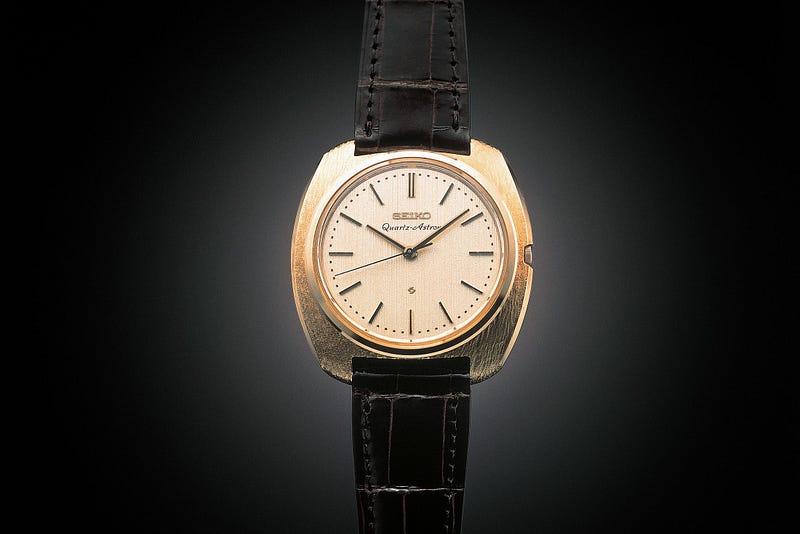
Photo: Seiko Watch Corporation

The story of the Seiko Quartz ASTRON watch -1969

Neil Armstrong rocked the world in 1969. Neil was wearing an Omega Speedmaster when the Eagle touched down on the moon. The Speedmaster will forever have a second name, the moon watch.

1969 was a busy year!

  • Jimi and Janis rocked Woodstock
  • The first ATM appeared
  • The Boeing 747 took off for the first time
  • The Beatles gave us Abbey Road
  • The Dow Jones was at 800
  • $.35 bought a gallon of gas

If you are not a watch guy, you may have missed one.

THE SEIKO WATCH COMPANY

Seiko not only rocked the world in 1969, but it also toppled the world of mechanical watches.

Seiko introduced the world to quartz movements. Battery-powered, accurate, and inexpensive, quartz revolutionized watchmaking. Quartz rocked the world.

DID YOU SAY BATTERY-POWERED?

The quartz watch did not happen overnight. There was a race to be the first producer of the quartz movement. The R&D war raged for years.

It started with the Hamilton Watch Company of Lancaster, Pennsylvania.

Hamilton tried to make an electric watch for years.

The problem was fundamental. How would the watch get power? An automatic or mechanical watch needs to stay wound. Accomplished by the movement of the wrist or by hand winding.

An electric watch would need electricity to keep it going.

Before the Astron, Swiss watchmakers embraced the status quo. In truth, watchmakers were making art. Companies like Patek Phillipe and Audemars Piguet made complicated, solid gold watches.

Watch buyers breezed through the shopping experience. Discerning buyers snapped up these exquisite pieces without hesitation.

In 1963, Omega and Rolex introduced sporty chronographs. Race Car drivers NEEDED a way to measure time. The rest of us WANTED the same watch to tell the time.

The Omega Speedmaster landed on the moon in 1969. The Rolex Daytona went on to be one of the most important timepieces of all time.

Paul Newman owned a ’60s Daytona. It recently auctioned north of $15,000,000! Watches hold a special place. They become a constant companion to the wearer. Looking back, your Rolex GMT was with you in Barcelona, Hong Kong, and Rio. Marking time is that important.

The ’60s Swiss watch was a freight train. No obstacles in sight! Full power ahead!

Yet, no one could foresee the events of the next decade. The imaginations of icons like Gerald Genta and Jean Claude Biver pushed the status quo. Two key players who forced change on the entire industry.

NASA certified the Speedmaster for use in outer space. Late in 1969 and something big popped in Tokyo.

REVOLUTION IN TOKYO

Seiko unveiled the Quartz Astron on December 25th, 1969. The world’s first quartz watch.

Astron was the shot heard around the watch world. The beginning of an upheaval that rearranged the world of watchmaking.

The quartz watch revolution was on.

THE POWER STRUGGLE IN PENNSYLVANIA

The battle to build the battery raged for years. Research by Hamilton and Union Carbide was not an immediate success. Issues related to the size and reliability of power lived on. Even after years of research and development, these rivals could not solve quartz.
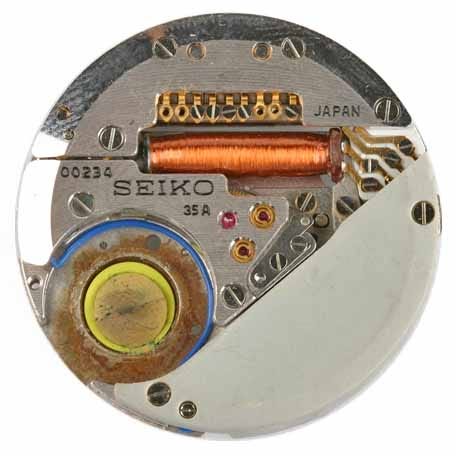
Quartz Movement of the Seiko Astron, 1969 (Deutsches Uhrenmuseum, Inv. Inv. 2010–006)

TILT GOES THE BALANCE OF POWER

The Astron shifted the balance of power to the Far East. Switzerland was no longer the world’s watch production leader. The Swiss watch industry entered a two-decade-long tailspin between 1970 and 1988.

Swiss watch employment fell from 90,000 to 28,000. Astron brought a quantum leap in watch accuracy not to mention a quantum change in watch styling. The quartz was here to stay.

SIZE MATTERED IN THE ‘60s

How do you make a power source small enough to fit in a watch case? Bigger watch case sizes were not popular then. Legendary designer Gerald Genta introduced the Patek Philippe Nautilus. Everyone thought the watch was too big. The 42mm case watch earned the name the jumbo.

Now a legend, Nautilus took a while to catch on. Most cases before the Nautilus were in the 32 mm to 38 mm range. Today, cases can range to 52 mm!

The ideal watch is accurate, never stops, and is beautiful.

— Seiko executive Tsuneya Nakamura

SEIKO WON THE RACE

Seiko marketed the world’s first quartz watch. The Seiko Quartz Astron appeared on the market in Tokyo on Christmas Day in 1969.

Immediately after its debut, Seiko opened the patents to the world. They limited the production of the Astron to 100 pieces. The Astron was offered in an 18k solid gold case with a leather strap. In 1969, these analog dial watches sold for 450,000 yen ($1,250). About the same price as a 1969 Toyota Corolla.

A WARM WELCOME TO ICE CREAM AND POCKET WATCHES

The Seiko history of watchmaking stretches back to the late 1800s. History buffs will know it as the Meiji period. Japan opened its doors. The Meiji era welcomed everything from ice cream to western dress. Japan welcomed marvels of every kind, mechanical watches included.

SEIKO MADE A BOLD STEP FORWARD

Collectors shell out big money for their prized mechanical Swiss watches. Quartz does not command the big bucks. Seiko made a bold step forward by introducing the Grand Seiko.

Grand Seiko aligned the company with Swiss quality and craftsmanship. The Grand Seiko high line can hold its own with the biggest Swiss names. Not a surprise.

QUARTZ IS HERE TO STAY

Seiko set the global standard with this powerful statement. Today most quartz watches use the system Seiko developed. Seiko’s giant leap in 1969 changed wristwatches forever.

*** *** ***

Douglas Pilarski is an award-winning writer & journalist based on the west coast. He writes about luxury goods, exotic cars, horology, tech, food, lifestyle, and workplace issues!

You’re welcome to share your thoughts or tell me your story. Email me here. [email protected]

Copyright © 2022 AstonBell Media

All rights reserved.

*** *** ***

Watches
Quartz
Innovation
Seiko Watches
1969
Recommended from ReadMedium