avatarScienceDuuude

Free AI web copilot to create summaries, insights and extended knowledge, download it at here

2396

Abstract

goats”.</p><p id="1267">Thus, perhaps, the polyamorous marriage of Math, Man, and War.</p><h1 id="b6a8">Fraction</h1><p id="24af"><i>This Fraction is twelve Seventeenths of a Haiku…</i></p><figure id="60ec"><img src="https://cdn-images-1.readmedium.com/v2/resize:fit:800/1*O1KoWu-U2kuVIvyhHtlrIQ.jpeg"><figcaption>Yale Babylonian Collection’s Tablet YBC 7289 shows an approximation of the square root of 2 with a precision out to 2 parts in a million (Wikimedia Commons)</figcaption></figure><figure id="fc18"><img src="https://cdn-images-1.readmedium.com/v2/resize:fit:800/1*yY1Nrgj9c2vFTsYq8X_ckg.jpeg"><figcaption>A portion of the Rhind Mathematical Papyrus (Wikimedia Commons)</figcaption></figure><p id="48c6"><a href="https://en.wikipedia.org/wiki/YBC_7289">The Babylonians</a> have one of the earliest claims to a powerful fractional calculation out to six decimals of precision. This is documented in an astonishing clay tablet from about 1800–1600 BC, held in the Yale collection. This tablet shows a square with two diagonals, and numbers representing the lengths of those diagonals given the length of a side. One of the numbers represented in the tablet is an approximation of the square root of 2, given as 1.414213, which is off by less than 2 parts in a million. This square root is key to calculating the diagonal of any square with known sides. The Babylonians, in turn, got their numerical notation from the <a href="https://link.springer.com/article/10.1007/s00407-019-00221-3">Sumerians</a>, who used it as far back as 2000 BC.</p><p id="f852">Another early use of fractions is recorded on an Egyptian papyrus from about 1,550 BC during the reign of Amenemhat III. This is known as the <a href="https://en.wikipedia.org/wiki/Rhind_Mathematical_Papyrus">Rhind Mathematical Papyrus</a> after Alexander Henry Rhind, a Scottish antiquarian who acquired it from Luxor, Egypt, in 1858. A fascinating and quite intuitive limitation of the <a href="https://www.basic-mathematics.com/history-of-fractions.html">ancient Egyptian expression of fractions</a> is that they only used unit fractions, which is a 1 divided by any number: ½, 1/3, 1/5, 1/101, are all unit fractions. This is intuitive because we first naturally learn about fractions by dividing one whole pie into two, or three, or four pieces to share with our friends. Today, we have moved past the limitations of having on

Options

ly the number 1 in the numerator, the top of the fraction. But the Egyptians were stuck with unit fractions at the time. Indian mathematician and astronomer <a href="https://en.wikipedia.org/wiki/Brahmagupta">Brahmagupta</a> in 630 AD was the first we know of to represent fractions with a number on top of another, but without the bar. <a href="http://www.math.hawaii.edu/~tom/history/fractions.html">Arab mathematicians</a> at first copied the Hindu notation for fractions and then added the bar around 1200 AD.</p><h1 id="b76b">Infinite</h1><p id="89e7"><i>You are Infinite Infinite is a Haiku Reflecting on itself…</i></p><figure id="a72b"><img src="https://cdn-images-1.readmedium.com/v2/resize:fit:800/1*5UYHi_rUOBMw-FiGrX9DlQ.jpeg"><figcaption>Blake in a portrait by Thomas Phillips (1807, Wikimedia Commonss)</figcaption></figure><blockquote id="3261"><p>“To see a world in a grain of sand And a heaven in a wild flower, Hold infinity in the palm of your hand And eternity in an hour….”</p></blockquote><p id="30fc">From Auguries of Innocence by Willliam Blake</p><p id="8909">For more on #30DaysOfScikuChallenge</p><div id="0447" class="link-block"> <a href="https://readmedium.com/the-beauty-in-numbers-a8bfed3663c1"> <div> <div> <h2>The Beauty in Numbers</h2> <div><h3>Day 4 Prompt: Mathematics inspired Haiku</h3></div> <div><p>medium.com</p></div> </div> <div> <div style="background-image: url(https://miro.readmedium.com/v2/resize:fit:320/0*0guhbLiYB_oS9yyp)"></div> </div> </div> </a> </div><p id="2deb">What to read next from <a href="undefined">ScienceDuuude</a></p><div id="aa6a" class="link-block"> <a href="https://readmedium.com/bird-brains-may-be-smarter-than-we-thought-7497f34f3d34"> <div> <div> <h2>Bird Brains May Be Smarter Than We Thought</h2> <div><h3>Four-month-old ravens may be as smart as adult chimps.</h3></div> <div><p>medium.com</p></div> </div> <div> <div style="background-image: url(https://miro.readmedium.com/v2/resize:fit:320/1*9Pji--HgnK-vOsfeOGs3bA.jpeg)"></div> </div> </div> </a> </div></article></body>

#30DaysOfScikuChallenge

Math Scikus

A real number of science-haikus.
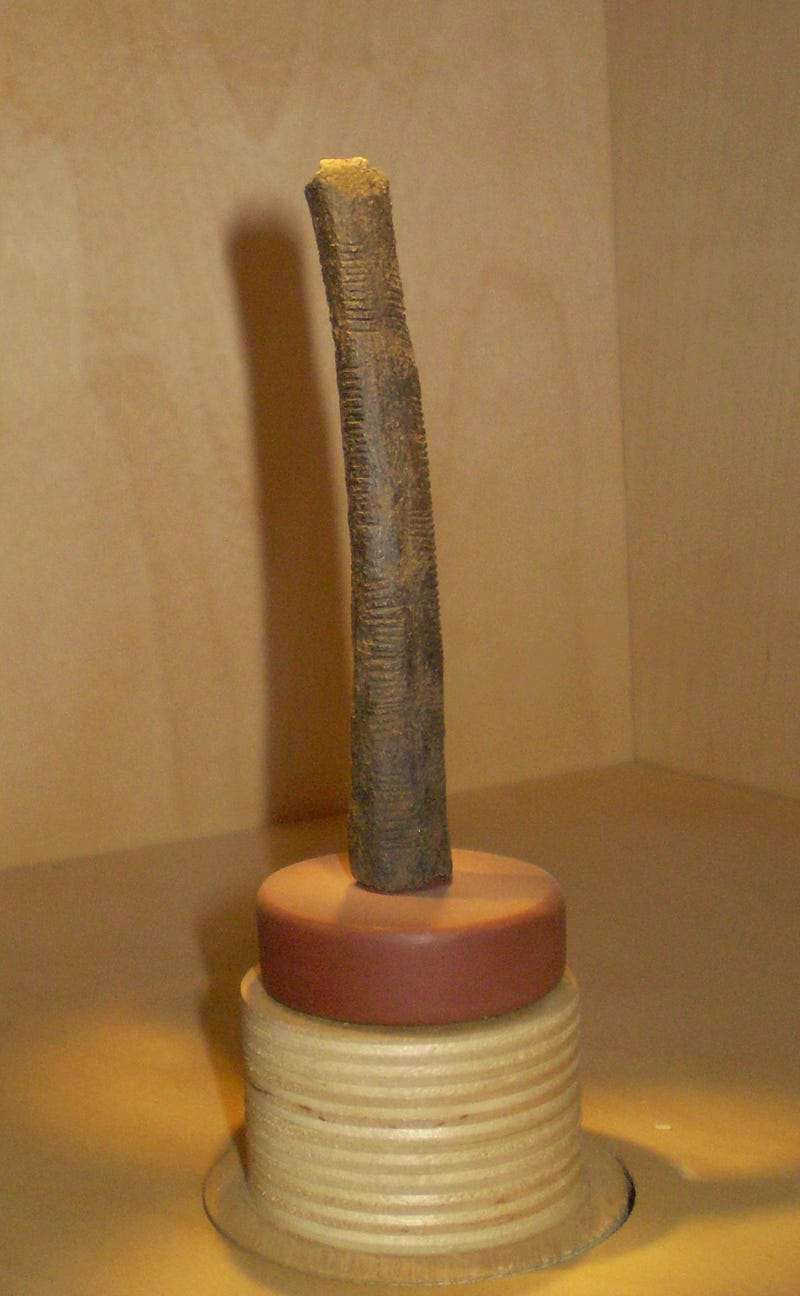
The Ishango bone exhibited at the Royal Belgian Institute of Natural Sciences (Wikimedia Commons)

Proposition

Nascent Logic Dawns Propose “Bone” before counting Mathematic’s birth

The Ishango bone from Africa, more than 20,000 years old, shows that counting may be as old as humans. But animal testing shows that monkeys, chimpanzees, and crows can quantify as well, so the roots of math may tunnel far into our evolutionary past, deep within our piles of genetic code….

Some of that code echoes from our single-celled origins within the midnight Hadean depths of submarine vents. Those single cells surely could not count, but their survival required following the trail of a chemical scent, a skill that biologists call chemotaxis… tumbling along with the faint whiff of a chemical, a food to its most concentrated origins, like a single-celled bloodhound. The automated ability to chase “More” is built into our Biology.

While a crow chooses a bigger pile of corn over a smaller one, does the concept of “more” or “less” interpose between avian observation and action? Does the idea of “one” or “zero” flash before the corvid brain? Or are counting crows merely a more complex version of chemotaxis, of chasing More?

There is a continent’s worth of daylight between the smartest animal and the dullest human. Perhaps the fuel accelerating human mathematics far beyond our nearest animal cousins is language, the basis of logic, and therefore of math. The inherent beauty and constraints of language and logic suffuse math but also power it. Before counting, humans needed the notion and the name of an object, to propose a flint, a club, a friend, a bone, a thing to be counted.

“I have five friends. They have four friends, and ten more goats than we. We can take their goats”.

Thus, perhaps, the polyamorous marriage of Math, Man, and War.

Fraction

This Fraction is twelve Seventeenths of a Haiku…
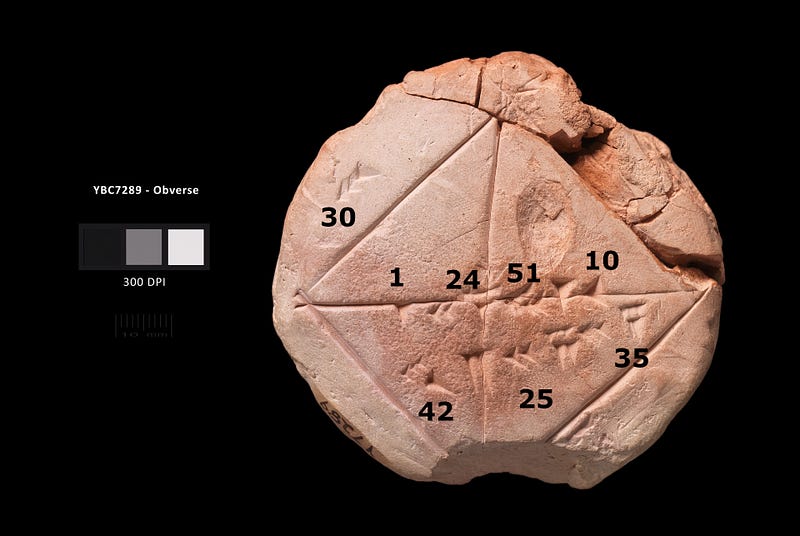
Yale Babylonian Collection’s Tablet YBC 7289 shows an approximation of the square root of 2 with a precision out to 2 parts in a million (Wikimedia Commons)
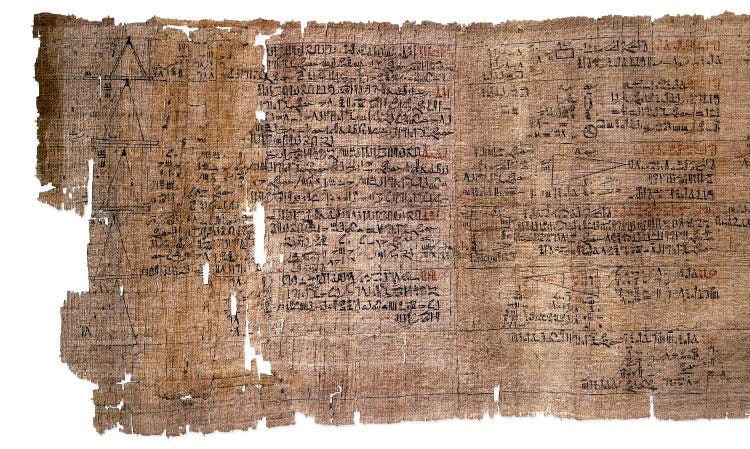
A portion of the Rhind Mathematical Papyrus (Wikimedia Commons)

The Babylonians have one of the earliest claims to a powerful fractional calculation out to six decimals of precision. This is documented in an astonishing clay tablet from about 1800–1600 BC, held in the Yale collection. This tablet shows a square with two diagonals, and numbers representing the lengths of those diagonals given the length of a side. One of the numbers represented in the tablet is an approximation of the square root of 2, given as 1.414213, which is off by less than 2 parts in a million. This square root is key to calculating the diagonal of any square with known sides. The Babylonians, in turn, got their numerical notation from the Sumerians, who used it as far back as 2000 BC.

Another early use of fractions is recorded on an Egyptian papyrus from about 1,550 BC during the reign of Amenemhat III. This is known as the Rhind Mathematical Papyrus after Alexander Henry Rhind, a Scottish antiquarian who acquired it from Luxor, Egypt, in 1858. A fascinating and quite intuitive limitation of the ancient Egyptian expression of fractions is that they only used unit fractions, which is a 1 divided by any number: ½, 1/3, 1/5, 1/101, are all unit fractions. This is intuitive because we first naturally learn about fractions by dividing one whole pie into two, or three, or four pieces to share with our friends. Today, we have moved past the limitations of having only the number 1 in the numerator, the top of the fraction. But the Egyptians were stuck with unit fractions at the time. Indian mathematician and astronomer Brahmagupta in 630 AD was the first we know of to represent fractions with a number on top of another, but without the bar. Arab mathematicians at first copied the Hindu notation for fractions and then added the bar around 1200 AD.

Infinite

You are Infinite Infinite is a Haiku Reflecting on itself…
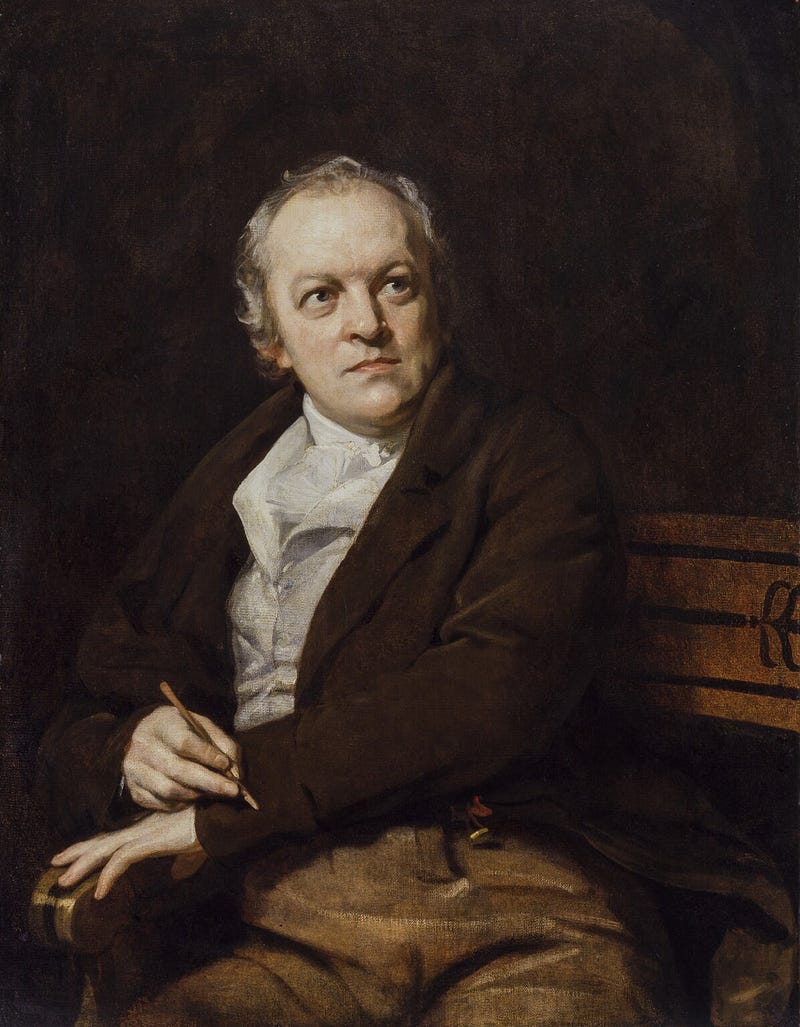
Blake in a portrait by Thomas Phillips (1807, Wikimedia Commonss)

“To see a world in a grain of sand And a heaven in a wild flower, Hold infinity in the palm of your hand And eternity in an hour….”

From Auguries of Innocence by Willliam Blake

For more on #30DaysOfScikuChallenge

What to read next from ScienceDuuude

Science
Poetry
Culture
Haiku
30daysofscikuchallenge
Recommended from ReadMedium