
Bird Brains May Be Smarter Than We Thought
Four-month-old ravens may be as smart as adult chimps.
Most of us believe animals are intelligent. But even if we all agreed that they were, the question remains, how smart? What do animals understand? What can animals do with their intelligence?
A group out of the Max Planck Institute in Germany set out to answer those questions.
1. Animal Intelligence Tests
We have been testing the intelligence and capabilities of animals for hundreds of years. Of course, as science advances, we often look askance at past inquiries, at the poor tests and lack of statistics and controls.
The most comprehensive and current test for animal intelligence is called the Primate Cognition Test Battery (PCTB), developed by Esther Herrmann at the Max Planck Institute for Evolutionary Anthropology. In these tests, the animal is challenged in various ways, including finding a reward, a food morsel like peanuts hidden within or under cups (imagine the con man’s shell game administered by a psychologist in a lab coat). The goal was to test the animal’s spatial memory, understanding of object permanence (that an object still exists even when out of view), relative numbers, causality, tool use, social learning, and many other capabilities.
In using these standardized tests, Herrmann showed that a two and a half-year-old human child has similar cognitive abilities about the physical world as a ten-year-old chimpanzee. However, when it came to the social world, human children far outperformed both chimpanzees and orangutans.
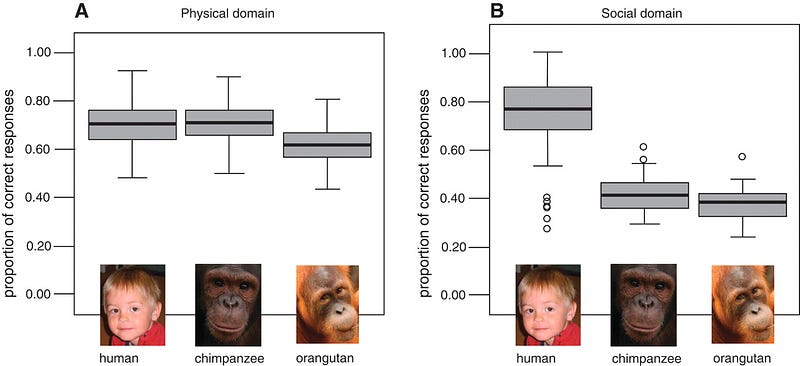
The off-the-charts social intelligence of human toddlers compared to mature, intelligent animals suggested to some that humans have uniquely-evolved skills needed to do things like pass along knowledge within cultural groups — but at the same time these human-specific social skills evolved from earlier skills we see primates exhibit regularly: social cognition, social communication, and social learning.
2. Origins of Animal Intelligence
Why did apes evolve intelligence? Some theorized that brain size increased in response to challenging environments, because primates that fed largely on fruits had larger brains than primates that fed on leaves. Others suggested that primate brains evolved in response to challenging social environments, supported by basal (primitive) primates, like the lemur, which evolved a typical primate society while lacking the monkey’s higher physical intelligence and ability to manipulate objects.
The idea of socially-driven evolution of brain and intelligence attracted a lot of interest and attention, and studies showed that indeed there was a correlation between the size of primate social network and the size of the neocortex (the most recently-evolved part of the brain).
Other studies showed that the type of society made a big difference, where long-term pair-bonding relationships correlated with larger neocortex compared to primates that formed brief, seasonal relationships.
These hypotheses and data about primates led to questions about brain size and intelligence in non-primate animals with similar complex and long-term social networks. A perfect example is the corvids, a family of songbirds found around the world that includes ravens and crows. Corvids and a few other birds like parrots have more neurons in a given volume of brain than primates, perhaps explaining why they are reported to have similar cognitive skills.
3. Comparing Corvids and Ape
Despite a long history of intelligence testing in apes, as well as in various corvids, there is no direct comparison between these two animals using a single comprehensive panel of tests. The PCTB in fact has been used to compare a wide range of non-primate animals like monkeys, parrots, and dogs, which makes a lack of direct comparisons surprising. The authors of a paper just published in the journal Nature: Scientific Reports aimed to fill this gap.
Simone Pika is the lead author of a paper titled “Raven's parallel great apes in physical and social cognitive skills”, reporting on their work to adapt the PCTB to hand-raised ravens. The main goal was to stick to the methodology of the PCTB closely, to enable direct species comparison, yet to adapt the test methods for ravens who use their beaks instead of thumbs.
Pika called this the Corvid Cognition Test Battery (or CCTB).
The authors bundled the many individual tests into larger groups which tested the animal’s understanding of: causality, quantity, space, communication, and theory of mind.
The subjects were eight hand-raised ravens, tested after they were fully hatched at four months, eight months, twelve months, and 16 months of age. Comparisons to non-human primates (chimpanzees and orangutans) used previously published primate studies.
The primary findings within the birds studied was that cognitive skills remained the same throughout the study period, and were approximately the same across types of cognition. In other words, raven’s impressive cognitive skills are already fully developed across a wide range of skills when they are only four months old.
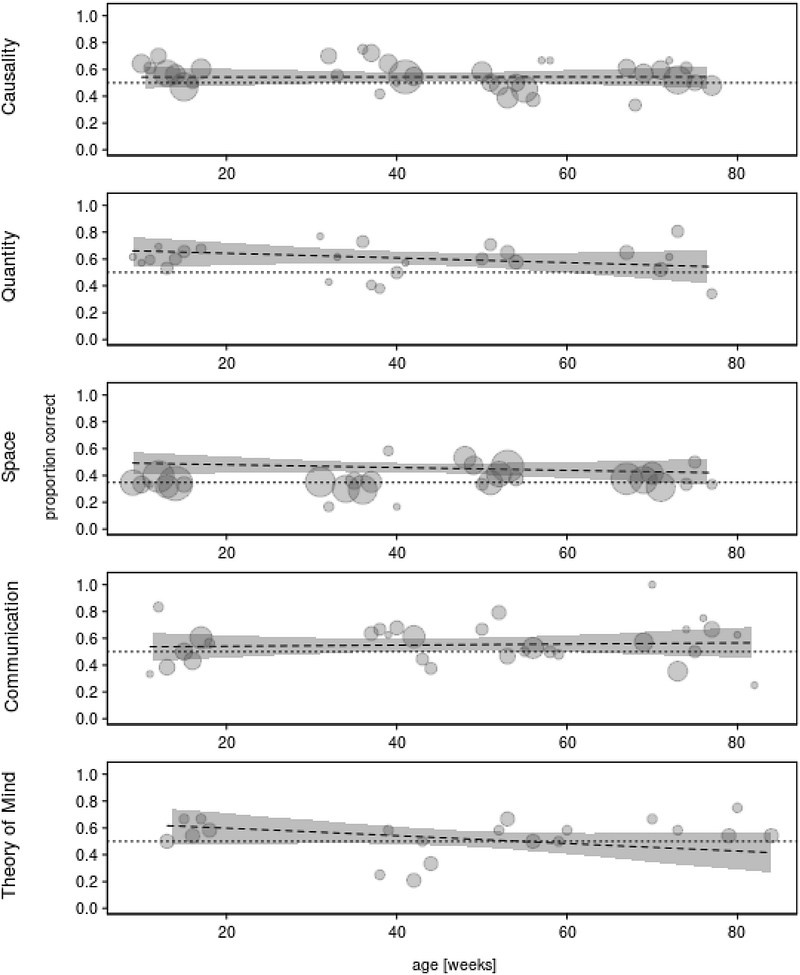
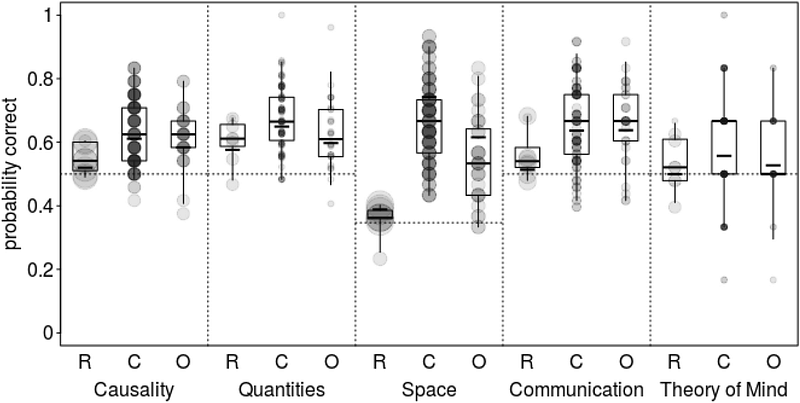
The ravens performed very similarly in both physical and social cognition, with their highest scores in quantitative skills, and lowest in spatial skills. The authors had a hypothesis going into this study that the ravens would perform higher in social than in physical cognition, given their complex societies and long-term monogamy.
The author’s hypothesis that ravens develop cognition very quickly was supported by their data showing that their performance didn’t vary over time and was already at a high level at four months of age.
The final hypothesis was that ravens would match apes in social intelligence because of their known complex social interactions, and that they would perform worse than apes in physical cognition. Their last hypothesis was not fully supported by their data. Ravens performed similarly to chimpanzees and orangutans in both physical and social intelligence. Only the raven’s spatial skills suffered in the comparison, all other skills matching the great apes.
4. Important Limitation
The authors illuminated the limitations of their study which are often overlooked. Pika et al. made the following important points about testing animal intelligence.
- The PCTB tests assume a natural division into social and physical intelligence, which has not been supported by recent analysis of the chimpanzee and human child data. Pika et al. suggest that social and physical intelligence did not evolve separately, but may be closely interlinked. An important detail in test methods may have been overlooked, such as the ability of animals to track the movement of the human experimenter, and whether that affects test performance.
- Pika et al. also point to the raven’s naturally competitive social life, with each raven looking at each other as both social partners as well as competitors for resources. The hand-raised ravens thus may have seen the experimenter as a competitor for the food reward — and this factor may have overshadowed the effects of intelligence alone in test performance.
- The raven’s performance on this test differed tremendously from parrots, which are also generally known for their outstanding intelligence. But the parrots performed no better than chance in these tests. These published studies vary considerably in the details of their execution. This raven study was performed by the same people who hand-raised the birds. The parrot study was done by people both familiar and unfamiliar to the birds, none of whom raised them. These details of human interactions with test subjects likely have overwhelming influence on the validity of the tests.
- The raven’s ability to track the gaze of another animal is a critical and confounding skill. Since ravens are exceptionally competitive with each other, it makes sense that they developed an ability to follow the gaze of other ravens. Where a raven looks is probably where the food is. A study by Christian Schloegel et al. found that ravens developed an ability to follow another raven’s gaze by eight weeks of age, but took another seven weeks before they could also follow a human gaze.
- Although the raven’s experimental scores were similar to great apes, Pika et al. do not claim that the intelligence of these different species are generally similar. The same behavior can be driven by completely different wiring and mechanisms of intelligence.
- Pika et al. also do not claim that the test performance of their hand-raised ravens represents ravens as a whole. They are aware that details of their test methods influenced the raven’s performance. They admit that developing statistically valid tests of animal intelligence still requires tremendous efforts, and that the field has a long way to go.
5. Conclusion
Pika et al. concluded that their study, the first direct quantitative comparison between ravens and apes, showed ravens perform similarly in both physical as well as social intelligence, and that ravens developed their abilities very rapidly.
They point out that the field of animal testing is still early in its development and still lacks the ability to clearly distinguish animal characteristics of intelligence from experimental variables such as human interactions. This is especially problematic when studying highly social animals.
The Apeiron Blog — Big Questions, Made Simple.
We know that Philosophy can seem complicated at times. To make things simple, we compile together the best articles, news, reading lists — and other free resources to guide you on your journey. To continue with us, follow us on Medium and sign up to our free mailing list.


