
Master Bao and the Running Man
Real wealth is peace of mind
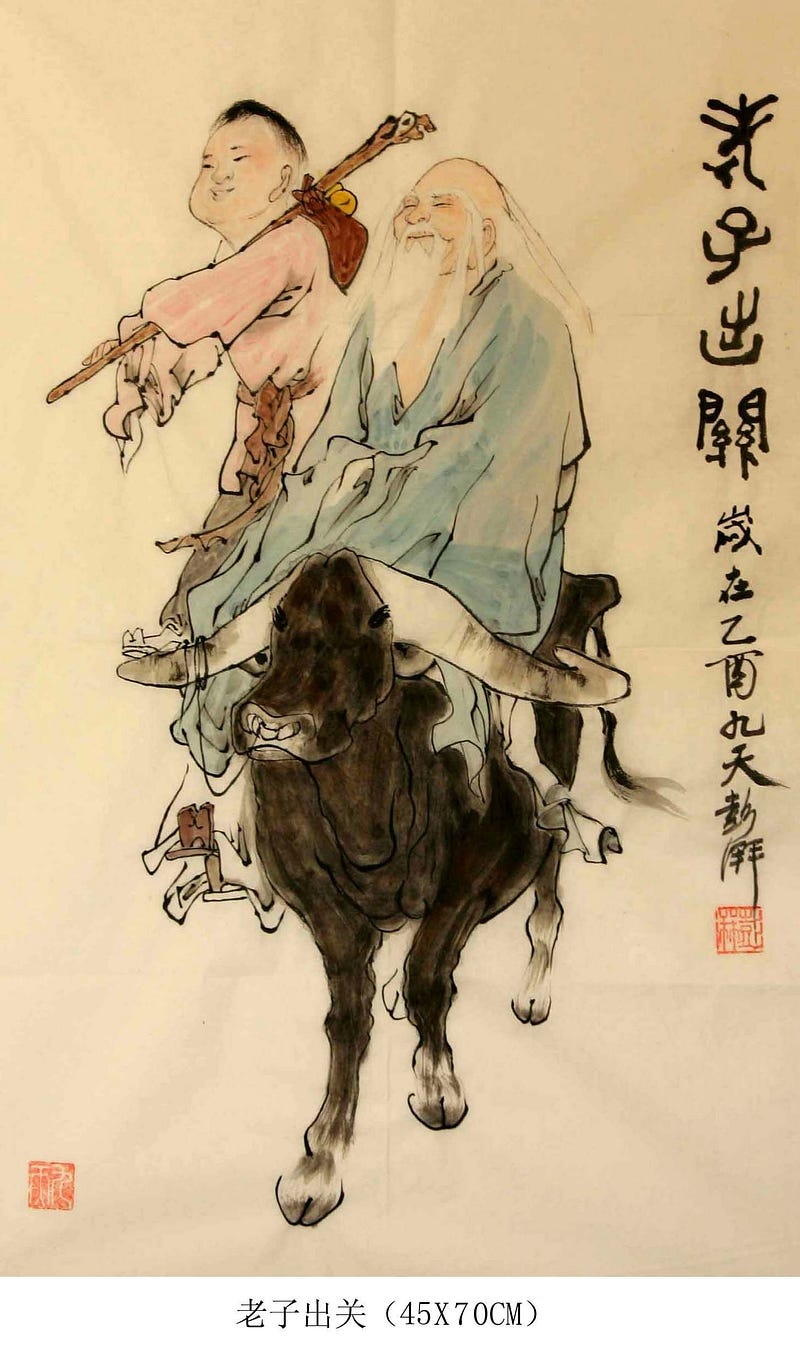
A tale from the Tang Dynasty (618–907 CE)
Master Bao rode his great ox, Xi, along a high mountain road in the province of Han-Yung. His pupil Ping strode alongside.
“Soon, Ping, we will be in the village of Yuen Chi known for its twin lakes, and bountiful fields of grain.”
“With two lakes for fishing and fields of grain, the people of Yuen Chi must be very happy,” Ping said.
“Yes, Ping. There is plentiful food. When drought strikes the rest of the province, the water from the lakes is used to irrigate the fields. It is a very content village.”
“Will we be stopping at an inn, or sleeping beneath the stars tonight, Master?”
“The Inn of Quiet Repose is noted for its vast vegetable garden, as well as its clean rooms. It is there we will spend the night. We should be seeing the twin lakes before too long. The village is set on a strip of land between them.”
About an hour later, the road leveled off and ran between two large lakes. Several fishermen in small boats were busy working with their tame cormorants. Soon, the travelers were on Yuen Chi’s crowded main street, walking among well-dressed merchants and bare-footed farmers in their simple shirts and pants.
“The people look happy, Master,” Ping said, “and I see very few beggars.”
Master Bao nodded. “If you notice, several of the buildings have the same name, ‘Liu.’ Over there is ‘Liu’s Cotton Goods,’ across the street from ‘Liu’s Leather Shop.’”
“I saw a ‘Liu’s Goldsmith,’ and a ‘Liu’s Fish Restaurant,’” Ping added
“Whoever Liu is, he must be quite wealthy. But here is the Inn of Quiet Repose, and a stable behind it. We’ll have the stable hand give Xi a rubdown and feed him, for he’s had a long trip today. Then, we’ll register in the inn.”
In a short time, Master Bao and Ping entered the wide doorway of the inn and approached the registration desk. A tall clerk with a full gray beard greeted the travelers with a bow and a smile.
“Our inn is honored to have two guests such as yourselves,” he said. “We have quiet rooms in the courtyard.”
A clash and clatter of cymbals and drums erupted from the street outside the inn, and the sound of people shouting filled the lobby. The innkeeper merely smiled, and continued to prepare the registration book.
Ping ran to the door and peered out. “The Magistrate must be approaching,” he said over the din. “Or perhaps a member of the Dragon Throne family.”
“No, no,” the innkeeper answered, “it’s just Mr. Liu hurrying past. He doesn’t stop here, or really anywhere, for he works day and night. The shouts and noise you hear are his men chasing people out of his way, for he hates to be delayed.”
Ping watched as a closed palanquin, carried by six chair-bearers, rushed down the street. A group of drummers ran before them, beating on skin drums, brass cymbals, and iron triangles.
“The story of Mr. Liu is famous throughout this province,” the innkeeper revealed. “His father was a prominent fisherman, who owned his own boat. So Liu knew hard work, but also comfort as a child. He was a curious boy, so my old clerk taught him to read and write.

“A tragedy struck, however. One day, Liu’s father’s boat floundered in a storm and only Liu lived. Soon, poor Liu’s mother died of a broken heart. His family gone, the boat gone, Liu was forced to work for other fishermen, and soon was reduced to rags.
“One day, a rich merchant’s son jeered at him, calling him names. The next day, people noticed that Liu had disappeared. No one heard from him for three years, but when he returned, he had a gold bar with which he bought a small wine shop. Since then, he has worked night and day to expand his holdings. Now, as a young man of only thirty, he is far richer than the merchant’s son who drove him away.”
That evening, as Master Bao and Ping were finishing their evening rice with fresh vegetables in the restaurant in the inn, the sound of shouting came from the lobby.
“Mr. Liu is dead,” a man screamed. “He just dropped over while at his desk.” The restaurant patrons, except for Master Bao and Ping, rushed out into the street.
Ping studied the Monk’s face, waiting for a reaction. After several minutes, Ping said, “What do you think happened, Master?”
Master Bao seemed to be examining the teapot sitting between the two. “The local Magistrate will no doubt order an examination by the Coroner, but I think he will find that Mr. Liu simply stopped running.”
Ping rose and bowed deeply to the Monk, his hands clasped inside his capacious sleeves. “Please enlighten this ignorant student, Master. Mr. Liu was not running. He was at his desk.”
Master Bao smiled. “Our wise Zhuangzi once told a story about a running man.
“There once lived a man who feared his own shadow. This man also feared the sound of his own footsteps.
“So the man ran and ran, but unable to outrun his own shadow and the sound of his footsteps, he finally dropped dead from running.”
The Monk filled both teacups. “Do you find a lesson in this story, Student Ping, that may help understand Mr. Liu?”
Ping smiled broadly. “If the man had stopped running, he would no longer hear his footsteps. Perhaps Mr. Liu feared his past was catching up with him. ”
“And?” Master Bao inquired.
Ping thought for a moment. “And, if he sat in the shade of a tree, he would not see his shadow. Do you think, Master, that Mr. Liu feared poverty, as this man in the story feared his shadow?”
“Perhaps. Real wealth, as followers of The Way know, is peace of mind, brought about by equanimity.
“And remember, Student Ping, equanimity does not come from running away from one’s fears.”
Thanks to Zhuangzi (369–286 BCE) for the idea
For more Master Bao:
Master Bao and the Golden Peach
A story from the Tang Dynasty (618–907 CE) on Immortality
medium.com
This is an original draft — never before published.


