
Marriage Is A Mess
If we no longer bother with ‘until death do us part’ — should we let this outdated institution die of its own accord
If you asked a whole bunch of African American folks to hold mock slave auctions, or got an entire synagogue of Jewish men and women to wear striped pyjamas I suspect you’d get pushback. This, you’d be told fairly quickly and uncertainly, is not how society should choose to reflect on either the Trans-Atlantic Slave trade or the Holocaust.
But, given enough social messaging and capitalist guff, it is more than possible to make a young Western girl giddy about wearing a white dress, changing her surname and being given away by her father to a man being defended by his ‘best men’. He might even get to put his finger in her ring — innuendo ahoy-hoy.
This is the cornerstone of romantic love in the 21st Century.
And sure… as this is indeed the 21st Century you don’t have to actually DO those things anymore but my question is why would you choose to? And even if you don’t choose to do those things exactly, why would you buy into the validity of a social contract which endorses both the historical and continuing social oppression of women?
Buckle up folks… this is Ben vs The Peng part one — and we’re talking about the institution of marriage.
So before we get any further into the cut and thrust of this debate there’s one important thing you need to know. This article is one half of a pair with “In Defense of Marriage” being written by Ben.
I’d encourage you to read BOTH articles before you decide I’m obviously right. Which, it’s fair to say, I might not be. I guess we’ll see. There will be bonus points for nuanced responses and please do feel free to write your own article and chime in with what marriage means to you and exactly how much you think I’m right.
Just include the tag ‘Panopticon’.
Ben is going to be arguing FOR marriage and I’m going to be arguing that just because something has been around a long time doesn’t make it inherently good. More specifically the institution of marriage didn’t come from a good place, isn’t leading anywhere promising and should be consigned to the dustbin of history.
Traditions should be examined carefully and constantly for signs of wear and tear and those found to be lacking should be binned by consensus.
What is marriage, where did it come from and can we put it back?
Marriage has been around for a long time. There are definite benefits to be had within society for people to pair-bond to raise children. As societies grew more complex so did the rulebook around marriage, superseding the benefit of pair-bonding came the intrusion of religion, social tinkering, economic necessity, the exchange of lands, and vows before a deity.
A selection of rules I’d argue that are expressly designed to both subjugate women and simultaneously hide this fact from them.
We move quickly from the Greek/Egyptian/Roman traditions based around the smooth transmission of property between generations into something more recognisably religious. Early Christians tie together the notions of fidelity and monogamy into the mix. Marriage rapidly became a political tool in which daughters became wives for political gain.
Largely, it has to be said, at the cost of other women.
Those women who did not fit the paradigm were quickly and brutally socially discarded. Widows burned at the stake, prostitutes and mistresses used and discarded. Marriage was a social safety net into which women were forced because a man to vouch for them was a necessity. Choice did not factor in these societies — women were a commodity.
This came with its own problem. Not all men are inherently safe, a fact consistently demonstrated year after year.
Whilst Hollywood has successfully rebranded married life for the modern go-getting liberal loved-up couple, elsewhere and in places where society chooses not to look too closely marriage can be a death sentence. I know this, I have worked on these cases in my time at the sharp end of society.
Marriages done wrong are tortuous, toxic, and sometimes deadly. Sometimes the death arrives with inexorable painful slowness leaving people in decades of hostility and misery.
My issues with YOUR marriage are minimal. Perhaps you have found a loving partner, had a wonderful wedding and love your partner. This remains a choice that has historically been denied to many and continues to be denied to others today. That isn’t your fault, you inherited a Judeo-Christian blueprint and followed the route to success as prescribed by the generations above.
We can’t choose to ignore the problematic nature of marriage elsewhere in the world because the West has a glossy sanitised version of it.
Two married parents are better than none
I suspect in Ben’s article he will make the argument that outcomes are better for children when they are parented by two people. I both agree with this and disagree entirely. Children are best parented by as many competent adults as can be encouraged to genuinely care about that child all pulling in the same direction.
That’s not about marriage, it’s about how we perceive parenting.
Would I prefer children be parented by two people over one? Depends. Are the two people competent or do they get in each other’s way? Two competent people are better than one competent person. One competent person with a partner, who happens to still be a psychological child, hindering from the sidelines will not work out great.
I suspect this may be at the root of ‘single parenting’, which often isn’t really ‘single parenting’ at all, it’s ‘group parenting’ outside of the convention of marriage. It’s often grandparents, friends and other family members who fill the gap left when the psychological child is jettisoned.
Two psychological children attempting to raise an actual child is the worst of both worlds. Unfortunately, because of the way our early childhood shapes our desires, those psychological children will find each other and they will become co-dependent.
Most people need to do far more work on themselves before they try to solve a problem like procreation.
The most important thing to ask about a couple is do their psychological patterns interfere with each other to such an extent that bringing children into it would exacerbate any pre-existing toxicity?
The answer in many cases is yes — and marriage cannot wish away this psychological malaise. This couple often marry to attempt to gain a sense of emotional security neither truly feels. This can be a terrifying trap. Many people hold the belief that marriage itself is an indicator of success.
It isn’t.
It’s an indicator that you have tied your lives together legally, psychologically and economically. What’s more, if two people who don’t fully understand themselves evoke a mechanism to tie their lives together, untying this Gordian knot is likely to be expensive, emotional, and traumatic for any children involved (but keep a lot of lawyers happy).
Divorce rates skyrocketed across the 20th Century in many Western countries but have stabilised now. I think that’s because more couples are cohabiting, testing the water, and delaying marriage and/or procreation.
Ben will not approve of this — I think it is a necessary and functional way for liberalism to apply the brakes and rethink society.
Marriage, monogamy and Penguins
I come from a working-class family where my mum was considered ‘geriatric’ by having me (her eldest) at 24. Her own mother was 21. Her mother’s mother was 17. All of these births were ‘proper’ in so much as they followed after marriage and not before.
Marriage has ‘worked’ in my family. My mother was passed from my grandfather to my father literally and metaphorically. When my father was posted to Iraq and Afghanistan we got a terrifying insight into what my mother would be like if my father were to die unexpectedly.
My Mum isn’t lazy but there are gaps in her functioning adulthood that have come from an over-reliance on my father.
This is in her blueprint. It is in my father’s too.
When my paternal grandfather died, my own father simply stepped into his responsibilities. My grandmother (although admittedly in the early stages of dementia) knew nothing of house finances. She outlived her husband by a decade, sliding inexorably into the fog of Alzheimer’s confused about whether my Dad (her son) was her husband or not.
In many ways, I understood her confusion. They were functionally the same — a blueprint copied.
Had my Gran gone first we would’ve had my Grandfather for a much shorter time. In their six decades together he’d never cooked anything more complicated than a ham sandwich. Even then he struggled to butter the bread.
Passed from mother to wife via the RAF mess hall.
Why am I telling you this?
I want you to understand why both I and the Significant Other Penguin (whose parents are also happily married) have rejected marriage entirely. Why, despite constant pressure after eleven years together to ‘pop the question’ we have consistently elected not to do so.
Both marriage and monogamy are not for us.
Whenever someone says ‘the other half’ or ‘soul mate’ I’m a little bit sick in my mouth. If you need another person to genuinely feel completely psychologically whole then you possibly need to work on what’s missing in your life.
The chances of an average human being picking the one person (soulmate) to meet their psychological, sexual, social, physical and emotional needs in the first thirty years of life are infinitesimally small and we should reject outright this Hollywood notion of romance.
Monogamy and the over-emphasis on ‘romantic love’ has led to a society in which people prioritise this relationship above all else. Capitalism has supercharged the desire for weddings and commodified love itself. The lack of questioning around both the tradition and the capitalist trappings has created a super-industry into which lashings of nonsense have been endlessly poured.
As for me. I am polyamorous (though I hate labels and so rarely talk about it). This means I happen to love multiple people sometimes — something that has become more mainstream to both practice and talk about in recent years. This doesn’t fit the marriage model, but then perhaps the vast number of people having clandestine affairs should simply just be more honest with each other about what they want.
I dated an additional Penguin for some of the last decade I’ve been with the SOP simply because it was fun and I wanted to. It didn’t alter my commitment and we Penguins are open about such things.
I also don’t think it’s inherently a bad thing. I don’t think love is finite, if you’ve had a child you don’t have to divide the total love you feel between your partner and your new child.
People are an infinite spring of love, love widely and fall in and out of love if you want. You only have 90 years, make sure you have fun.
I also enjoy sex the way other people enjoy tennis or going for a round of golf. As far as I’m concerned you can go and have sex with friends or strangers for the sheer fun of it — and it can have no impact on your other relationships whatsoever.
You may disagree, and that’s fine too. You do you and just try not to hurt anyone, that’s the cornerstone of Penguin liberalism.
But I have found the only time it becomes problematic is when two people psychologically consider each other to be ‘property’ and then become jealous. I do not care what the Significant Other Penguin does with their time as long as they are safe and happy and they think likewise about me.
We do not belong to each other because that implies ownership and control. Marriage is the formal declaration of that control.
Law (not love) and Marriage
I am sure that Ben will make the case that marriage leads to better life outcomes — I suspect he will make this point about LGBTQ+ couples too. I imagine there will be stats to back this up — and I believe those stats are going to be well-researched and true.
I can’t compete with that, but I do think the scales are already tipped in favour of both monogamy and marriage. There are advantages to being married — and these make it both legally desirable as a state of being and the default-setting for many.
But just because it’s a default setting doesn’t make it inherently good.
I was very vocal about the rights of LGBTQ+ to marry but simultaneously vocal about the pointlessness of fighting for a prize that is really no prize at all. We have since seen the uptake of ‘civil partnerships’ here in the UK which seem like marriage-lite and confer all the legal advantage with none of the pomp, circumstance and Godliness.
If pushed I’d take one of those. And only for three very specific pushes.
- To get someone in or out of a country or to save the life of someone fleeing a war-zone if it was requested.
- To get access to healthcare for a partner under any terms of employment related to me
- To ensure that any Significant Other Penguin (and any hatchlings we have) get access to my money if I am suddenly and unexpectedly mauled by a Polar Bear.
I want to be absolutely clear on this. I think these are problems with British and then US law emerging out of Christianity and with marriage as the default for legal advantage. I’d argue it remains inappropriate for a secular society like the UK — along with Bishops in the House of Lords and singing hymns in schools.
There should be no legal advantages conferred upon anyone for being married and nobody should be disadvantaged for leaving a marriage. The law must be fair and I’d argue that it isn’t, but heading the right way.
Here in the UK we now have ‘no-fault divorce’ — a small but welcome step.
Divorce increases are making marriage less and less relevant with each passing year. If marriage is simply there as a psychological salve to scratch the itch of tradition and get our kicks from the notion of romantic love then we would expect to see it fall by the wayside over time. This is because traditions fall away under financial pressure, technological progress (hello contraception) and binary ideas of romance have been directly affected by first the internet and then by social media.
Divorce was taboo because nobody was doing it, everyone was married but only because everyone else was. We’d expect to see the marriage rate decrease over time as people have stepped away and become better informed about their choices.
That, I’m delighted to say, is exactly what is happening here in the UK.
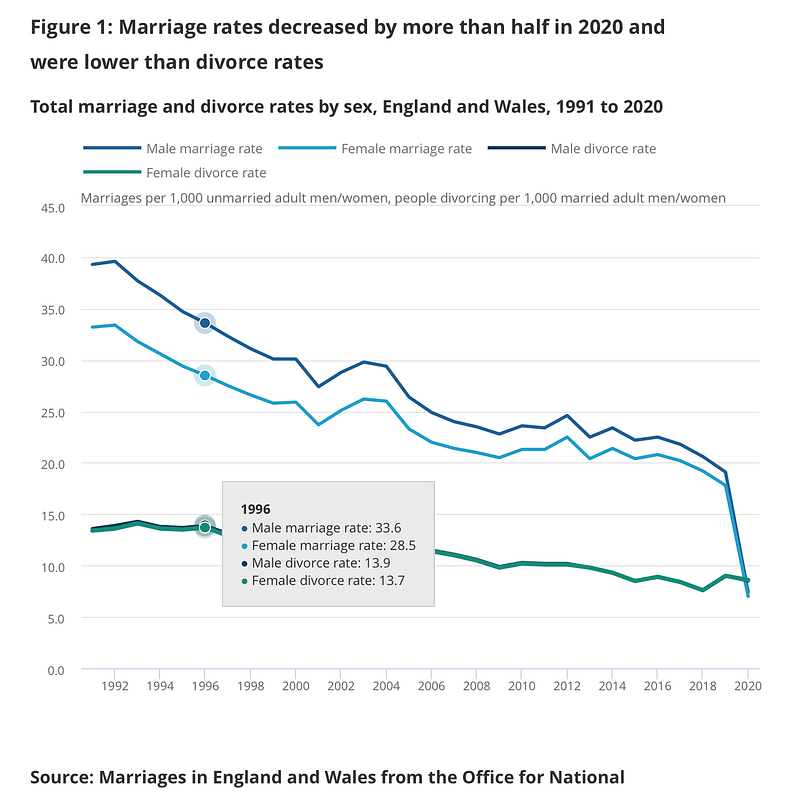
Between 1989 to 2019 the number of marriages decreased by 36.6%. Over the last 30 years, there has been a steady increase in the percentage of marriages performed as civil ceremonies and in the last four years alone civil ceremonies have increased from 76.0% of all marriages in 2016 to 85.5% in 2020.
If it takes us Brits until 1991 and the USA until 1993 to universally recognise spousal rape, is it really a progressive force for good?
The conclusion
I’m not going to conclude by saying that marriage is a sham — though in some cases I think that’s the case. I hope I’ve made the point that marriage is at best a neutral but unnecessary experience in a modern democratic liberal state.
It’s the default setting, though I’d argue this is starting to change and I’m happy about that change happening in my lifetime. I reject entirely the presumption made by previous generations that a relationship isn’t proper unless it’s been overseen by the state or a big beardy sky-lord of one flavour or another.
Just because we have always done something doesn’t mean we always should. Brain plasticity favours the primates.
I’ve found the fascination with weddings to be bizarre and a little sickening for most of my adult life. These traditions are the trappings of being traditionally trapped and buying into that culture is problematic. I’m always baffled when I meet a feminist who is a) furious with the patriarchy but b) is married and who had a lovely wedding and wants to show me the photos.
I find these people to be a walking contradiction.
When you say yes or when you get down on one knee to propose. You’re joining a tradition of oppressing women, one at odds with liberal feminism in everything other than the right to choose your legal status. Marriage is not a force for good for young women or society and brainwashing young Western girls and boys into this belief I’d argue is fundamentally and morally compromising.
Marriage is not a measure of success — it has been watered down so much to become meaningless. A state of being it is so easy to opt in and out of that it’s keeping lawyers happy and nobody bats an eyelid at hearing you say for the second, third or fourth time ‘until death do us part’.
I’m liberal. I will always fight for you to have the choice to marry — but a huge part of me wishes you wouldn’t. Penguin out.
In one of the greatest betrayals of the modern age, long time reader Peaceful Dave (Some Guy) has sided with Ben on this one.
Did I mention you should go read Ben’s story? Want to write your own response? Tag “Panopticon” and if we like it, we’ll include it in the publication.


