
Many Popular Narratives About Humans Are Just Plain Wrong
A look at some of the false stories we keep perpetuating about history, culture, and mating
As someone who often writes about erroneous cultural narratives, it never ceases to amaze me how sticky they can be. Something may have been disproven in the scientific community decades ago and replaced with a widely accepted new theory, and yet, often the old, outdated one is what still remains in the consciousness of the general public.
A good example of this is the narrative that men are just naturally randy and promiscuous and that women are naturally sexually reticent and choosy. It’s a story that has been debunked up one side and down the other for decades by a variety of scientific disciplines, but nonetheless, the narrative is still widely believed and often talked about as fact. (See Story I below for more about that)
Perhaps it’s because school isn’t truly a place for learning. Perhaps it’s because the media pushes its own agenda for its own purposes. Perhaps it’s because people tend to cling to what feels known and therefore most comfortable to them. Whatever the reasons, I’m more interested in getting as close to the truth of things as I can by studying the most current theories about human life and cultures.
Although we can’t always know the absolute truth, particularly about things that took place in pre-history, a wide body of interdisciplinary knowledge often paints a very compelling picture. When we take into account not only the latest in archeology, anthropology, and paleontology, but art history, linguistics, child development, neuroscience, and primatology (to name just a few) we can start to get a pretty clear sense of things.
After about 5 years of consistent reading and writing about human history, sociology, mating, and cultures, including a lot on Paleolithic life (something that most people never study), I feel like there are quite a few things that still loom in the popular imagination that really are just flat-out wrong. Here are a few of the more glaring ones, as well as what most experts concur is the actual story because, from an interdisciplinary standpoint, it is what the preponderance of the evidence points to.
Note: In the interest of not getting too bogged down with citations, I have referenced other stories which include further information and greater citations to support what is said within them.
- Since the beginning of time… This is one that I hear way too often, and it’s the phrase that most gets under my skin. There is very little that has remained as a part of human cultures that is unchanged since the beginning of time. Perhaps the only thing around which we might correctly be able to use this phrase is that we are extremely social animals. The way that this is expressed in the present is quite varied from culture to culture, but the fact remains, we survived because of our social networks, and we suffer now when we ignore how intrinsic a part of our humanity this is.
- Along with this goes the Flinstonian notion that we’ve pretty much always lived and been socially organized as we are today — just without the modern conveniences. Never mind the broad, sweeping changes that the Industrial Revolution or the second 5k years of widespread plowed agriculture brought, let’s just pretend that until fairly recently humans always lived like it was the 1950s in America — as if that were a reasonable thing to do.
- The idea of a male “breadwinner” who supported a female “homemaker” and their children as a pervasive family construct is one that existed for less than 20 years — arising in the 1950s, it was largely defunct by the end of the 1970s. Of course, families like that existed after the 70s and still exist today, but they are not the norm and certainly were not before that time. For much of recorded history, families lived in extensive networks of kin, and except for the very rich, both women and children contributed substantially to the economic success of the family. In Paleolithic tribes, gatherers provided the bulk of daily calories (as they do in most current forager bands), and food-sharing and communal child-rearing were key survival strategies. (Story B)
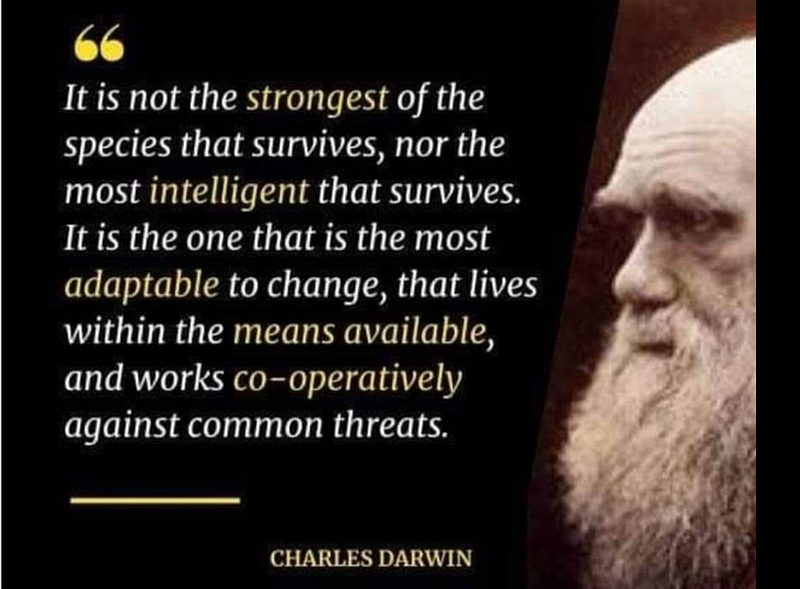
- As noted in the graphic above, survival of the fittest does not indicate that the strongest or the biggest always prevail — that’s a patriarchal dominance hierarchy social construct that only arose in the past 5 thousand years or so. (Story A) Evolutionary fitness is much more a product of adaptability to current conditions and the ability to cooperate to mutual advantage.
- In fact, there’s quite a bit of evidence (genomic and otherwise) that nearly all early hominid social dynamics revolved around establishing and maintaining bonds of cooperation and mutual benefit as a survival strategy. (Story C) As primatologist Frans De Waal has noted, “I am not trying to ignore the role of aggression and competition in understanding primate and human social interactions. My perspective, however, is that affiliation, cooperation, and social tolerance associated with long-term mutual benefits form the core of social group living.” (Story E)
- Another way that the “we’ve always been this way” idea manifests is around violence. And yet, the oldest known evidence of any sort of mass killing took place in Jebel Sahaba in the Nile valley about 13,000 years ago. This doesn’t mean that there was never any killing or violence before that time but there is a distinct difference between organized war and personal squabbling, flared tempers, or execution of those who have violated the rules of the group.
- We know that killing is difficult for humans because soldiers have to be trained and indoctrinated into doing it, and even then they still often suffer detrimental psychological effects. Even cultures that are considered to be quite violent still have mechanisms for avoiding lethal interactions. Sometimes those involve simply avoiding each other and sometimes they are more elaborate, including singing contests or ritualized battles where conflicts may be resolved without any significant bloodshed. Periods of peace may be agreed upon to allow for trade as well. (Story E)
- Modern forager groups typically move to a different part of their territory if a conflict arises with a neighbor. Given that the population of the world only reached 1 million in the past 10–15k years; that modern forager groups are very conflict-averse and have a lot of social mechanisms for maintaining group harmony and peace; and that so much of early survival revolved around cultivating wide networks of cooperation and mutual aid, it seems rather unlikely that prior to Jebel Sahaba, that war, raiding, or other types of mass violence took place. In fact, going by archeological evidence, most mass violence only took place in the past 8k years.
- Egalitarianism doesn’t mean Utopian, or even exact gender parity, although many egalitarian (and all matrilineal) cultures today do have a sort of balance between male and female power. (Story A) It refers to no entrenched social or political hierarchy and typically no major wealth disparity. Ad hoc leaders emerge as needed and then fade back into the fabric of the group. There are no mechanisms for the permanent placement of certain people above others, and certainly no hereditary leaders. All members of the group have value, and their contributions, which may not necessarily be equal, are nonetheless acknowledged. Everyone eats because everyone counts — and not just because that’s nice, but because tomorrow someone will be sharing their food with you. (Story C)
- This brings me to gender roles. I believe this topic needs its own story, but I haven’t gotten there yet. In short, unlike in a patriarchal culture where there are rigid rules about what is for men and what is for women, egalitarian societies don’t seem to worry too much about who does what, as long as everyone contributes in some way and the work gets done. Gender roles appear to have been devised as a way to ensure that all the bases get covered, but the additional strong value of personal autonomy (Story F) means that there are not too many concerns if someone does work not loosely designated for their gender, as long as they work. Evidence of this goes back thousands of years, with female big game hunters and warriors as well as current cultures where both men and women hunt and both men and women gather.
- There is no one mating strategy that humans have universally used throughout time. Again, what is evolutionarily fit is what is most adaptable in that particular set of circumstances. (Story D) Any assertions about mating that claim that what takes place most commonly now (or more likely what took place in the 1950s or the Victorian era) is somehow indicative of ancient pair-bonding or sexual practices, is nothing but wishful thinking and junk science. (Story G)
- In addition, assuming that marriage, mating, and family structures all look exactly the same around the world and throughout history is another conceit of the ill-informed. Pair bonding is indeed an ancient building block of human social systems, but that doesn’t always look the same from culture to culture, and may not even always imply sexual monogamy. (Story H)
Human social systems and behaviors are complex, and often quite varied from culture to culture and from era to era. Trying to lump us all into one never-changing box, beyond the deep need for social connection, is a poorly conceived way to create a shorthand that suits some narrative — typically one that attempts to reinforce Victorian notions of masculinity and femininity. (Story I) Flinstonizing the world may feel good to some, but it’s both naive and unscientific. I’d rather stick with what the most modern theories from a wide variety of disciplines tell us about ourselves and our past and continue to read and write about that.
© Copyright Elle Beau 2022
Story A
Story B
Story C
Story D
Story E
Story F
Story G
Story H
Story I


