
Is It Emasculating That Women Also Hunted?
I think you’re looking at all this from the wrong perspective, dude
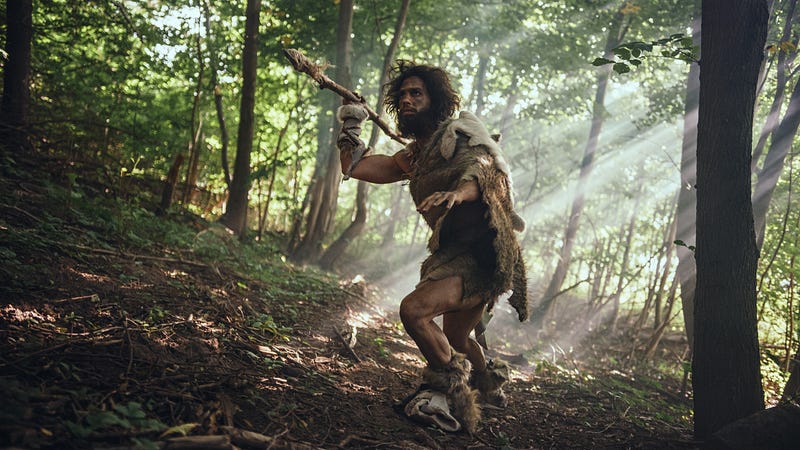
There seems to be a lot of angst in the zeitgeist lately coming from men who feel a bit useless. If they are no longer needed to “provide and protect” then what are they supposed to do with themselves they seem to be saying? Women who opine that they “don’t need a man” tick them off, but it also clearly rattles their cage. In a world where the genders have had very specific roles, it seems to be quite disconcerting to discover that is all an artificial construct that is rapidly eroding.
To make matters worse, more and more new evidence keeps coming to light about the role of both ancient and more modern women as big game hunters and warriors. A new technology that can evaluate peptides in tooth enamel now gives us a reliable way to know for sure if ancient bones belonged to a man or to a woman and it’s proving a lot of old assumptions to be wrong. Just because a body has been buried with a sword or with a bow and arrows doesn’t tell you anything about the sex of the person.
I’ve been meaning for some time to write something about gender roles in indigenous societies, but for the men who feel threatened and marginalized by the growing realization that humans have survived not necessarily by gender specializing but by working together, I’m not sure it’s going to make them feel any better.
Yes, nearly all cultures have some form of gender roles, but unlike patriarchal societies where there are a lot of pressures to strictly adhere to them, more cooperative cultures tend to have more flexibility. As long as you are contributing to the group, nobody cares all that much about what you do. In many contemporary forager societies, both men and women hunt, and if men feel like gathering, that is what they do. Eating is more important than roles.
Scientists who study ancient anthropology believe that our hunter-gatherer ancestors lived in small bands of 20–50 individuals. It makes a whole lot more sense for everyone to have a wide variety of skills than to be highly specialized in such a harsh environment where survival is job #one. For example, Australian Aboriginals have a more gender-delineated culture than a lot of other foragers, and even so, they each do fine when men go off for any period of time.
In general, men and youths mostly hunted large game, while women collected vegetable foods and hunted small game, such as lizards. However, adults of one sex could easily subsist for long periods without members of the other — for example, when men absented themselves from their bands to undertake journeys related to religious concerns. All adults of each sex normally possessed the full range of skills required for getting a living. (source)
For a lot of forager tribes, gathering provides 60–80% of the daily calories, with meat being a more sporadic source of nutrition although a recent research paper shows that in 79% of forager societies for which there is data, women did and do hunt. “Wall-Scheffler and her collaborators combed through accounts from as far back as the 1800s through to present day. And rather than relying on summaries of those accounts — as scientists often do when analyzing large numbers of them — Wall-Scheffler notes ‘our goal was to go back to the original ethnographic reports of those populations and see what had actually been written about the hunting strategies.’”
In another similar study, focused on the forager cultures of today, they found similar results.
Women were found to have hunted game of all sizes, but most often large animals in a majority of societies, according to the study, spearheaded by Abigail Anderson of Seattle Pacific University’s biology department.
The study found women were actively involved in teaching hunting practices, used a larger variety of weapons than men and were instrumental in bringing home animals for their families to eat, regardless of whether or not they were mothers. (source)
But what then is the evolutionary purpose of men having, on balance, greater upper body strength if women were hunting big game too? I suppose the same might be said of the long history of women warriors in a wide variety of cultures. I don’t have a definitive answer for that, although I do know that sexual dimorphism in humans is only about 15% compared with 50% for gorillas and that differences in average height have been attributed to higher levels of estrogen in women. I also know that when you live a life where you are expected to build and use your muscles every day, women can be quite strong.
As a story in National Geographic about the Mosuo of China notes, “The matriarchs (photographer Karolin) Klüppel met were ‘often very funny, and very active’, at odds with the German culture she is used to. ‘I saw an 80-year-old woman carrying things I could no way carry myself,’ she says. ‘Their bodies are really tense with power. I realized that physical strength really depends on what you do with your body — the women have more strength than the men!’”
What I also know is that humans are a highly social and collaborative species. “As compared with other primates, human beings are inordinately cooperative, especially with nonrelatives.” Some researchers believe that even though Neanderthals were likely more intelligent, we survived when they didn’t due to our ability to share information and work together. We were friendlier and more apt to recognize others as a part of “our group” even if they weren’t from our tribe. It served our species well.
I think that’s what we need to be focusing on here — our longstanding proclivity to work together — not the loss of some recently devised artificial role. For most of human history, we lived and worked in communities that balanced personal autonomy with interconnectedness in a way that did not create dependencies or methods for controlling others. It’s only within the past 5k years, with the rise of patriarchal dominance hierarchies that this has changed.
If your sense of self is predicated on someone else’s dependency, and therefore their inferiority, I think it’s time for an attitude adjustment. You aren’t necessary or important because you can offer something that someone else has traditionally been kept from providing for themselves, you are important and useful because everyone can contribute to others as fellow human beings.
And, if you as a man truly feel the need to be necessary to women, you can start by connecting with other men to shift the norms that equate masculinity with domination of others and control of women. That’s the primary thing we need men to be doing for women these days.
The question that men who feel unnecessary need to be asking themselves is how they can be useful and important to their neighbors and their communities, for the good of us all, as well as to their partners and friends in a more general sense. Aside from the fact that when women say they don’t need men, they are primarily reacting to centuries of messaging that they don’t have any value unless they are wives and mothers, nobody needs anyone in particular. Human beings need other humans. Shouldn’t we be honing in on that? Isn’t that what is truly important? Isn’t that enough?
© Copyright Elle Beau 2023


