
Impressive Women of History: Soldiers, Warrior Queens, and Pirates
A look at some of the fiercest, boldest soldiers and pirates the world has ever known who just happened to be female
This is the first in a series on impressive women. Too often the lives of interesting and important women, women who contributed to history and made their mark in various ways, have been pushed to the sidelines or forgotten. This series aims to rectify at least some of that. Reference materials are listed at the bottom.
Lagertha
We don’t necessarily know a lot about shieldmaidens, the women warriors of the Vikings, but about a few of them we do. One name you may recognize is Lagertha, who along with a group of other female Vikings, voluntarily helped Ragnar Lothbrook to avenge the death of his grandfather. Lagertha’s bravery and skill in battle reportedly entranced Lothbrook, who relentlessly pursued her until she agreed to become his wife. Characters based on these two were central to the Vikings television show that appeared on the History channel.
Freydis Eiríksdóttir
Arguably the most famous female Viking warrior is Freydis Eiríksdóttir, daughter of the legendary Erik the Red. Various historical accounts say that when Eiríksdóttir and her party first landed on the Eastern coast of North America (Vinland) they were met with a bunch of angry natives who caused them to fall back. This didn’t sit well with Eiríksdóttir, who reportedly grabbed a weapon, ripped open her top, and proceeded to charge the astonished natives, who retreated. Some reports say that she was also pregnant at the time.
Tamar the Great
Tamar the Great of Georgia was crowned co-ruler of the Georgia kingdom in 1184 by her father, George III who had no male heirs. After her father died six years later, Tamar continued to reign, eventually taking on the title of “king.” Under her rule, Georgia negotiated for peace with Saladin after he retook the city of Jerusalem, but continued to expand their influence and landholdings elsewhere. She built one of the most unstoppable armies in history.
Irritated by her ever-expanding empire, the Seljuk Sultan Rukn ad-Din Süleyman Shah launched an attack and sent a demeaning letter to Tamar, demanding that Georgia surrender. He also told her that if she converted to Islam, he would make her his queen (but if she did not, he would take her as a concubine). Tamar assembled a large Georgian army, which fought back ferociously, and even succeeded in injuring Süleyman, who then withdrew.
After capturing Süleyman’s brother, she exchanged him back for one horseshoe, demonstrating that she had “absolute power in the Caucasus, Anatolia, Armenian Highlands, Shirvan, and western parts of the Black Sea.”
“Under Tamar, Georgia reached its greatest territorial and political height. Its armies campaigned from Trebizond to Iran, and Georgia was undisputedly a major power in the region. While there is no historical record of her fighting in battle, the image of Tamar as a warrior queen has also been passed down through Georgian legend as well as images of her as a deity or saint. Tamar was declared a saint by the Georgian Orthodox Church centuries later.”
Ching Shih
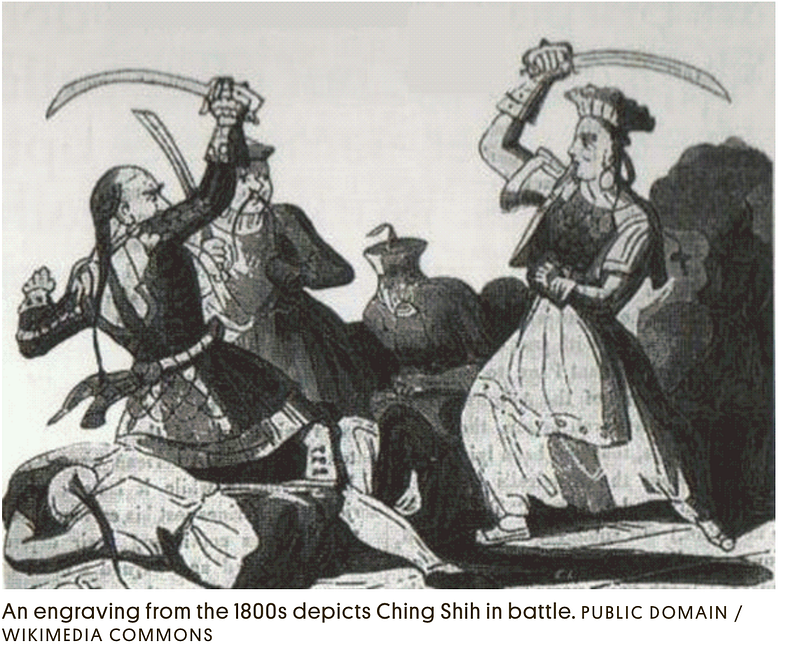
Ching Shih (which means Ching’s widow), also known as Cheng I Sao or Zheng Yi Sao, is arguably the greatest pirate of all time. When she married Ching in 1801, he was the commander of a fearsome group of pirate ships known as the Red Fleet. Ching Shih was known for her business savvy and intelligence and a condition of the marriage was that they would share control of the fleet, which continued to grow and flourish under their joint command. After Ching’s death, she continued to build and solidify the Red Fleet and her legacy far eclipsed that of her husband. “Following his death, she succeeded him and commanded over 1,800 pirate ships, and an estimated 80,000 men. In comparison, the famed Blackbeard commanded four ships and 300 pirates.”
Women on pirate ships were not unheard of in China at this time, but it was certainly not common for them to be in charge. Ching Shih reclaimed power after the death of her husband and instituted a strict code of laws, punishing insubordination with immediate death. Female captives were not to be raped, upon pain of death as well. “Whatever they thought about her, it does seem clear that the pirates respected and obeyed her authority.”
The Quing dynasty, as well as the East India Company, both tried to vanquish her, but in the end, Ching Shih retired voluntarily a few years later, with governmental amnesty, keeping all of her money as well as her freedom. She lived to the age of 69.
Dahteste
Dahteste (pronounced Ta-DOT-se) was a Chiricahua Apache warrior born around 1860. Although she was married and had children, it was reported that she could out-ride, out-shoot, out-hunt, out-run, and out-fight her peers, both male, and female. She took part in battles and raiding parties alongside her husband as well as her best friend Lozen, another famous Apache woman warrior.
Dahteste spoke English well and Geronimo chose her to be his official translator in his talks with the US Cavalry. After negotiating treaties with the US government, she was imprisoned in Alabama and Florida, and later, Fort Sill, where she survived both tuberculosis and pneumonia. Nineteen years later, she was finally released and lived out the rest of her life on the Mescalero Apache reservation where she refused to speak English any longer. Who can blame her?
Nakano Takeko
Nakano Takeko was born in Edo, Japan in April, 1847. Her father was an official of the Aizu Domain, part of the Tokugawa Shogunate and her mother was the daughter of a samurai of the Ashikaga Domain. Beginning at age 6, she studied martial arts, as well as literary arts and calligraphy. “She loved to read the many stories of Japanese female warriors, generals, and empresses, but the legend of Tomoe Gozen deeply affected her.” Tomoe Gozen was another onna-musha, or woman of the warrior class, trained to fight alongside samurai men. She is said to have commanded 300 samurai in a battle against a rival clan and she is a beloved figure of Japanese literature.
During the Boshin war, Takeko along with her mother and sister formed an ad hoc group of female warriors, later to be known as the Jōshitai. They pushed their way to the front lines and fought bravely against overwhelming imperial forces who were armed with guns. Takeko fought with a Japanese polearm called a naginata and she killed five or six soldiers before being fatally shot in the chest. Takeko asked her sister to behead her so that her head would not be taken as a war trophy.
There is a monument to Nakano Takeko that was erected beside her grave at Hōkai Temple. “During the annual Aizu Autumn Festival, a group of young girls wearing hakama and white headbands take part in the procession, commemorating the actions of Nakano and her band of women fighters of the Joshigun.”
The Night Witches
The Night Witches was the nickname of the all-female Soviet 588th Night Bomber Regiment which operated during WWII. Given that name by the Germans, they were so hated and feared that anyone who downed one of their planes was automatically awarded the German Iron Cross medal. The squadron flew rickety plywood planes that were formerly used for crop dusting. They had no radios, braving frostbite, and anti-aircraft guns in order to drop bombs on Nazi targets. The name comes from the whooshing sound the flimsy planes made, like sweeping brooms, as they flew in low to attack. Because the planes could only carry two bombs at a time, the Night Witches often flew between 8 and 18 sorties a night.
Because there was no history of women in air combat, these pilots had to wear hand-me-down male uniforms and boots that didn’t fit as well as deal with rampant skepticism and misogyny. Nonetheless, they were anxious to serve the war effort. Marina Raskova, known as the “Soviet Amelia Earhart” had been receiving letters from women wanting to get more fully into combat and she is the one who conceived of and championed this regiment.
“Beyond their steep learning curve, the women faced skepticism from some of the male military personnel who believed they added no value to the combat effort. Raskova did her best to prepare her women for these attitudes, but they still faced sexual harassment, long nights and grueling conditions. ‘The men didn’t like the ‘little girls’ going to the front line. It was a man’s thing.’ Prowse told HISTORY.”
The Night Witches were the first women military pilots to directly engage an enemy in combat. Most of them were in their late teens to mid-twenties. In addition, all the members of the 588th were women, including the navigators, ground crews, and support staff. They trained for about a year learning skills that typically took several years to master.
“The Night Witches carried no parachutes because they flew so close to the ground and parachutes also added extra weight. They also had no modern instruments and had to rely on maps, compasses, stopwatches, pencils, and flashlights to find their way to their objectives. Because the cockpits were open, the pilot and navigator were exposed to the elements, including rain and freezing wind. In extremely cold weather, they could get frostbite. If they put their bare hand on the fuselage, the flesh might come off when they pulled their hand away. The Night Witches also carried pistols to use if they crashed, but would save the last bullet for themselves so they wouldn’t be captured alive.” Talk about some badass women!
Archeologists have found evidence of female warriors throughout history, although at times they were not immediately recognized as such due to initial assumptions that anyone buried with weapons and armor must necessarily have been a man. I was particularly fascinated to learn in researching this piece that in certain eras and in certain cultures, women warriors were not altogether rare. I hope that in time, the stories of these remarkable women and more like them will become better known.
Here is another story in this series, Impressive Women of History: Scientists and Inventors. Coming soon, Impressive Women of History: Politicians and Social Reformers
© Copyright Elle Beau 2023


