
Management Models: The Johari Window

Most of us probably have an intuitive of sense or grasp of what others think of us. You generally know if someone likes you or dislikes you based on the sort of first impression you make with them, or on the basis some other combination of similarly subjective factors — looks, style, speech, and so forth.
Wouldn’t it be cool to explore a model that gives you a structured way to approach those impressions and interactions with others in a more reliable and consistent way than in comparison to going solely based off intuition?
I think so, and it turns out that there is a systematic way to break human interactions and perceptions down that’s frequently used in management.
It’s called the Johari Window.
While reading a few articles on business management and models of the self relevant to employees, I came across this cool heuristic, and I want to share the ideas with you because I feel that they’re really intuitive and will fit in with what most people already know.
In fact, it’s helped me re-evaluate and visualize my own relationships, leading to a bit more insight.
So to start off, the Johari Window derives its name from a study by Joseph Luft and Harry Ingram in 1955 as a framework or tool to help people better understand and categorize certain interpersonal relations, and it has far-reaching informal and formal usage and applications.
Moving onto the main subject, it’s called a window because the model proposes four quadrants into which interpersonal relations with regard to others and to knowledge of oneself interact. The model is shown below.
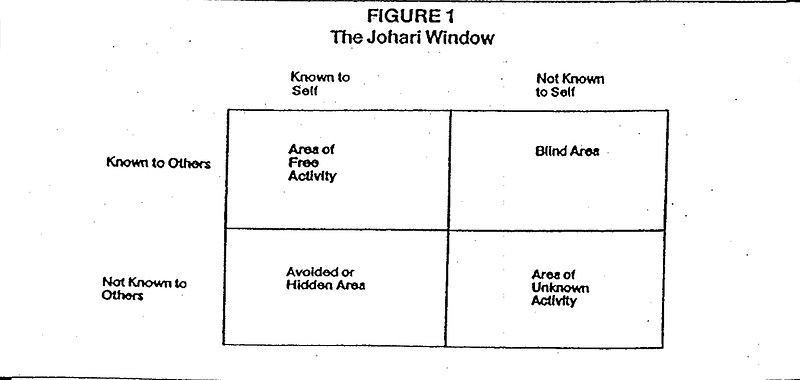
So what’s all this stuff mean? Let’s take a closer look at each of the quadrants.
Each of these quadrants describes a modality and a level of personal awareness.
- The open quadrant (area of free activity). This area consists of things known to both the individual and the people they’re interacting with such as names, preferences, areas of expertise, and so forth. It can reach into more subjective territory as well concerning knowledge about your wants, desires, motives, behaviors, and so forth. You can visualize this quadrant as one that expands in size as you get to know a person and their habits, personality, and other things that make them unique.
- The blind quadrant (blind area). This space represents things that other people know about you but for which you do not know they are aware. In other words, it contains the set of things that I think you don’t know about me but that you actually know about me. A salacious example that might help you remember is a spouse that cheats on their partner with the catch being that the partner knows and is filing for a divorce. Blind areas reduce through communication, like the filing of divorce papers.
- The hidden quadrant (avoided or hidden area). This is the inverse of the blind quadrant in the sense that it captures things that I know about myself but that you don’t know about me. So the list of things you could write into this square might be your weird fetishes or that one embarrassing thing you did as a kid or teenager that everyone’s long forgotten.
- The unknown quadrant (area of unknown activity). I conceptualize this space as a combination of the blind and hidden quadrant in that it represents things that you don’t know about yourself and that other people don’t know about you. Suppose that you’re a grade schooler and you were adopted. Further, your parents haven’t told you yet. In the context of the community of your peers, the status of your birth parents is unknown. There’s probably a better example out there, but you get the idea.
Anyways, the relationship between all four of these quadrants may get very complex at times, and there is a sophisticated interplay between each part of the Johari Window model that Alan Chapman summarizes very well in the picture below.
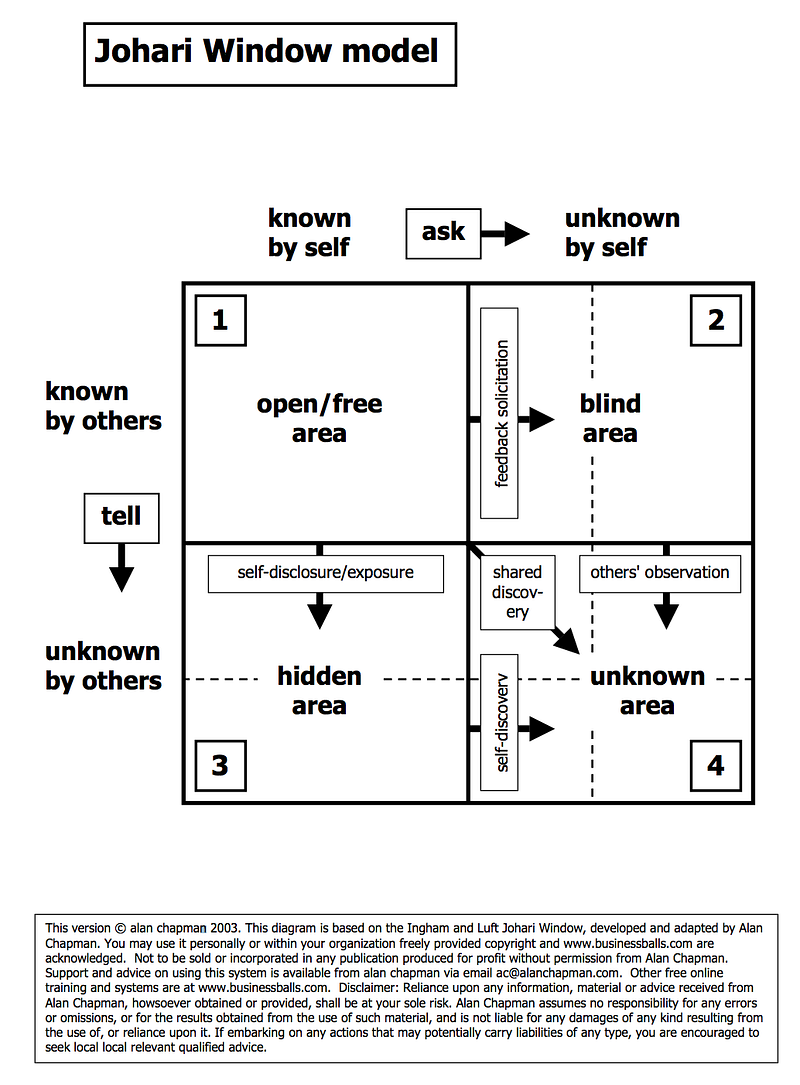
Things can shift around depending on how you see yourself and how others see you. That’s the gist of what these arrows and squares moving around imply. The open areas are always increasing over time and the unknown areas are always decreasing over time (unless something happens like you getting a neurodegenerative disorder that leads to amnesia).
The blind and hidden areas are sort of like a middle ground between the open and unknown spaces which that contract and detract as secrets are created and revealed over time and as people turn from acquaintances into friends.
PS: If you’ve enjoyed my work and want to support me, you can become a Medium member using my link for a relatively low cost of $5 or so per month!

This story is published in The Startup, Medium’s largest entrepreneurship publication followed by 302,074+ people.
Subscribe to receive our top stories here.


