
How Much Do These Top Contributors Really Write?
I’m not sure I believe it, but if it’s true, I want in.

“Here’s how I write X,000 words per day,” or “I just made $X,000 from home.”
Any of these headlines sound familiar?
No disrespect intended to any of these guys and gals who do this, but this topic has been beaten beyond what you could call a dead horse.
And people are still doing it even though to the point where one of these stories probably appears as “from your network,” every other hour.
Guys, I don’t know about you, but I even see some of the same Unsplash photos being used as I browse around Medium.
So, what’s this all say about creativity and content quality?
Consequences of Recycling Headlines for Creativity
Again, I want to emphasize that I have a problem with the trend and the content that it creates, not the people.
For example, I’m starting to think that between this and the “Towards Data Science” publication we have, there could be a collaboration between coders and content writers that use this headline to write a code that generates this specific type of article automatically.
That’s how formulaic I think some of these posts are, but what works works, right?
Let’s break it down.
The Prevalence of the Success Article
I’m going to attach a list of some of the most prominent articles that use this tactic. We have quite a beautiful, long lineup, so I’ll keep it to around five links so we all get the general idea here.
There’s some free publicity for those articles, not that I have a huge base or anything (yet), but if you just go to the Medium search bar and type in “How I…” or “X,000 words”, you’ll get a slew of these articles pop up.
That’s a problem because if you really think about it, if the idea’s been done so many times, even from the perspectives of so many different people, is it still useful?
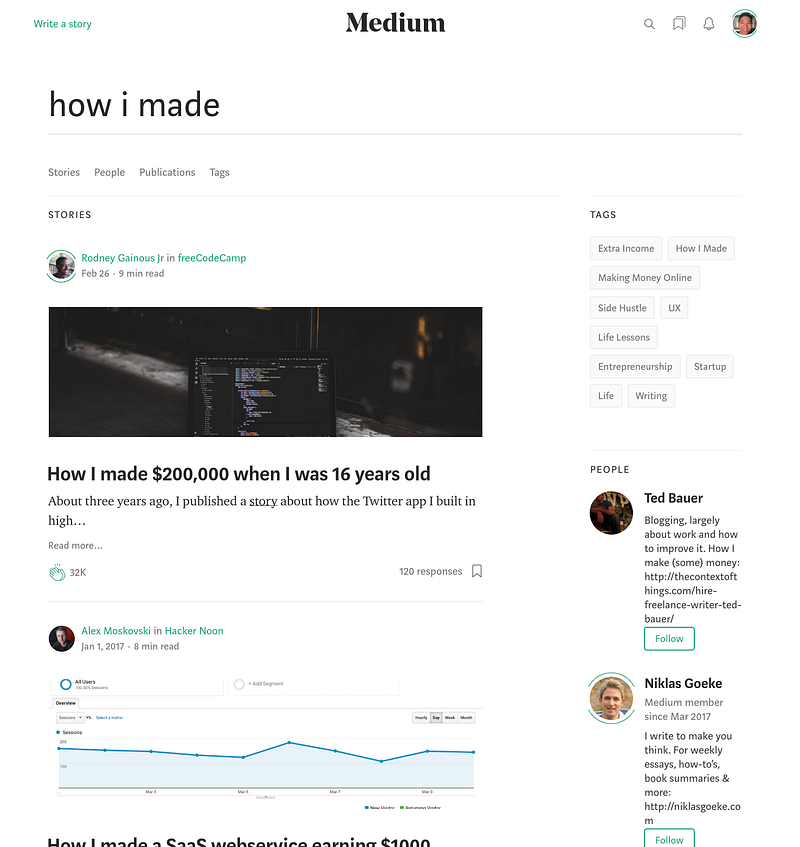
Yet, one thing is for certain — they work.
Apparently money sells to entrepreneurs and freelancers in the same way that sex sells in general, except for headlines.
Tapping into the American Dream
Why does this work so well in grabbing the attention of people? I think it’s because of the values that a lot of users on this site hold as Americans.
We want to live through the success of these individuals vicariously.
The idea that people with the right amount of grit, determination, social savvy, intelligence, and a combination of other entrepreneurially beneficial factors can really make a splash with their content is exciting.
This is especially true with the rise of the gig economy, where more and more people are becoming independent contractors and seeking out the ambitions of starting their own consultancies, boutiques, and businesses.
Everyone really loves numbers, “$2000 a week? That’s impossible. I have to check out it that’s real or not!”
Or maybe, “If he can do it, maybe I can too, let’s hear what he has to say!”
But if the headline was the only thing, that most people would have already left a few seconds after realizing they’ve been duped. There’s usually something more.
Writing You Can’t Stop Reading
Then, they’re led down the rabbit hole of course, because despite whatever these guys claim, one thing is for certain, they’ve got style and personal narratives that are addicting to read.
Once you hit the headline and it piques your curiosity, you click on it. Then the rest of it is a real-time demonstration of the author’s skill.
They have some interesting narrative about how the struck it out and were lucky, or how their persistence finally landed them that big deal. Either way, the content is relatable enough to keep you engaged and wanting to keep reading.
Remember, the goal of any copywriter in the first place involves getting you to read the first sentence, and then the second, and then the third, and so on, and it starts with the headline.
To be honest, it’s my opinion that if you asked any of these guys to continuously produce interesting, non-formulaic, novel works on topics they’re unfamiliar with or not really interested in, that daily word count is probably going to tank immediately.
How Social Writing Feeds On Itself
Part of the reason these people are able to produce this much content, assuming they are producing it, is because they love writing and because they’re experts in one particular area or niche.
One of the suspicions I have, though, is that social writing, and even scientific writing is feeding on itself.
What I mean by that is these writings never contribute anything novel other than the author’s perspective, not to say that individual perspectives are not valuable, but do you really want to read about how the perspective of how ten people see a rock, a moving car, or their success dozens of times over?
The popular outlet Vox seems to report in one of its stories that so much research spending is wasted. The author, Julia Belluz makes the surprising claim that:
“As much as 30 percent of the most influential original medical research papers later turn out to be wrong or exaggerated.”
Although this applies to scientific papers and research journals more than say, blogs, I think that’s one of the key problems that Medium content producers should be aiming to address: originality.
If you really think about it, one of the best times to have joined Medium would have been in early 2016 or maybe even 2017, or perhaps a few months after its inception.
That’s because there would be much less competition and shared ideas bouncing off of every author, or even the case where two authors have the same idea and decide to publish a story on it independent of each other (this has happened for a few Nobel prize discoveries, believe it or not).
The Challenge
Originality on its last legs. Try this experiment.
Find an article that’s liked by 100 unique people and then try to prove that its ideas haven’t been published on Medium or some other website in some form or another already. Use your common sense for what’s redundant.


