Manage your Emotions Better with Yijing (I-Ching)
Ancient Wisdom for Better Mental Health and Wellness
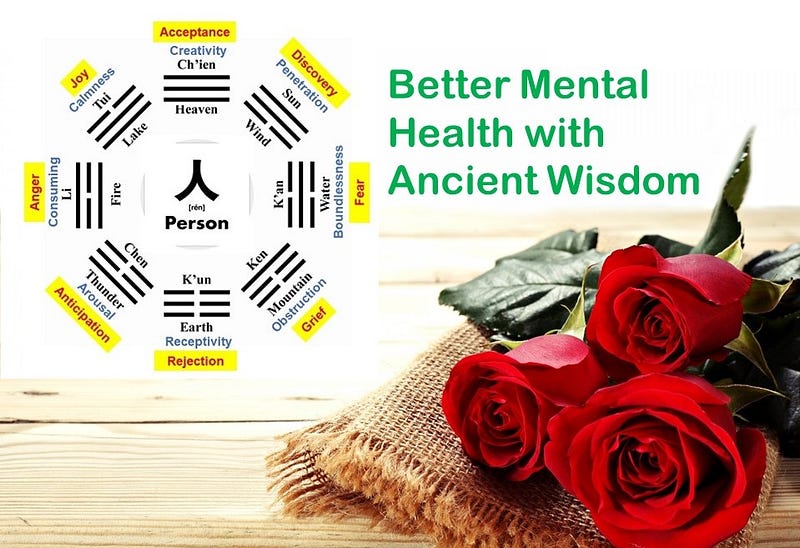
The natural permanent change phenomenon evokes in humans a social-psychological response in adaptation to whatever social contexts one engages with whom and at what intensity level and depth of intimacy of the social relationships. The Yijing (I-Ching) points to adaptive human reactions in the 8 trigrams, which are also paired to reflect the duality energy (qi) generated by yin-yang (push-pull) forces in perpetual flux working to drive the change.
Remember our earlier case regarding Mary and her relationship with Tom? Mary contacted me again after some weeks. She attended a couple of skills upgrading courses, and even applied for some jobs even though she was advised to defer any career decisions. Her restlessness prompted her to act instead. However, the disappointing and fruitless job interviews did not allay her anxieties but instead accentuated them. Her relationship with Tom is progressing well. They have gone on more than one date, and he explains that he has been separated from his wife and pending final divorce proceedings. He however continues to attend counselling with his wife who hopes for eventual reconciliation instead. Tom has already given up their marriage but went along just to support her. Mary was elated with her blossoming relationship with Tom, with whom she also now enjoys sexual intimacy regularly. She believes she is deeply in love with him, but did not care whether the feelings were mutually intensive. She is not thinking about any longer term permanent outcome. She shares more about her feelings and emotions over the previous weeks and seeks my understanding from the Yijing (I-Ching) perspective.
I pointed out that human emotions are capricious and dynamic, therefore usually unpredictable. Another woman in the same context as her social life would have very different emotions and feelings. Mary’s decisions would therefore be very different from any other women.
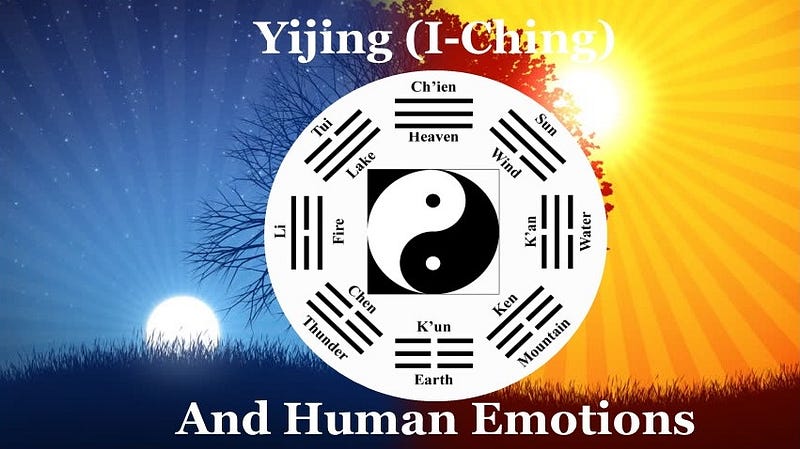
The Yijing (I-Ching) is not designed to predict human emotional adaptive response in any social or life situation. It however observes and identifies 8 basic primary human emotions which could be associated with each of the “kua” of the Bakua. The 8 primary human emotions determine the direction of the interactive weak and strong “yin-yang” forces within the “kua” even as the 8 trigrams activate (agitate, excite, reinforce) each other and with other “kua” in transformational change to restore the natural harmonious equilibrium. The 8 trigrams can be further understood as 4 pairs of opposites in continuous yin-yang interactions; Heaven-Earth, Lake-Mountain, Fire-Water and Thunder-Wind.
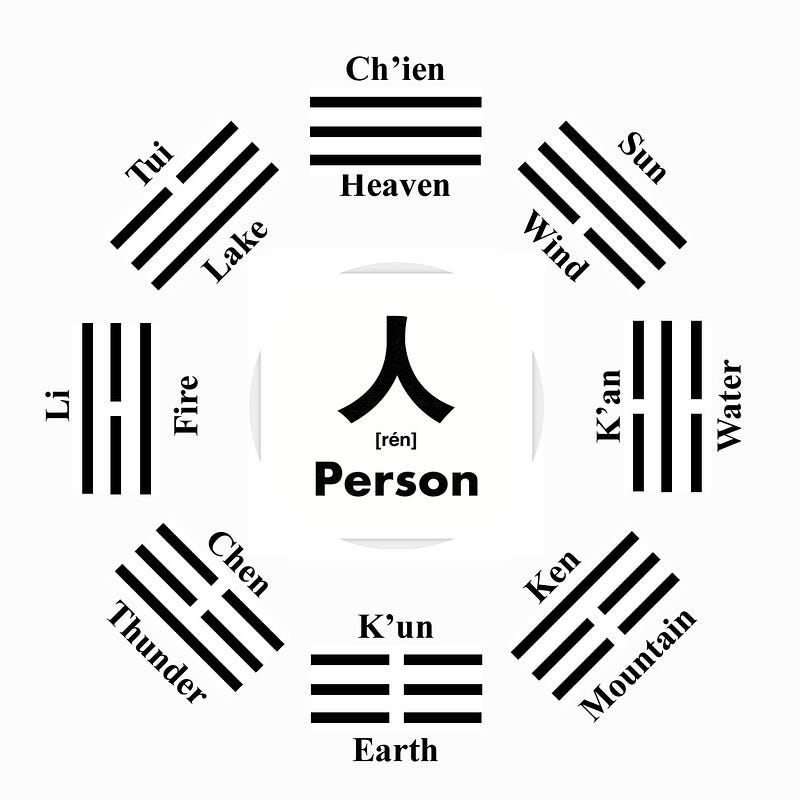
I have placed humans (ren) at the centre of the Bakua. In the human social eco-system, there are 4 existential situational problems with which we struggles daily irrespective of our global geo-position or the socio-economic developmental level of our respective community.
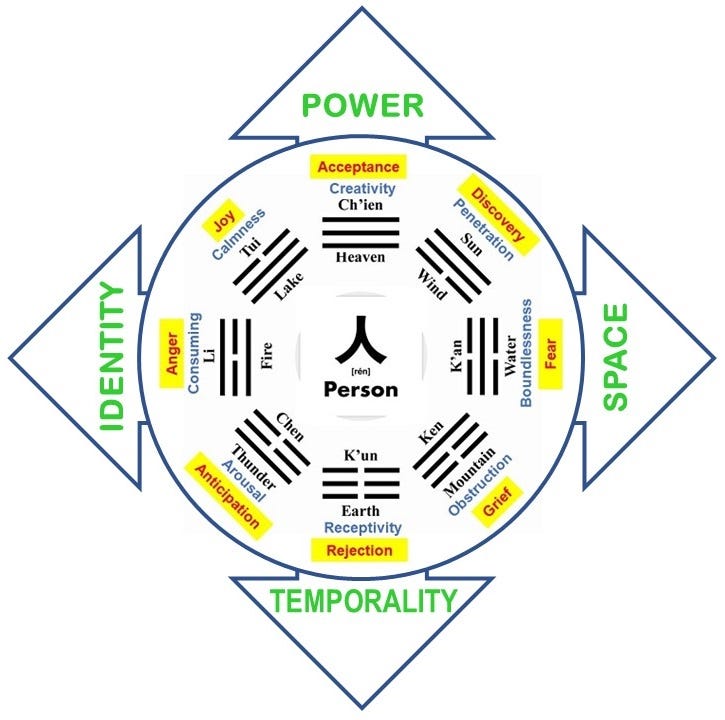
These 4 existential human situations relate to (1) identity, (2) power, (3) space and (4) temporality.
(1) Identity
This evokes feelings of acceptance and rejection. Humans are formed by the creative forces of Heaven. Each person is unique and exceptional. Every person desire and deserve respect and acceptance as unique creature. The person is operationalised on Earth the Receptacle, where competing forces engage furiously to mould conformance and compliance to “standardised” behavior. They create self-serving social categories for human identity by ignoring the natural diversity of human nature. Natural harmony is restored through the balance of Heaven-Earth yin-yang forces by addressing the psycho-emotions associated with acceptance and rejection. Conflicts over identity are further understood by the opposing Heaven-Earth forces of the Bakua.
(2) Power
This evokes feelings of anger as well as fear resulting from the consequences to the structure and stricture of the man-made bureaucratic power hierarchy. Power confers artificial authority and demand subordination. The imbalance of power creates social conflicts as humans respond invariably like Fire to Water. The consuming force of Fire drives the power-hungry towards it and who often cling on to their power positions. They inevitably meet the opposing forces of infinitely boundless Water which draws upon the energies of social injustice and economic inequality suffered by those who fear them and fled from often intolerable control and blatant authority. Power conflicts are better understood by the opposing Fire-Water forces of the Bakua.
(3) Space
This evokes feelings of anticipation from the freedom to explore in unlimited space and territory. The feelings of anticipation are surprised by wonderful discoveries or inventions, or blocked and thwarted by boundaries or rules limiting its freedom. The arousal force of Thunder drives human curiosity in exploration and inventions, initiating excitement of new frontiers, relationships and ventures. The opposing force of Wind, through man-made limits like rules and prohibitions as well as repeated failures from inevitable trials and tribulations, will penetrate the excitement to dent the enthusiasm so as to dampen or extinguish any anticipatory optimism. Emotional, psychological and territorial disputes are further enlightened by the opposing Thunder-Wind forces of the Bakua.
(4) Temporality
This evokes feelings in response to threats to life and the “premature” certainty of death. The cycle of life and death is a manifestation of the endless transformation of permanent change. For those who have had the experience, the fear of losing loved ones constitutes the greatest fear (like drowning in the dark abyss of boundless Water). This is often followed by the most unbearable pain of actually losing a loved one. I know personally these opposing forces of joy and grief well. Grief, sadness and unhappiness can be paralysing and immobilise human actions as it sucks out whatever active energy to block life like the immovable Mountain. Depression, alienation, restlessness and suicidal tendency can stop normal functions and motion, making one passive and listless to feel being trapped under the weight of a Mountain of emotional pain and physical loss. By this, we can understand and appreciate the joy and calmness of the opposing Lake forces. Sadness and joy are the feelings of temporality and they are well understood by the opposing Lake-Mountain forces of the Bakua.
Human Situations and The Emotional Yijing (I-Ching)
Human adaptive response to the 4 basic existential situations in our social life present complex and dynamic challenges to the effective management of positive mental health. The emotional Yijing (I-Ching) can provide a comprehensive template for understanding and analysis. Each human existential situation contains negative-positive or yin-yang forces which impact his adaptive thinking as well as the resulting response action and reactions
The following diagram depicts the natural opposing forces (blue) on the 4 human existential situations (green) and the basic emotions (red) associated with respective decision-making as described above. Know that they are dynamic and it is more important to understand the tendencies of their movement in the change transformation cycle rather than merely their state of being.
In Mary’s case, she has moved from her earlier Bakua positions to new current positions. Her growing fear of finding new jobs, in the event of post-Covid19 retrenchment, resulted in a new trigram. Her first line is fearful but rational action of upgrading training and job interviews, especially without any valid news of imminent layoff, which is a strong pro-active Yang action. Her sense of her job prospect is uncertainty, making her middle line a negative Yin. However, she is less confident than before regarding her 18-years’ experience as an advantage for future jobs. Her previous positive Yang top line has changed to a strong negative Yin. The combination of her new 3 lines (yang-yin-yin) points to ☳ Thunder, which explains the arousal of mixed feelings in anticipation of possible new career beginnings, but the failed interviews also evoke the opposing Wind forces to explain her feelings of ambivalence.
Further disappointments may discourage her and change her first line to a passive Yin energy, resulting in (yin-yin-yin) ☷ Earth, to explain her eventual receptiveness of any change to come, if ever. She needs to stay calm, not fearful until more information is available at a later future date. She faces the existential situations of Space and Identity.
More feelings surfaced in her relationship with Tom. In her new situation, her first line is strong Yang energy from her regular and increasingly intimate dates with him. She has a positive sense of their relationship in not expecting anything, at least, in the short term, another strong Yang middle line. Her outlook of their relationship is non-existent as she is happily enjoying their intimacy without any promises, a strong Yang energy. The combination of her 3 strong Yang lines (yang-yang-yang) points to the creative forces of ☰ Heaven. In her existential situation of Identity, she feels loved and accepted by Tom, which seems to weigh above other considerations.
On one occasion, Mary was angry with Tom and told him not to be dishonest and insincere to his wife by attending counselling with her when he did not have any actual intention of their reconciliation. Mary was in a Power situation and she felt strong and confident in their relationship to exert a superior moral position (Fire) and communicated her feelings. Tom promised to talk to his wife regarding the finality of their divorce. A more complete Yijing (I-Ching) reading will require construction of the hexagrams pertaining to Mary-Tom as well as Tom and his wife.
Conclusion
The Yijing (I-Ching) can incorporate the emotional adaptive response to life’s situations and explain the social psychological underpinnings driving human decisions in addressing social problem conditions to restore the natural harmony of human affairs and relationships. Wholly human subjective response emboldens objective decision-making and empower his conscious and unconscious connection with the true reality of the universe.
The Yijing (I-Ching) is not prescriptive nor predictive. It can explain and elucidate a current situation given honest and sincere input. By understanding the truth of your circumstances using its comprehensive framework, it helps to facilitate the harnessing of the energies involved to restore harmony to your relationships, your mindware and change your life.