
Using the Yijing (I-Ching) Mind-map to Understand your Personal Crisis
A personal crisis is a normal regular life-changing event. It often upsets your comfort level and creates unhappiness, anger, sorrow, depression, helplessness and sometimes inflicts great emotional pain. Anxieties and the fear of uncertainty drive everyone to reach outwards, sometimes upwards, for solutions and wrong answers to obtain the strength to move into the dark and mysterious future.
In a possible future, Mary approaches me to advise on a personal situation. She thinks that she would lose her job after the coronavirus pandemic, and worried about financial security because she may not be able to secure another job at a similar salary level since she is in her late 30’s. She has been working in her company for the past 18 years as a Customer Service Manager. She is also emotionally attracted to Tom, a married but younger colleague who is a Senior Division Manager. He asked a few times and she has agreed to go on a date with him, finally. She contacted me for an unconventional solution approach because she had heard my Talk on the ancient Chinese problem-solving and decision-making methods of Yijing or I-Ching.
This is her case story.
I reminded her that the Yijing (I-Ching) is a personal and relational tool. It has no religious or ideological roots and has been applied to Politics, Economics, Military, Science and Life generally.
At the core of the Yijing (I-Ching) philosophy is the notion of permanent change, an endless fluxing of transformational movement from relative “stability” to radical, sometimes chaotic, disequilibrium before returning to another level of stable order.
The Yijing (I-Ching) Mindware
The Yijing (I-Ching) is a practical mental tool which unpacks and opens numerous philosophical and psychological possibilities for human responsive actions. The goal of Yijing (I-Ching) is to promote and maintain harmony (和), referring to the balancing of relationships and processes between the realms of Heaven and the Human world. The requirements of harmony are presumably known to humans because the mind of Heaven (天) and the mind of Man (人) are considered one (天人合一). The natural environment interacts with Heaven and Mankind through endless change and transformation processes in order to strive towards a state of permanently changing balance repeatedly as a matter of some divine directive.
Holistic harmony is the union of the natural, complementary and opposing forces of yin (陰 or 阴) and yang (陽 or 阳) among things and ideas in the universe in accordance with the Yijing (I-Ching) principle of opposite polarity and duality. All forces in the universe produce either yin (陰) or yang (陽) energy. The Yijing (I-Ching) believes that all human efforts, activities and processes act on the same universal path toward harmony.
Unlike most Western thinking heavily influenced by early Greek philosophy whose central focus is stability amidst change, the Chinese sees and embraces change as the constant character of the universe. The Yijing (I-Ching) was made for man, not man for the Yijing (I-Ching). Man or Ren (人) is the major actor of change through his exercise of human choice and disposition.
In the Yijing (I-Ching) mindware, nature is visualised and represented by things and concepts such as mountains, water, lakes, sun, fire, thunder and wind, but can also refer to ideas that can be grasped, positions that can be determined, situations that can be identified, and processes that can be discerned. The Yijing (I-Ching) develops 8 Trigrams to captures these things and ideas.
It should be noted that Chinese characters are not representation of words, but symbols of ideas and concepts, and therefore by itself or any combination of them is not a representation of what’s literally said, but of the ideas and images they embody.
Bakua — The Yijing (I-Ching) Mind-Map
The opposing forces of yin (陰)-yang (陽) are found in the 8 Trigrams to symbolize the different forces pushing and pulling among one another to form a multi-dimensional and multi-directional change resulting in situational possibilities or action frames represented by the 64 hexagrams of the Yijing (I-Ching). The yin (陰)-yang (陽) forces of change generate the energy (氣) to drive the perpetual transformation cycle of change. I have placed Man (人) at the centre to highlight his central role in responding and managing the permanent change cycle.
It is the interaction of these 8 forces that forms the movement or change of the universe and resulted in your personal crisis, I told Mary.
Together, they constitute the octagonal 8 (ba) areas (guas) or Bakua (八卦) of the Yijing (I-Ching). Each gua (卦) has “yao” (line) symbols consisting of 3 lines each to describe the respective Trigram. Each line in the “yao” symbol (line symbol) is either yin (陰), 2 short lines representing the receptive (female) force of nature, or yang (陽), 1 long line representing the creative (male) force of nature.
The Bakua (八卦) is shown below followed by brief descriptions:
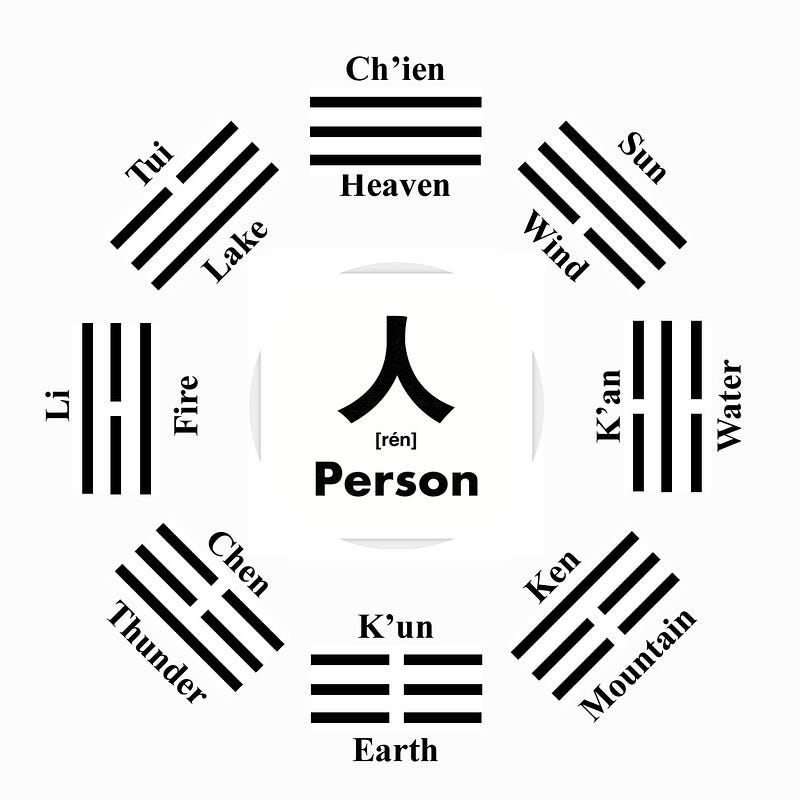
First, qian or ch’ien, symbolizing Heaven, moves straight forward on an upward direction. It is strong and firm, and represents the force of creativity.
Second, k’un, symbolizing Earth, moves in a receptive manner to gently form a peaceful or calm space. Kun represents the force of receptivity.
Third, k’an, symbolizing Water, moves in an undulant manner which represents the revolving revolving watery curves towards an unknown abyss. Kan is then the force of boundlessness.
Fourth, li, symbolizing Fire, moves in an all-embracing manner with an oblique direction. It is the force of consuming.
Fifth, ken or gen, symbolizing Mountain, in a sense is a move to stop an ongoing movement. Gen can be regarded as the force of obstruction — to delay or procrastinate, slow, tardy or defering decision.
Sixth, sun, symbolizing Wind, moves in a relentless pointed manner in a specific direction. Sun is then the force of penetration.
Seventh, dui or tui, symbolizing Lake, moves in a circulating manner which resembles the function of lake as a calm depository. Dui is the force of calmness.
Eighth is zhen or chen, symbolizing Thunder, moves in a rolling manner with a forward direction on a plane that arouses or forewarns. Zhen is then the force of arousing.
The 8 forces of change, namely; creativity, receptivity, boundlessness, consuming, obstruction, penetration, calmness, and arousal (symbolized by the 8 Trigrams), systematically regulate the laws of change embraced by the Yijing (I-Ching). The movement of the 8 trigrams also produces the action frames of the 64 hexagrams. The 8 Trigrams activate (agitate, excite, reinforce) each other as strong and weak Yin-Yang forces engage in continuous transformation, renewal and revival.
It is the confluence and conflation of these eight forces that form the change movements of the universe. They are also “responsible” for favourable and unfavourable outcomes in your life.
The Bakua (八卦) mindmap is derived from the notion of the Wuji (無極), which refers simply to a single point in space at creation. There is no forms or polarities. At creation, the Yijing (I-Ching) considers the universe to be in a Wuji (無極) state.
From the Wuji (無極) emerged Taiji (太極), a Chinese cosmological reference to the “Supreme Ultimate” state of undifferentiated absolute and infinite potential, or the singularity or oneness prior to the duality from which Yin (陰) and Yang (陽) originate.
According to the Yijing (I-Ching),
The Limitless (無極; wuji) produces the delimited (有極; youji), and this demarcation is equivalent to the Absolute (太極; taiji). The Taiji (the two opposing forces in embryonic form) produces two forms, named yin-yang (陰陽) (which are called Liangyi (the manifested opposing forces)). These two forms produce four phenomena: named lesser yin (少陰, shaoyin), greater yin (太陰; taiyin, which also refers to the Moon), lesser yang (陽, shaoyang), and greater yang (太陽; taiyang, which also refers to the Sun). The four phenomena (四象; Sìxiàng) act on the eight trigrams (八卦; Bagua), eight ‘eights’ results in sixty-four hexagrams.
Its original Chinese version:
無極生有極、 有極是太極, 太極生兩儀, 即陰陽; 兩儀生四象: 即少陰、太陰、 少陽、太陽; 四象演八卦, 八八六十四卦。
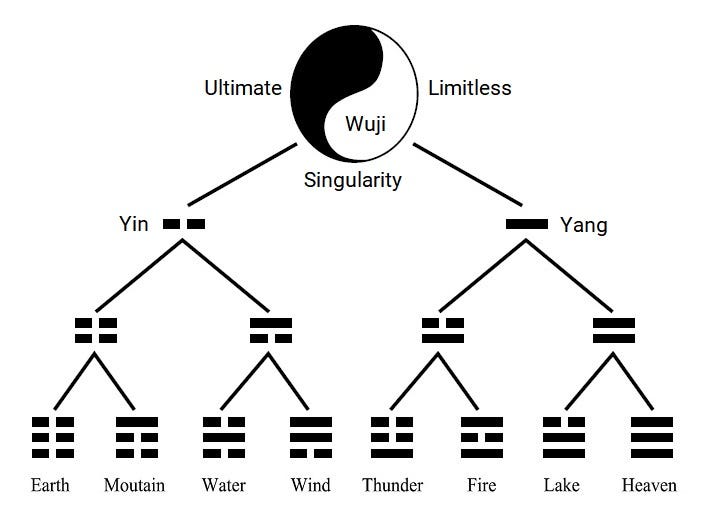
Basically, changes originate in the Limitless or Ultimate; from the Ultimate was created the two spheres. From the 2 spheres, 4 elements were formed and together, they constituted the Bagua (八卦). The Bakua (八卦) depicts the ancient Chinese knowledge of the cosmos and the universe. The Ultimate refers to the origin of all things and creatures. The 2 spheres refer to heaven and earth, or yin (feminine, negative) and yang (masculine, positive). The 4 elements are metal, wood, water and fire, which are omnipresent. The 8 Trigrams symbolize the 8 natural phenomena: sky, earth, thunder, wind, water, fire, mountain and lake.
This is the Mind-map of the Yijing (I-Ching).
The Yijing (I-Ching) is not interested in “what causes what?”. Things happens. They are synchronous or “coincidental”. Nothing actually “cause” them. This acausal approach unpacks alternative thinking and ideas for solutions instead of seeking blame and retribution. It is therefore not concerned with “what happened?” but “what it means?”. It looks into life situations and focuses not on the causal relationship between events, but instead at the pattern of events as a whole. The situational context or ground is everything relevant and material in seeking the right actions to restore balance and equilibrium to the natural order of harmony.
Using the Bakua Mind-Map
The Bagua is a self-referencing tool. Which “kua” best describes your crisis situation(s)? The key to building your own situational trigrams lies in the ability to make a correct assessment of the parties involved, without exaggeration or wishful thinking. Know your motive, be sincere and act with purpose. Remember that the best trigram(s) is only as accurate as the honesty and authenticity of your input.
The role of the three “yao” lines in any relational analysis is as follows:
Bottom line represents the action context of the situation
Middle line represents the affective sense of the situation
Top line represents perspectives of the situation
I presented the initial first analysis of Mary’s situation. She in fact has 2 major situational settings; her job stability and her relationship with Tom. Where is Mary on her Yijing Mind-map? She has a stable and comfortable job like a Lake (Tui) which is now threatened by the Mountain (Ken). Bottom line — she feels insecure and expects or is waiting to lose her job; this anxiety is a passive Yin action. Middle line — her sense of the situation is the uncertainty and fearing to be able to find another compatible job, clearly a negative or Yin energy. Top line — she has 18 years of experience and perhaps with some upgrading training and career counselling, other perhaps better jobs in a related or unrelated field awaits. If that’s her confident perspective in the event of being retrenched, that’s positive Yang energy. The combination of the 3 lines (yin-yin-yang) points to ☶ Mountain (Ken), which would suggest delaying any action decision until more information is available at a later future date. She can however look around for possible opportunities and developmental training courses to attend. As for now, she should remain in the comfortable and stable ☱ Lake (Tui) position.
Mary’s situation with Tom is not simple straightforward. Bottom line — Tom initiated and she finally accepts his repeated date requests, which is a strong (responsive) Yin and weak Yang action, for whatever reason whether because she likes him or because he is a senior executive. Middle line — her sense of the situation is clearly one of caution since he is a married man while his age may or may not matter. Her sense of going on a date with him whom she likes is positive Yang energy. Top line — her perspective of potential romantic involvement with a married man is fraught with risks for herself, her reputation and for Tom even though she may like and eventually fall in love with him. If she thought that one date would not lead to anything, she may be dishonest and insincere, blinded by her emotions consciously or unconsciously — I see this as negative Yin energy. The combination of the 3 lines (yin-yang-yin) points to ☵ Water (Kan), which suggests she might be plunging into an unknown abyss with uncertain (boundless) outcome. The Yijing (I-Ching) conclusion here is however unreliable. We will need Tom’s Yijing’s situation (yao lines) in order to complete a suitable hexagram for a better “read” and understanding. As for now, she has the choice option to go on the date or postpone it, while waiting for a more conducive Yijing hexagram to be rendered from adding Tom’s “kua” to her Water (Kan) position for further analysis.
Concluding Remarks
All Yijing (I-Ching) analysis are ultimately provisional subject to the contingency of human existence in our constant struggle between the “heavenly principle” of harmony and “human desire” from the dictates of the flesh. They embolden a spiritual dimension into our daily moral struggle to empower hope of victory over the daunting challenge of surviving mishaps and failure.
Our lessons from Mary’s case point to the primary focus on finding the constancy in change (buyi 不易) and thereby assuring us that everything is predictable. We are then directed to incessant change (bianyi 变易) which would embolden and empower living with uncertainty and risks (jianyi简易).
We therefore do not have to anxiously suppress or externalise the fear of uncertainty, but face and grasp the fear squarely with humility and confidence. The fundamental takeaway in using the Yijing (I-Ching) mind-map is to provide people the tools to choose and live more meaningfully by becoming aware of the imaginative innovative choice offerings.
THESE BOOKS PROVIDE FURTHER GUIDE TO ENGAGE YOUR PERSONAL CRISIS MORE EFFECTIVELY:
The Living I Ching: Using Ancient Chinese Wisdom to Shape Your Life
The Laws of Change: I Ching and the Philosophy of Life
I Ching Guide for Beginners: Seek Guidance and Wisdom from the Book of Change
.


