
Major Tom … to Ground Control
“There’s nothing I can do”.
The Space Race of the 1960’s Cold War between USA & USSR was pipped at the post when David Bowie released a new album about an astronaut called Major Tom, who’s space rocket lifted off just days before NASA’s Apollo11.
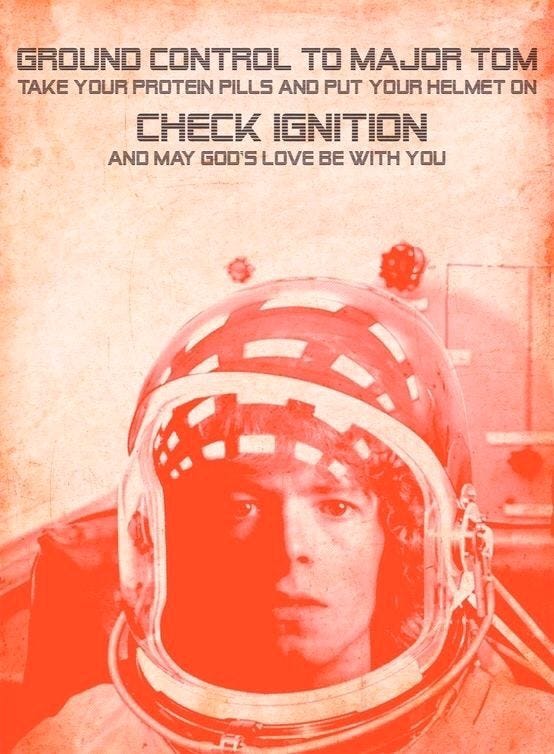
The album, “David Bowie” (later to be re-named “Space Oddity”) was released on July 11th 1969, a mere 5 days before the launch by NASA of Apollo 11’s attempt to put a man on the moon.
***************************************
In the song, Bowie introduces Major Tom, an astronaut who finds himself floating in space, questioning his role in human existence.
The song was so hauntingly ‘realistic’ and Bowie paints such a realistic portrait that for many listeners it was hard to believe that Major Tom only exists in our imagination. Some even asked the question: “Is major Tom a real person?”
If you’ve never heard the song, you might like to check out this Link to hear the captivating lyrics. Bowie’s delivery of the lyrics was so convincing that it left many people thinking that this was a real event.
In the second verse, there’s an interesting example of this reality-focus, when Ground Control says:
“This is Ground Control to Major Tom You’ve really made the grade And the papers want to know whose shirt you wear”
Explanation: This phrase is emphasizing the world-wide newspaper coverage of the event, and, the desire to know which football team Major Tom supports.
If you are not ‘English’, or not familiar with the ‘almost religious culture’ of English Football (soccer to you?), you might ask the question: “What on earth does this question mean?” … totally baffled. Well, now you know!
*****************************************
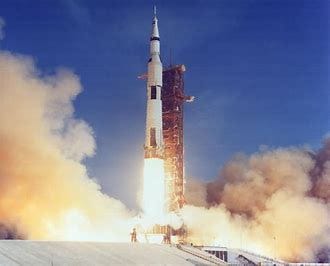
Meanwhile, on July 16th 1969, back on planet earth and just five days after the launch of the Bowie album, NASA’s Apollo 11 Mission was ready for lift-off in the real world. People like me (a young man at the time) watched the event “live” on black & white TV screens at home. Others watched through shop windows and in gatherings in sports grounds (all over the world) because not everyone had TVs in those days.
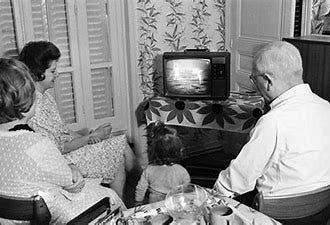
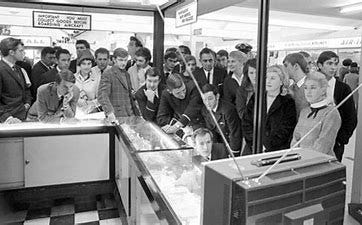
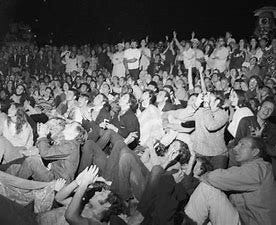
We were watching the first attempt to land a man on the surface of the moon, and return him to earth. An awesome event to watch.
All the world was captivated.
We heard the announcer at Mission Control say:
“5.. 4.. 3.. 2.. 1.. (seemed like ‘forever’) … we have lift-off”
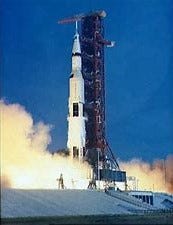
Project Apollo: ‘Apollo 11’ was on its way!
At about the same time, Bowie’s space craft hit a problem …
5 days after leaving earth (“past one hundred thousand miles” says the lyric), Major Tom says:
“I’m feeling very still”, and adds: “I think my spaceship knows which way to go”, then … chilling words: “Tell my wife I love her very much, she knows ..”
Then ground Control: “Ground Control to Major Tom: your circuit’s dead, there’s something wrong”.
Attempts to re-establish contact with Major Tom fail.
Major Tom is alone in space … forever …!
With the lyrics of this song being so persuasively delivered, it was easy to get sucked into ‘believing’ that this was indeed real.
*****************************************
Back in the real world, on that July 16th day, as we watched the Apollo 11 Mission successfully lift-off, we were seriously wondering just how this actual space journey would go.
We had just witnessed lift-off … but what would tomorrow bring?
******************************************
Apollo 11: the real story:
I’ve researched the Apollo 11 Mission quite a bit, and this story, this article of mine, though beginning with David Bowie’s ‘Major Tom’ song, is really about a bunch of very special engineers who played a vital part in helping Neil Armstrong land on the moon in 1969 … and get him back!
Some Background:
In the 1960s, the American National Aeronautics and Space Administration (NASA) gave Grumman Aerospace Corporation the contract to build the Lunar Landing Module, and a team of fine-tuning engineers was assembled to produce component parts for the craft that would be named ‘Eagle’.

One of the engineers who worked on that team, told me what it was like working on the project, and he also mentioned the associated computers. He said: “they were huge container-like structures in an air-conditioned room (probably with less computing power than the modern mini-computers in our mobile cell phones!); they spewed out the technical data and exact measurements to be machined for each part of Eagle that we were working on”.
There were many engineers building the Lunar Module, and at the end of this story, I’ve listed referenced articles that give a fuller technical coverage of Eagle’s production, plus reference to a book about Apollo 11 published in November 2020, about the associated political overtones to the ‘space-race’ of the 1960s.
******************************************
Eagle:
‘Eagle’, the Lunar Landing Module, was a quite small entity when compared to the other parts of Apollo 11’s components, yet it was probably the most vital and essential part, if the mission was to succeed.
To honor that bunch of very special engineers that I mentioned above, I think that my story; this story; the real story, should be titled:
“They Helped Armstrong Land on The Moon”
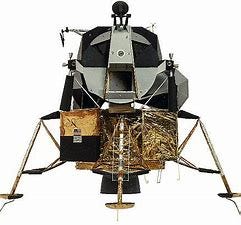
When Eagle’s components were completed, the finished structure could take its place at the top-end of the moon-rocket, between the rocket itself and the command module that would carry the three astronauts:
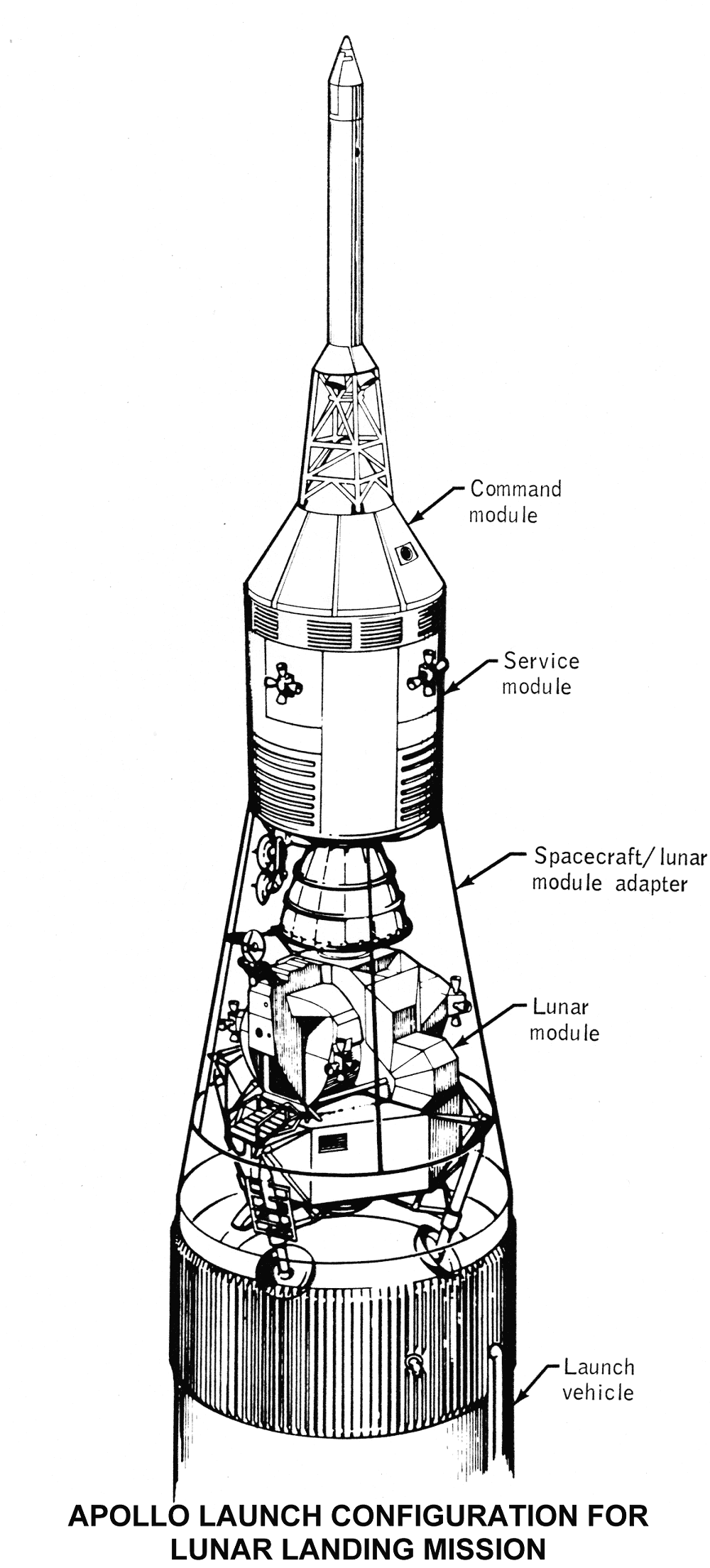
The completed and finished Lunar Module took its place at the top-end of the Saturn V launch vehicle, between that rocket and the command & service modules.
<< Top of the rocket
The accompanying diagram shows the launch configuration.
The command module would carry the three astronauts.
The service module provided propulsion, electrical power and storage for the various consumables required during the mission. An umbilical connection transferred power and consumables between the service module and the command module.
The Lunar Landing Module Eagle, was folded neatly below a smooth covering that would, late in the space-flight, open up. At launch, it was not occupied by any of the astronauts.
As described earlier, the launch and lift-off of Apollo 11 on 16th July 1969 was a success.
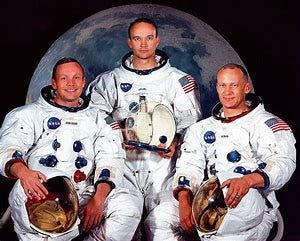
Atop the rocket, housed in the command module ‘Columbia’, were the three astronauts (Neil Armstrong, Michael Collins, and Buzz Aldrin):
Once the various rocket-stages had propelled the craft beyond earth’s gravitational pull, the Command Module (CM), its Service Module (SM), and the Lunar Module (LM) were left to continue the journey to the moon as a combined unit of three parts: (CM;SM;LM).
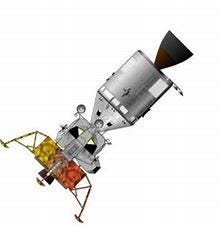
After four days of space-travel since lift-off, this combined unit was close enough to the moon’s gravitational region to prepare for the moon-landing. The unit split apart, twisted around in a controlled maneuver, and the CM was positioned right next to the LM, forming a new configuration: (SM;CM;LM): All three astronauts were still inside the CM.
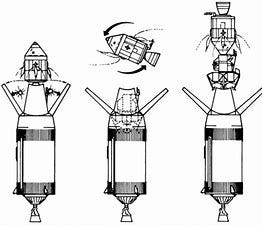

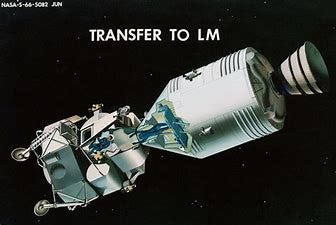
All three astronauts were still in the Command Module (CM), but now, Armstrong and Aldrin were able to transfer from Command Module into the Lunar Module through the interconnecting tunnel … seen here in diagram:
Eagle then separated from Columbia to prepare for the moon landing, leaving Collins to continue circling the moon in Columbia, ready to receive the other two back (if they managed to get back!!), so that all three astronauts might return to earth … the ultimate aim.
Eagle flew over the moon’s surface looking for a suitable landing site:
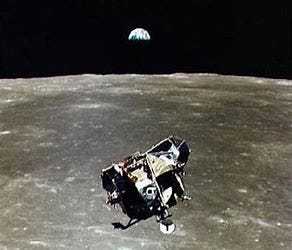
When a suitable landing area was identified, Armstrong & Aldrin made a successful landing on the evening of 20th July 1969, and some 6½ hours later, in the early hours of July 21st, they were ‘ready’ to emerge … Armstrong lifted the hatch and, dressed appropriately, he began to descend the ladder fixed to Eagle’s side … He was about to take mankind’s first step on the moon’s surface.
At home, and all over the world , we watched the grainy-black & white pictures on our small TV screens. This is what we saw:

It was a truly awesome moment. Then we heard Neil Armstrong’s now-famous words as his feet touched the moon’s surface at the foot of the ladder:
“One small step for man; one giant leap for mankind”
**************************************************
Finally, to emphasize the role of those special engineers from Grumman, here’s my closing tribute:
“One small step for man; one giant leap for mankind …………… and one great relief for the Grumman engineers”
Thank you, guys
***************************************************************
Postscript … The 50th Anniversary:
In 2019, a re-enactment of the Apollo 11 event, from rocket launch on earth to lunar module landing on the moon, came in the form of a new movie: “First Man”, released to coincide with that 50th Anniversary.

The movie was based on a book (first published in 2005) titled FIRST MAN: The Life of Neil Armstrong, (a biography of Armstrong by James Hansen)
The film re-tells the story of the Apollo 11 project … The story of 3 astronauts (Neil Armstrong, Buzz Aldrin & Michael Collins), a rocket (Saturn V), a command module (Columbia), and a Lunar Landing Module called Eagle.
**************************************************************
Researched sources and links:
(Lunar Module Articles with added references):
Milestones: Engineering and Technology History by ETHW
Engineers Remember the Making of the Lunar Module by Jeff O’ Heir
For a Political perspective: How the USA used space exploration as a propaganda weapon in the Cold War by Teasel Muir-Harmony (Curator: Smithsonian National Air & Space Museum) … (Basic Books, New York)
***********************
“Major Tom … To Ground Control” * by Fred: Almost Famous * * * * * © Fred Ogden 2021 * * * * * Email: [email protected]

* * * (Feel free to share it on social media if that’s your scene) * * *
You can also Clap & Comment (via icons at top or bottom of this article)
******************************************
NAVIGATION PANEL: TO EVERYTHING FRED: (clickable links)
- All You Need to Know About Fred (including an Index to Fred’s Stories)
- New Index to ALL Fred’s Story Collections
- Get Fred’s new stories delivered to your email inbox … There’s no charge
******************************************
- Follow Fred on Medium: 👉 Fred’s Follow-button (top of all his stories), and he’ll click YOUR ‘follow’ button if he finds your stories appealing.


