
Maidan
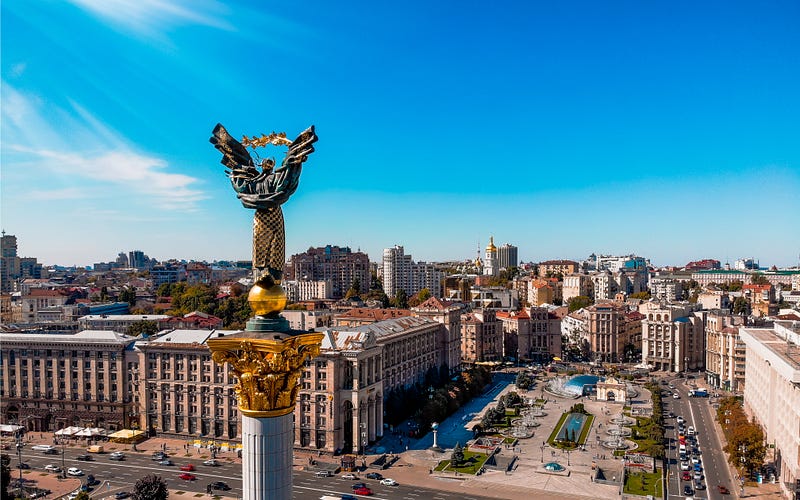
The square below is maidan Ukraine (groan)
Today’s New York Times Spelling Bee letters:
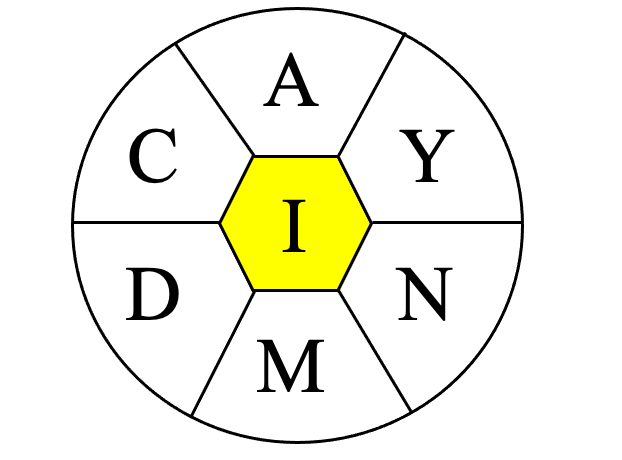
A, C, D, M, N, Y, and center I (all words must include I)
Merriam-Webster says…
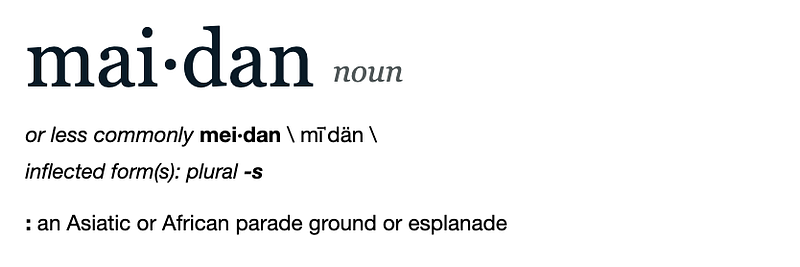
Silly little dictionary! Don’t you know that maidan can’t possibly be a word if The New York Times says it ain’t?
For further fascinating facts, check out the Spelling Bee Master.
What’s your favorite dord* from today’s puzzle?
My Two Cents
The bad pun in the subtitle of today’s article (maidan Ukraine) works only based on an incorrect assumption about the pronunciation of maidan. In other words, one would pronounce it MADE-in for the dad joke to make sense. But actually, the word is pronounced something like my-DAN or mey-DAWN, depending on whether you’re using the European or Hindi version.
The photo at the top of today’s column shows Maidan Nezalezhnosti (literally “Independence Square”), the main square of Kyiv (Kyev), the capital of Ukraine. Maidan Nezalezhnosti has been the site of some important political protests, the most recent and notorious being 2013–2014’s Euromaidan, a three-month uprising against the government of Viktor Yanukovych. The protest ended with his ousting, but not before almost 100 protesters and over a dozen police officers were killed in clashes.
The New York Times covered these events extensively, which makes one wonder why the word maidan was not accepted as a valid word in today’s Spelling Bee.
What’s in a name?
Our friends at Merriam-Webster explain that maidan comes from the “Hindi maidān, from Arabic”. Which is very succinct, yes, but also very incomplete according to other sources. The best one I found was an article written in 2016 by Thomas M. Prymak from the University of Toronto, published in the very interesting and unusual blog of the Toronto Galician Genealogy Group, also known as TORGGG. As Prymark explains:
…“maidan”… is a loanword into Ukrainian (and also to a lesser degree into Russian) from Turkish, or rather from the Turkic languages of Central Asia. In those tongues, a maidan was an open place where trade or military exercises took place… even in the Turkic languages “maidan” is not a native term, but rather is a loan word. In fact, it came into the Turkic languages from Persian (an Indo-European language), where it had pretty much the same meaning… This loan took place because the nomadic Turks and settled Iranians were in close contact with each other in central Asia from very early times. Seemingly from Persian, it also entered Arabic (probably shortly before, or after, the Muslim conquest of Iran in the seventh century), was given an Arabic twist by those early Arab conquerors, and then re-entered Persian in a slightly different form.
Wow! Talk about a convoluted origin. And as the old TV ads said: but wait, there’s more! According to some experts, maidan may have started off as an ancient Aramaic word that spread throughout the rest of the Middle East and Asia. Other scholars believe it was originally an Arabic word derived from the verb madda (to pull or to stretch). A third camp thinks it has a purely Persian origin, from an Old Persian word meaning “middle”.
Today the word is used across Asia and Eastern Europe mostly as a name for towns and villages, and even municipalities. However, there are plenty of squares also named maidan, some of which we’re not aware of as English speakers. For example, the famous Tahir Square in Cairo, a focal point of the 2011 Egyptian Revolution, is called Mīdān at-Taḥrīr in Arabic.
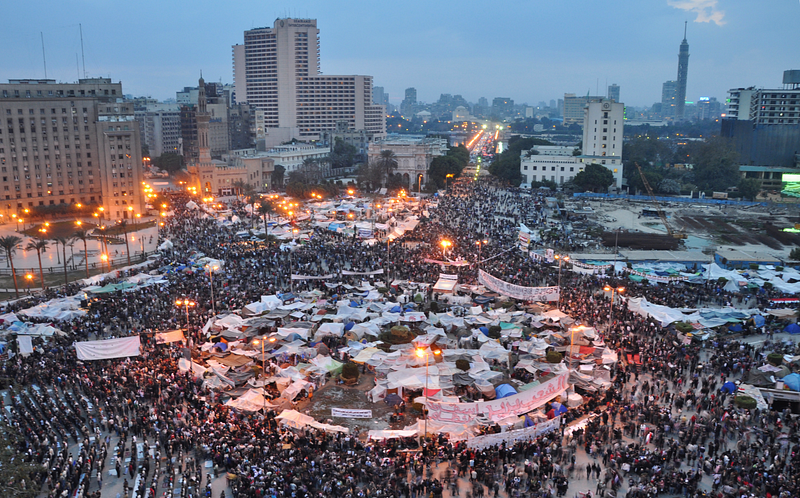

The above photo was shot on February 9th, 2011, two weeks into the protests.
The real McCoydan
One of the first and oldest maidans still in existence is Naqsh-e Jahan Square (Maidān-e Naghsh-e Jahān), which translates to “Image of the World Square”. It’s located in the city of of Isfahan, Iran, some 250 miles (400 kilometers) south of Teheran.
It was built mostly in the early part of the 16th century when when Shah Abbas the Great, the 5th Shah of the Safavid dynasty, relocated the capital from the north-western part of his empire to the more central city of Isfahan. The new location needed a makeover, however, so Abbas did just that in one of the greatest architectural endeavours in Persian history.
Within that plan, the maidan, or central square, allowed the Shah to have the three main components of power in Persia close at hand. The Masjed-e Shah, or Shah Mosque, represented the clergy; the Imperial Bazaar reflected the power of the merchants; and the Shah’s himself had his residence in the Ali Qapu Palace. Below is a drawing of the Great Bazaar made in 1703.
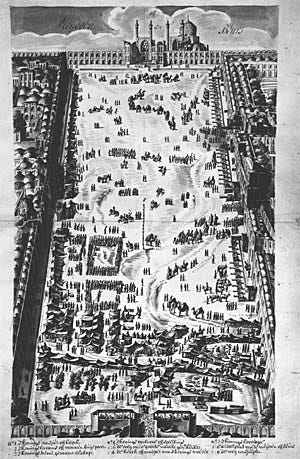
The city of Isfahan had been originally set along the Silk Road, so it served as an important economic and cultural crossroads of the Western and Eastern civilizations of the time. The maidan was especially admired by the Europeans who visited the new capital of the Shah’s empire. Below is an illustration of the Naqsh-e Jahan maidan by French architect Xavier Pascal Coste, who traveled to Iran with the French king’s embassy in 1839.
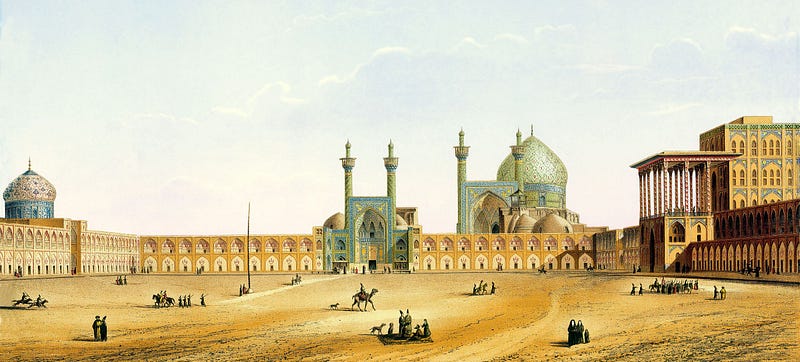
Today this maidan is considered an important historical site, and a UNESCO World Heritage Site since 1979. It measures 520 feet (160 metres) in width and 1,840 feet (560 meters) in length, which gives it an area of close to one million square feet (almost 90,000 square meters.
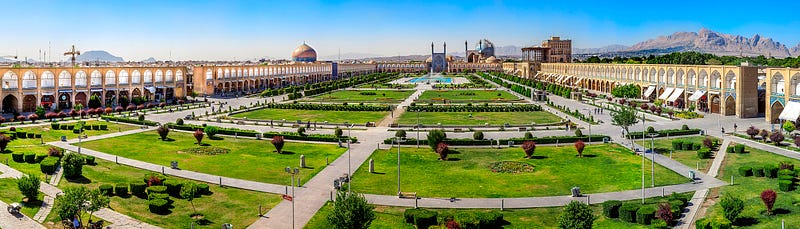

If the above panoramic isn’t enough, though, you can enjoy a 360-degree virtual tour of Naqsh-e Jahan Square by clicking on this link.
That’s it for today. Hopefully the war against Ukraine will be over sooner than later, and the country will be able to rebuild. Maybe then you or I can safely visit “Independence Square” in Kiyv. We just won’t be able to call it a maidan… because the editors of the Spelling Bee decided that maidan is a dord*.
You can check out my previous entry on another dord* here:
*What the heck is a dord, you ask? Here’s the answer: