Data Driven Architecture
Machine Learning Architecture
What Is the Future of Architectural Design In the 21st Century
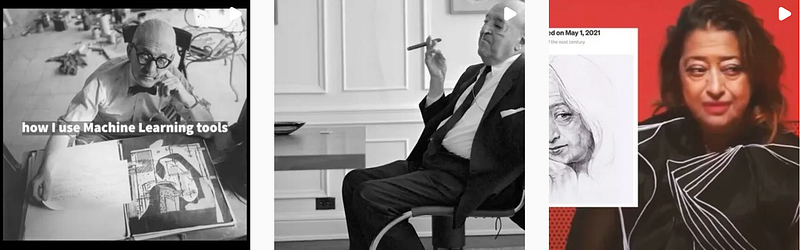
The story is about the birth of Machine Learning architecture and how each of the three architects developed their own AI style. We tried to figure out how to teach AI to make architecture without mimicking existing styles. Their approach is a bit different from the typical Machine Learning approach because they involve humans in the process from start to finish. The NEXT TOP ARCHITECTS community powered by MLearning.ai has started a project that opens a new era in architecture design. Machine learning models create a new chapter in AI architecture, drawing on world heritage. Machine Learning architecture offers the same possibilities and opens up a new era for architecture to be reinterpreted.
On the one hand, it is a recognition of the value of world heritage, and on the other hand, it is an attempt to change the way we design. It’s a transformation in seeing legacy and more profound regard for earlier generations. In this manner, by using art to train AI, we can effectively demonstrate how ML can transform the history of architecture. This is not merely a replacement of engineers with AI. But a new era that melds the past into the future. We have started an open community to complete this project. We invite architects to make their style a subject for training AI. We hope you will join us to create a new era in architecture design. Architecture has always been the result of human creativity and imagination, and with machine learning, this can be dynamically changed at any time.
Famed architects Zaha Hadid, Le Corbusier, and Ludwig Mies van der Rohe were all architects with very different styles.
Zaha Hadid
was an Iraqi-British architect who studied at London’s Architectural Association School of Architecture. She is known for her unusual style and is the first woman to win the Pritzker Prize, awarded in 2004. Her most famous projects include the MAXXI Museum in Rome, which opened in 2009. 520 West 28th Street, designed by ZHA , a building on New York’s High Line
Le Corbusier
was born Charles-Édouard Jeanneret-Gris. He was an architect known for his focus on humanity’s relationship with nature. He was born in France and received several significant awards and commissions. In 2016, 17 Le Corbusier structures in 7 countries were named UNESCO World Heritage Sites for their “outstanding contribution to the Modern Movement.”
Ludwig Mies van der Rohe
was born in Germany and is considered to be the father of modern architecture. He was educated in Germany and studied at the Royal Academy of Fine Arts in Munich, Germany. He worked in Berlin as a freelance architectural draftsman before entering architecture school. Mies’ final project was the Neue Nationalgalerie, Berlin’s National Gallery.
This story of the birth of Machine Learning architecture reminds us that it is not enough to look at aesthetics. Architecture has always been about more than just how any building looks. It was never about what seemed like the most beautiful design but about how it makes you feel when you walk into and experience it.
It wasn’t always easy for these three brilliant architects, but they persisted, and their efforts have made strides in new directions in architecture with Machine Learning in their approaches.