
Macaco/a
A monkey, a martial arts technique… and an infamous slur
Today’s New York Times Spelling Bee letters:
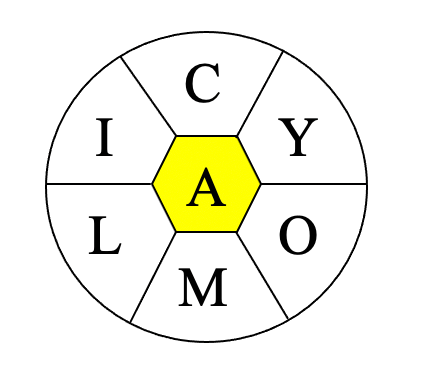
C, I, L, M, O, Y, and center A (all words must include A)
Merriam-Webster says…
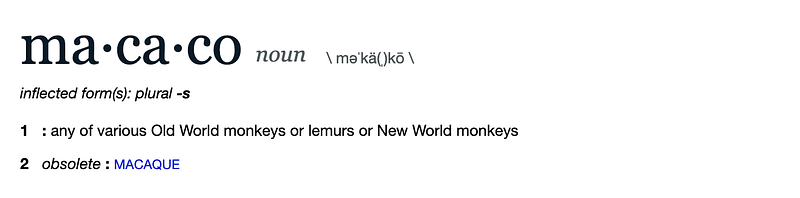
Silly little dictionary! Don’t you know macaco can’t possibly be a word if the New York Times says it ain’t?
For further fascinating facts, check out the Spelling Bee Master.
What’s your favorite dord* from today’s puzzle?
My Two Cents
The word macaco should conjure up only positive feelings. It’s related to cute monkeys, after all, as well as a martial art with UNESCO cultural heritage status and a multicultural musical project.
But it also has an ugly history as a racial slur that was brought to the forefront of American consciousness in the 2006 United States Senate election in Virginia.
Old World monkeys and New World martial arts
Macaca is a genus of monkeys that has 23 species in Asia, North Africa, and even Gibraltar. The English word for this genus is macaque. These social primates arrange their social groups around dominant females, are found in a bunch of habitats, and adapt very quickly and easily to new environments. A few species have even learned to live with humans and have become invasive in some cases.
The type species (the species that contains the biological type specimen) is the Macaca sylvanus,or Barbary macaque, but there are other interesting species, too.
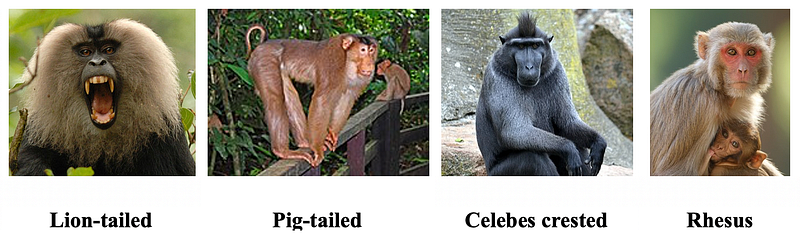
That macaque all the way on the right, the rhesus, has been used extensively in scientific research. The Rh blood group system we commonly use (positive/negative) is named for the monkey because Karl Landsteiner and Alexander S. Wiener, who discovered it in 1937, believed it was a similar antigen found in rhesus macaque red blood cells. (It was later proven that the monkey and human factors were not identical.)
The macaco is a move in the Brazilian martial art of capoeira that originated during the 16th and 17th centuries as a way for African slaves to survive in a hostile environment when they were able to escape their Portuguese colonial owners. The slaves who had managed to liberate themselves established their own settlements, known as quilombos, in places that were hard to reach. Quilombos grew and expanded when more fugitive slaves, Brazilian natives, and even some Europeans escaping the law joined them.
The macaco is basically a back handspring in which the capoerista starts from a low crouch with one hand towards the back. The move is known as the “monkey jump”; hence macaco, which means “monkey” in Portuguese.
Amy Bond wrote an interesting piece on the macaco move right here on Medium, and included several instructive videos. Check them out!
Macaco is also the stage name of Daniel Carbonell de las Heras, a Spanish musical artist born in Barcelona. His music is a mix of rumba, reggae, and funk. He started out as a street musician and was able to recruit artists from Brazil, Cameroon, Venezuela, and Spain to start his own multicultural project, also known as Macaco. His songs feature lyrics in several languages, including Spanish, Portuguese, French, English, Catalan, and Italian.
A man “ahead” of his time…
In 2006, George Allen, former Virginia governor and son of NFL hall-of-fame coach George Herbert Allen, was running for reelection as a U.S. senator on the Republican ticket against Democrat James H. Webb, Jr., former Secretary of the Navy. On August 11, at a campaign stop in Breaks, Virginia, Allen said this about S. R. Sidarth, who was filming the event for the Webb campaign:
This fellow here over here with the yellow shirt, Macaca, or whatever his name is. He’s with my opponent…. Let’s give a welcome to Macaca, here. Welcome to America and the real world of Virginia.
S. R. Sidarth did not need to be welcomed to America or Virginia, having been born and raised in that state. But I guess he did receive a good dose of the “real world” of hate speech when several people in the audience applauded Allen’s comments.
As I mentioned earlier, macaca (feminine) and macaco (masculine) are the Portuguese words for “monkey”. Unfortunately, in Portugal and Portuguese-speaking countries, macaco had been frequently used as a racial slur against black people. Historically, a similar French term — macaque — was used as an epithet by Belgians when referring to people in African countries during the time they were colonies of the European nation.
The video of Allen’s speech went viral and he was forced to issue an apology a couple of weeks later. However, it’s likely his racist sentiment ended up making the difference in an election he lost by less than half of one percent of the vote. This despite the fact that he ran a blatantly right-wing campaign during which the Marshall-Newman Amendment, defining marriage as solely between one man and one woman, was also on the ballot.
Allen was a decade “ahead” of his time, and those quotes around the word ahead are meant to be sarcastic and cynical. If 2016 proved anything, it’s that polarizing and prejudiced comments now get you more votes and support. I can’t imagine Allen losing an election in Virginia today after saying what he said ten years ago.
Heck, he’d probably endear himself to many people. The sad truth in politics is that the more things change, the more they stay the same. Politics is just an eternal Broadway play in which different actors play the same roles. Our societies seemed to slowly progress in the late 20th century only to enter into a slow but sure regression at the beginning of the new millennium.
Who knows… perhaps that’s why the editors of the Spelling Bee decided that macaco should remain a dord*.
You can check out my previous entry on another dord* here:
*What the heck is a dord, you ask? Here’s the answer: