

Lying in the Gutter and Gazing at the Stars
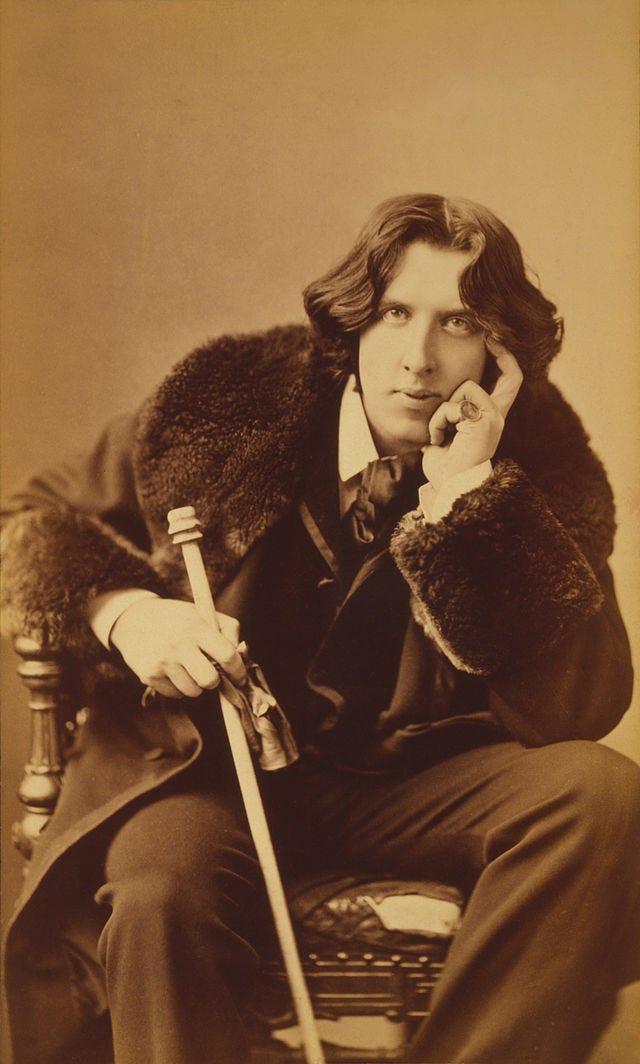
They say that the ghost of Oscar Wilde haunts the Waverly Inn. Let’s go and see, shall we?
I took a look at the obligatory pamphlet, which detailed the history of the establishment where I would be spending the evening.
Originally constructed back in 1865 — (yadda-yadda) — the Waverly Inn was one of the oldest hotels in the Nova Scotia city of Halifax.
Blah-blah-blah.
I had intended to get myself a room in a more modern hotel. Somewhere with actual working air-conditioning, room service that you could count on, and an indoor swimming pool and a weight room that I could feel guilty about not putting to use. However, I had waited until the last minute to call for a reservation, and a huge local blues festival had filled every hotel that was handy to the downtown area.
It was a little hard to believe. I mean, how many syncopated sob stories spun in 4/4 time led by a stoic walking bass background could any person listen to?
I had already sung my own sad version of my alibi to the desk clerk.
“You waited until the last minute, didn’t you?” asked the desk clerk, a balding fire plug of a man with eyes that peeped through a pair of black horned rim glasses, and a moustache that looked as if it had been sketched in with an eyebrow pencil.
I shrugged.
There was no point in lying about it.
“Nobody ever expects our little port city to be such a booming concern,” the desk clerk went on. “Still, I can’t berate you more than I already have. Procrastination isn’t that bad of a habit. After all, it was Oscar himself who said, ‘I never put off till tomorrow what I can possibly do — the day after.’
“Who?” I asked.
“Oscar,” the desk clerk said, with surprise in his voice. “Oscar Wilde. I guess you haven’t read all of the way through our historical brochure.”
“I guess not,” I said. “Just what exactly did I miss?”
“Only the number one reason why folks love to stay here at the Waverly Inn,” the desk clerk explained. “We have been known to be haunted by the ghost of Oscar Wilde, since his very first visit back in 1882.”
I barely resisted the urge to ask the man who was going to call — Ghostbusters?
“Oscar Wilde,” I said. “You mean the writer.”
The desk clerk laughed with barely enough disdain to be called rude.
“I mean Oscar Fingal O’Flahertie Wills Wilde — the poet, the playwright, the performer and philosopher.” The desk clerk sermonized. “The author of The Importance of Being Earnest, The Happy Prince, Salome, The Selfish Giant, and of course who could forget that blood-chilling novel The Picture of Dorian Gray?”
Oh God.
A fanboy.
“But of course,” I replied, trying to hide my disdain of this supernatural song and dance. I was sure this would both beguile and bewitch the average trailer park tourist, but all I really wanted was to spend the evening enjoying a comfortable snooze.
“Mind you,” the desk clerk went on, entirely unaware of my total lack of interest. “He only stayed for a couple of nights. He gave a talk at the Halifax Academy of Music. Unfortunately, his choice of topic failed to gather a suitable crowd. Bluntly put, he bombed. So he left Halifax, but his ghost has been seen here night after night in Room 122 — also known as the Oscar Wilde room.”
“The whole thing sounds rather terrifying,” I allowed, assuming that was the reply that the desk clerk hoped to hear.
“Oh no,” the desk clerk said. “He hasn’t really terrified anybody, as far as I have heard. He is often seen reading a book, probably one that he wrote.”
“So,” I said. “May I have the key to my room?”
“Certainly,” he said. “And you are in luck tonight. The room had been booked but there was an unexpected cancellation, and I am happy to tell you that you will be spending the evening in the much sought-after comfort of Room 122 — the Oscar Wilde room.”
“Oh joy,” I said sarcasticly, taking the key and heading upstairs. “Yippee, skippy, hooray.”
#
I drew back the curtains and lay back in my rented bed, closing my eyes and trying very hard to pretend that the raucous music blaring out of the blues bar across Barrington Street was actually some sort of a primeval brass and steel string lullaby.
“Does the music bother you?” a soft British accented voice spoke out of the heavy darkness. “It usually stops by 2 am. You will get some sleep after that.”
What the hell?
I opened my eyes warily.
“Who is there?” I cautiously asked.
“Is that really the very best question that you could think of?” the voice replied. “I should think you might do much better than that rather simplistic interrogative.”
I blinked, squinted, and blinked again; and then, as my vision cleared I saw a tall heavy looking man standing in the center of the room, dressed in a garish green bathrobe and carrying a massive ancient volume.
“Who are you?” I asked. “And what are you doing in my room?”
He ignored my questions, turning instead to look out of the window. He stood there, lit by the glance of moonlight. He raised his head proudly, as if he were posing for a portrait in oil.
“Is that really supposed to be music that I hear?” he wryly asked.
“It’s the blues,” I answered, still trying to decide if I were dreaming or if this was some sort of a sleep-deprived hallucination. “It is supposed to be music, or at least it is considered music by some.”
“Blue is it?” the tall man asked. “I rather prefer the color green myself; or perhaps a brisk and breezy lime or a piquant avocado? Blue is such a very cold and lonely color.”
I shook my head carefully. Was I dreaming? Was this a sophisticated break-and-enter artist or just the world’s tallest and homeliest chambermaid? I should have been terrified to find a stranger in my hotel room, but in truth I was oddly intrigued and curious.
“I rather think that’s supposed to be the point of the music,” I suggested. “I believe it’s supposed to sound sad.”
The tall man nodded, carefully considering my theory.
“Would you like to hear what I think of music?” he asked, and then before I could say yes or no to the question he continued with his answer. “I believe music is the art form closest to both tears and memory — and I’m afraid this particular form of music is closest to bringing me to tears of grief for the injustice done upon Euterpe the muse of music, but what else can you expect from the barbaric melancholy that men call America?”
“We’re in Canada, actually,” I pointed out. “America is further south.”
“There’s no real difference between the two, as far as I’m concerned,” the tall man said. “A border does not change a thing.”
“I ought to feel a little bit insulted at that remark,” I admitted. “You are the most impudent sort of a dream that I’ve ever experienced.”
“Is that really what you think I am,” he said, with a crooked grin of ironic amusement. “An impudent sort of a dream, am I?”
“Either you’re a dream or else there was something of a hallucinogenic nature hidden in my supper plate; something that I really should have avoided digesting.”
He struck another regal pose. It felt to me as if he were standing upon an open stage — the star of all he surveyed, and my only task was to stand there and stupidly stare.
“Dreams are nothing more than stories your imagination tells to your mind to while away the tedious hours of simple and bleak existence,” he said.
“Wow,” I said with a grin of my own. “You really are a cheery sort, for a dream. Are you always trying to impress people whenever you speak?”
“Forgive me,” he replied. “I make it a habit to speak so cleverly sometimes I don’t understand a single word I’m actually saying. Don’t tell anyone my secret, will you?”
“I have the same problem with my in-laws,” I replied ruefully. “They keep on talking no matter how hard I try not to listen.”
The tall man laughed softly. His laughter sounded a little like the first few drops of rain splashing down upon an open meadow. I was puzzled at how oddly poetic I found himself thinking around this man.
“So you are a married man,” he said. “I was married too, once.”
“What happened?” I asked.
“Marriage happened, actually,” the tall man said. “You see, I have the belief that a man should always be in love, which is the reason why one should never marry.”
“Ha!” I laughed. “That’s a good one. Dream or not, you’re a very clever man. Are you quoting yourself, or is that just something you read in a book?”
“I did not say a great deal of things that I am supposed to have said,” he admitted. “I write far more cleverly than I actually speak and I think more slowly than people care to listen to. That’s the problem with physical existence. The stories told about you — whether true or false — live on much longer than your actual lifetime.”
“Do you have a name that you go by?” l asked. “Or do you just hand out silver bullets and ride into the sunset yelling hi-ho Silver?
“Yes, I actually do have a name of my own,” he replied. “Do you? Forgive me. That was really quite rude of me. My name, sir, is Oscar Wilde.”
Of course it was.
I know what you’re thinking. How could I so readily accept the existence of this ghost in my room? Why wasn’t I calling out for the police or reaching discretely for a convenient weapon of self-defense? The whole experience seemed to strike me in an almost matter-of-fact sort of fashion. I couldn’t even consider questioning the veracity of this rather odd paranormal event.
“Oh, are you the ghost I’ve heard so very much about?” I asked, attempting to sound casual. “The clerk at the front desk said something about you, but I am afraid I wasn’t paying all that much attention.”
“I’m not the least bit insulted,” the ghost replied. “I’m used to being ignored here in Halifax. When I first came here absolutely no one truly understood me. I think it might have been my accent, which is far too cultured for the colonies.”
“I’m very sorry to hear that,” I said. “You sound fine to me.”
“No apology is necessary, my dear boy,” the ghost said. “That is all in the past now, and no man is rich enough to buy back his past.”
I couldn’t believe how sad he sounded when he said that last sentence and I told the ghost so.
“Pray do not feel sorry for me, my dear man,” the ghost replied. “Besides, I never really spoke those words at all. I only wrote that sentence in my novel The Picture of Dorian Gray.”
“I remember reading that story in school,” I said. “They made a movie about that story, didn’t they?”
“They made several movies. It is the novel that I am most remembered for, which is a shame because I wrote so many other stories. I really wish people would talk more about my other works rather than remember me for that one simple pedantic Faustian fable. ”
And then the ghost turned towards the wall and he reached his hand out towards the rose-printed wallpaper. I half-expected him to put his entire arm through the wall.
“Isn’t that funny,” he asked. “I don’t believe they’ve changed this wallpaper since the Inn was first erected.”
I shrugged noncommittally.
“I actually thought the wallpaper was rather pretty,” I said. “I mean, I’m no interior decorator. I just like roses is all.”
“Did you really think that?” the ghost replied. “I thought that the wallpaper was rather drab myself, roses or not.”
The ghost posed once more, artfully, and yet almost without even thinking about it, standing poised and ready as if he were prepared to wield an invisible rapier.
“This wallpaper and I are fighting a duel to the death,” the ghost wryly declared. “Either one or the other of us has to go”.
“Ha!” I said, with a sharply barked laugh. “I know that one. That was supposed to be your last words, weren’t they?”
“Yes, they were actually supposed to be my last words,” the ghost admitted. “Only I never really said that on my death bed. I was far too busy trying to remember a good Catholic prayer. I am afraid that I was afraid of death, like anyone else pretending to live ought to be. It is my one solitary regret, perhaps, that I did not really say anything quite so memorable with my dying breath. That whole wallpaper-fighting anecdote was nothing more than just another story that somebody else wrote down about me — and I am very much afraid that stories always outlive the truth.”
And then the ghost turned and stepped directly through the wallpaper. He didn’t just vanish like a popped soap bubble. Rather, he seemed to almost reach out and part the roses that were printed upon the wallpaper before stepping completely into the pattern and then he was gone.
I sat there in my bed clothes, listening to the music pounding in the blues bar across the street.
Then I walked to the window and I stared through the pane, gazing up towards the stars. I could smell the reek of sewage but I kept on looking up at the stars.
I must write this down, I thought to myself. I must keep this memory sacrosanct and try my level best to pick up a pen and immortalize it upon paper.
Weariness overtook me, and I lay back upon my bed and closed my eyes. In the morning there was nothing left but the fleeting sensation that somehow in the passage of a single random evening I had missed something utterly unique and somehow priceless?
I wonder what it was.
Can you tell me?
The End
Ginger Bangs is a complicated lady. She is as changeable as a prairie fire. She writes erotica, horror, recipes, slice-of-life, and EVEN poetry! Please follow her today. Believe me, once you’ve read one of her stories you will DEFINITELY want to stay on her tale!