
Lupulin
To beer or not to beer? That is the question
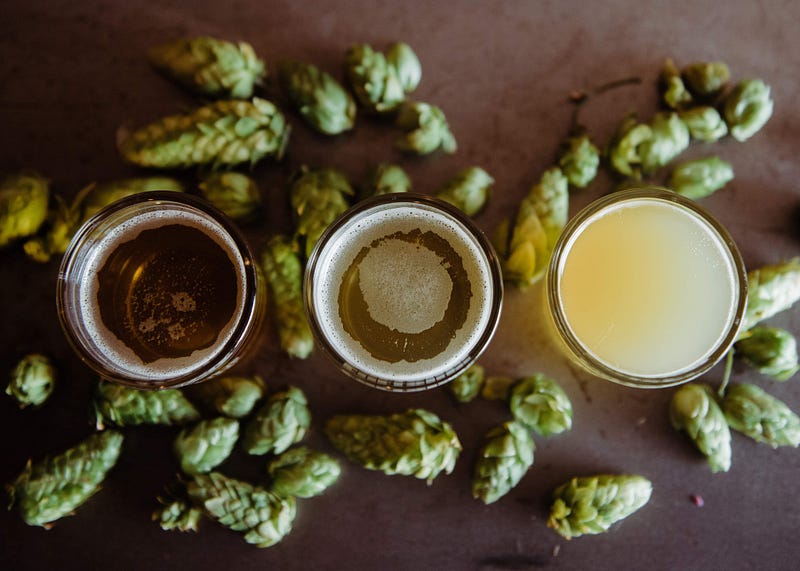
Today’s New York Times Spelling Bee letters:
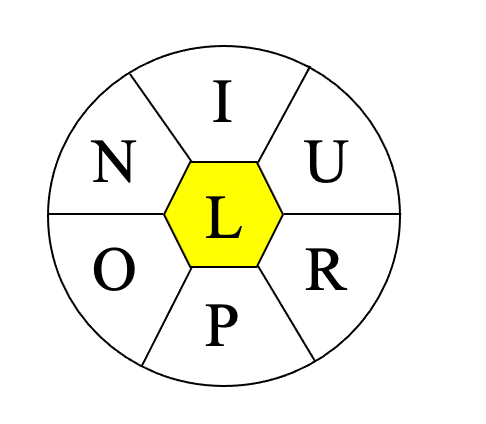
I, N, O, P, R, U, and center L (all words must include L)
Merriam-Webster says…
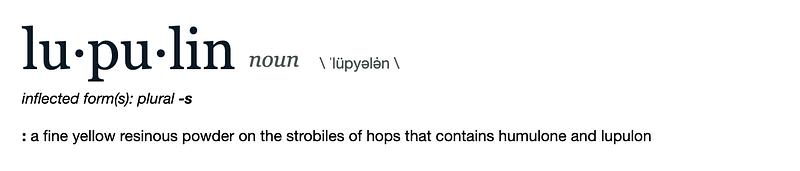
Silly little dictionary! Don’t you know lupulin can’t possibly be a word if the New York Times says it ain’t?
For further fascinating facts, check out the Spelling Bee Master.
What’s your favorite dord* from today’s puzzle?
My Two Cents
There is a quote about beer by Ben Franklin, which I heard many years ago and have now seen in meme format:
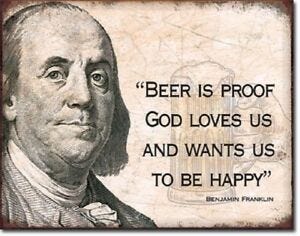
The quote is quite famous and is sold on the front (or back) of t-shirts sold by breweries across America.
The only problem, of course, is that no one has actually been able to find evidence old Ben ever really said or wrote these words. The closest we can get, according to The Spruce Eats, is a sentence about wine that Franklin wrote in French to his buddy André Morellet.
“Behold the rain which descends from heaven upon our vineyards, and which incorporates itself with the grapes to be changed into wine; a constant proof that God loves us, and loves to see us happy.”
Everything I remember about Franklin from my school days and some of what I’ve read recently makes me think it’s likely he preferred wine over beer. Then again, I could be wrong. If you happen to know for sure either way, please enlighten us in the comments section.
Now, since I’m writing about beer — or at least one of its key ingredients — I might as well sip some as I type. And because I live in Spain, I’ll imbibe locally:
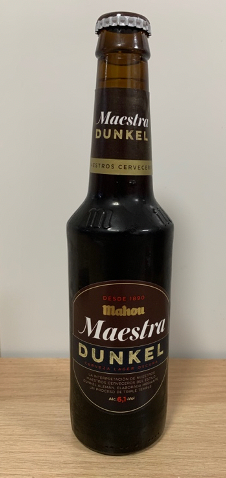
Cheers!
Hopping towards an IPA
Merriam-Webster explains that the word lupulin is made up from the root lupul- (from New Latin lupulus —specific epithet of the hop plant Humulus lupulus —from Latin lupus hop plant, wolf + -ulus) and the suffix -in.
That plant — Humulus lupulus — is better known as hops, a flowering plant in the hemp (marijuana) family. Hops are dioecious, meaning that there are separate male and female plants. And it’s the female cone-shaped fruits that supply the flavors and bitterness of your favorite ale, lager, IPA… or whatever your favorite poison is.
Hops plants can grow to between 15 to 20 feet (4.6 to 6.1 meters) in height. Here’s one next to a house, for comparison.
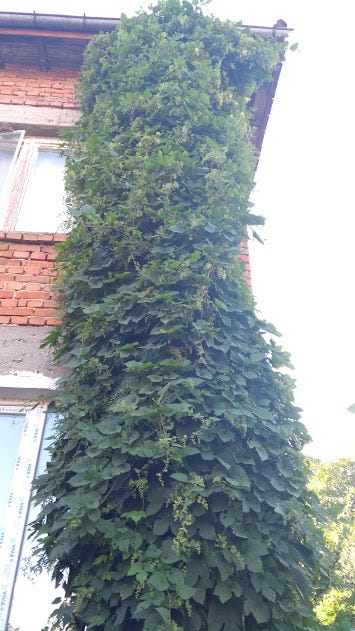
If the word lupulus rang a bell it’s because lupus is Latin for “wolf”, and lupulus means “little wolf”. Not sure why someone decided to call a 20-foot plant “little”, though. Perhaps it was the same ironic person who named Robin Hood’s pal “Little John”.
Why “wolf”, though? Well, hops have the antisocial tendency to strangle other plants. (As an aside, the autoimmune disease known as lupus was given that name in the 13th century because the facial rash it induces made the skin look like it had been bitten by a wolf.)
Hops were not always used to make beer; before they became popular, brewers used a herb mixture called gruit, which usually included mugwort, yarrow, and sweet gale. Hops have the advantage that they can ward of bacteria, which is a big reason they started being favored in the Middle Ages: beer would keep longer.
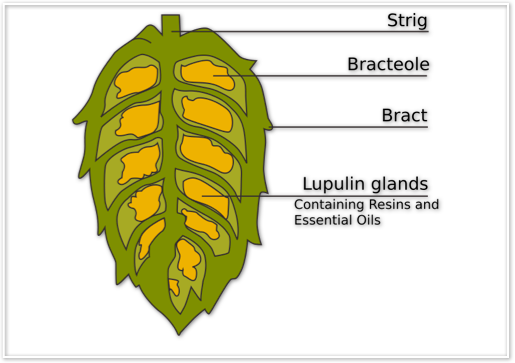
The fruits of hops have a simple structure; the lupulin glands that contain the coveted resins and essential oils are just under the bracteoles. Here is an image that repeats exactly what I just said:
Lupulin itself is yellowish and waxy resin, and it contains two types of acids, alpha and beta. Among the alpha acids are humulone and cohumulone, which have the antibacterial properties I mentioned earlier. They are also the ones that give beer its bitter taste. The longer the hop is boiled while brewing, the more alpha acid is transformed into its more soluble form, the one that gives beer that distinct bitterness.
The varieties of plant specifically grown to have high alpha acid levels are known as “bittering hops”. Many of those are used specifically for crafting IPAs, known to be extra-hoppy.
Beta acids include lupulone and colupulone and, although they have similar effects to their alpha counterparts, do not contribute as much as the alphas do. (Surprise, surprise…) However, the process known as dry-hopping is done with beta acids.
Alpha acids also have a downside, as explained in the article Hops: Anatomy and Chemistry 101: “Special care has to be taken with alpha acids though. If iso-alpha acids are allowed to react with light, and riboflavin (vitamin B2 coming from the malt), the beer will produce a “skunk” like smell that is not at all desired. This is why many beers are bottles in brown glass, to prevent certain wavelengths of light from starting this process.”
Beer is brewed from water, a grain or combination of grains (barley and/or wheat, usually), yeast, and… hops! Haven’t you been paying attention? Here is a brief description of the brewing process I just stole from Wikipedia, without the references included:
The first step, where the wort is prepared by mixing the starch source (normally malted barley) with hot water, is known as “mashing”. Hot water (known as “liquor” in brewing terms) is mixed with crushed malt or malts (known as “grist”) in a mash tun. The mashing process takes around 1 to 2 hours, during which the starches are converted to sugars, and then the sweet wort is drained off the grains. The grains are then washed in a process known as “sparging”. This washing allows the brewer to gather as much of the fermentable liquid from the grains as possible. The process of filtering the spent grain from the wort and sparge water is called wort separation. The traditional process for wort separation is lautering, in which the grain bed itself serves as the filter medium. Some modern breweries prefer the use of filter frames which allow a more finely ground grist.
And if a picture is worth a thousand words, then surely a video is worth gazillions.
You can believe everything you saw and heard… except for the Ben Franklin quote!
Hop out of my whisky!
I love beer. And I also love whisky.
Of course I do! They are both related.
How? Well, whisky is simply beer without hops, distilled. In much the same way wine is distilled to make brandy, beer (minus hops) is similarly processed in order to raise its proof (alcohol content) and change its flavor. Then the good distilleries, the ones worth their salt, age the whisky in oak or sherry barrels to give it even more flavors and nuance.
Ever had whisky right after it’s been distilled and before it’s been poured into a barrel? It’s like one of those places you like to visit on occasion but don’t want to stay too long. Barrel-aged quality whisky, however, is like home.
Now, I could write about whisky all day long. But here in Spain the day is less than an hour from being done, and my brain is a few minutes from shutting down. So I’ll just provide you with another video (made by the same person) that goes into detail about the distilling process for whisky. And then I’ll go pour myself a dram of Scotch as a nightcap. Sláigne!
Did you notice the differences? Right, no hops… and no Ben Franklin quote this time. As for Rudyard Kipling’s writings on whisky, you’ll have to go verify them yourself.
Now, despite the clear importance of lupulin for brewing beer and not distilling whisky, the editors of the Spelling Bee still decided that lupulin is a dord*.
You can check out my previous entry on another dord* here:
*What the heck is a dord, you ask? Here’s the answer: