
Lunule
You can bet your last sand dollar on this word
Today’s New York Times Spelling Bee letters:
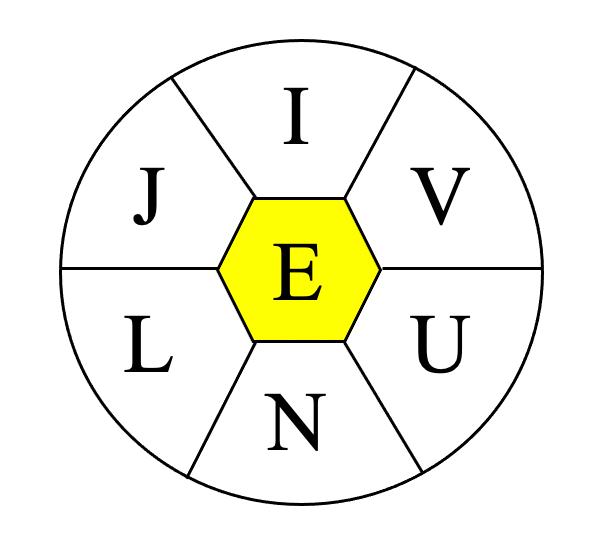
I, J, L, N, U, V, and center E (all words must include E)
Merriam-Webster says…
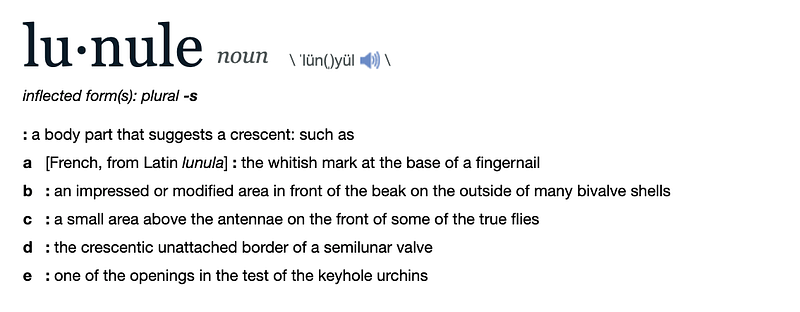
Silly little dictionary! Don’t you know that lunule can’t possibly be a word if the New York Times says it ain’t?
For further fascinating facts, check out the Spelling Bee Master.
What’s your favorite dord* from today’s puzzle?
My Two Cents
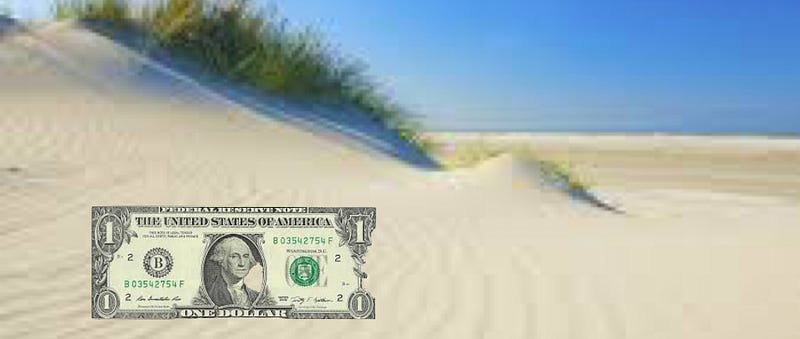
I searched far and wide today for a photo of a dollar bill on some sand. Just so I could post a visual dad joke. You would think at least one of the many photographers that publish their work on Unsplash would have prepared for the possibility that someone might search for “sand dollar” by including an image of a dollar on sand. (By the way, I also searched for “dollar sand” and got nothing.)
So I asked man-in-the-mirror and mediocre screenshotter Iva Reztok to create a collage for me, and that lame photo at the top of today’s column is all he was able to come up with. And just so that you don’t have to tire your fingers by scrolling back up, here it is again:
I noticed that this particular dollar was missing part of its left side ––your right side, as a reader. I thought it might be due to the high inflation the U.S. has had over the last year or so, but Reztok explained that it was due to an attack by a seagull, who managed to bite off a chunk. Seagulls are well-known natural predators of sand dollars, in case you didn’t know.
By now you may be wondering what all this has do with our daily dord*, lunule. (And even if you’re not wondering, that’s okay. I don’t judge.) After all, none of the five definitions in the dictionary mention a sand dollar. Or do they…? You’ll have to read on to find out.
Human touch
Our friends at Merriam-Webster tell us that lunule comes from the New Latin lunule, from the same word in (old?) Latin, meaning “crescent-shaped ornament”, from the diminutive form of luna (moon). In Spanish, luna is, in fact, the word for “moon”.
There are two lunules in the human body. One is easy to find and check out. However, if at any point in your life you happen to see the other one… you may be in big trouble.
If you didn’t bother to read the definitions provided by the dictionary, but you did pay attention to the origin of the word, you may have guessed that lunule is the light-colored part of the nail that looks like a crescent moon. Some people (myself included) have confused the lunule with the cuticle, but the latter is the thin, dead epidermis layer at the bottom of the lunule.
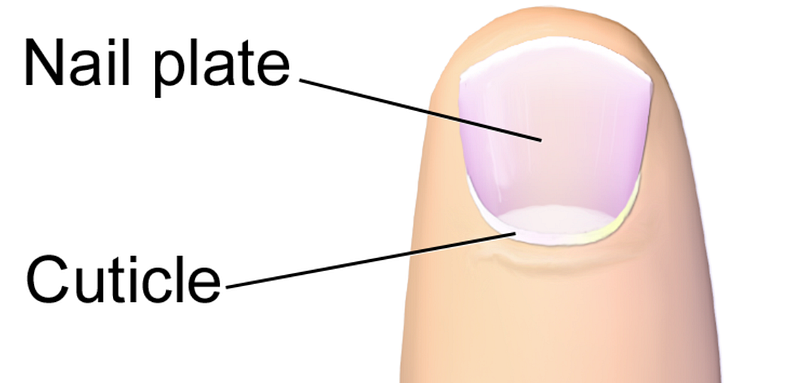
That convex white-ish thing between the nail plate and the cuticle is the lunule. It’s also called the lunula oftentimes. You can observe a live version by simply checking out your nails. (Ha! Made you look!) It may not be readily visible in the pinky finger; pushing down the cuticle may help you see it.
In the human fetus, the lunule appears around week 14, and is located under the nail itself, creating the “border” after which the nail plate grows out. Underneath the lunule is the matrix of the nail, in charge of generating tissue and making the nail plate grow outward.
The other lunule, the one you don’t ever want to see for yourself, is inside your heart. In fact, there is more than one. Your heart has four valves. Two connect the upper and lower chambers on either side, and are known as the atrioventricular valves. The one on the right side is the tricuspid (so called because it has three leaflets), while the one on the left is the bicuspid, or mitral (because it resembles a miter). Neither of those valves have a lunule. I’m just showing off my knowledge of anatomy.
The valves that connect the ventricles (lower chambers) to the aorta and pulmonary artery are known as the semilunar valves, and these are the ones that come with lunules.
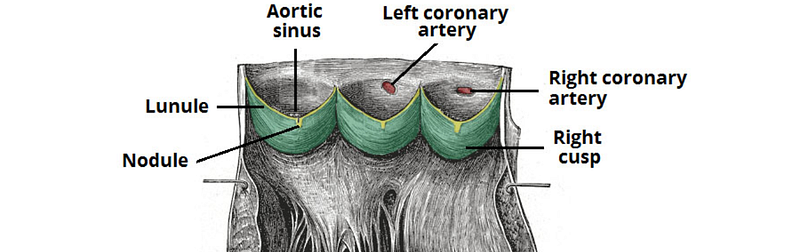
As teachmeanatomy.info explains:
The sides of each valve leaflet are attached to the walls of the outflow vessel, which is slightly dilated to form a sinus. The free superior edge of each leaflet is thickened (the lunule), and is widest in the midline (the nodule).
Creatures of the air and sea
We’ll start with flies. Or “some of the true flies”, as the dictionary says. I hate dealing with those pesky fake flies anyway. All they do is try to sell you worthless crypto. So… some true flies have a small area above the antennae, called the lunule. Since a picture is worth a thousand words, here are ten hundred of them:
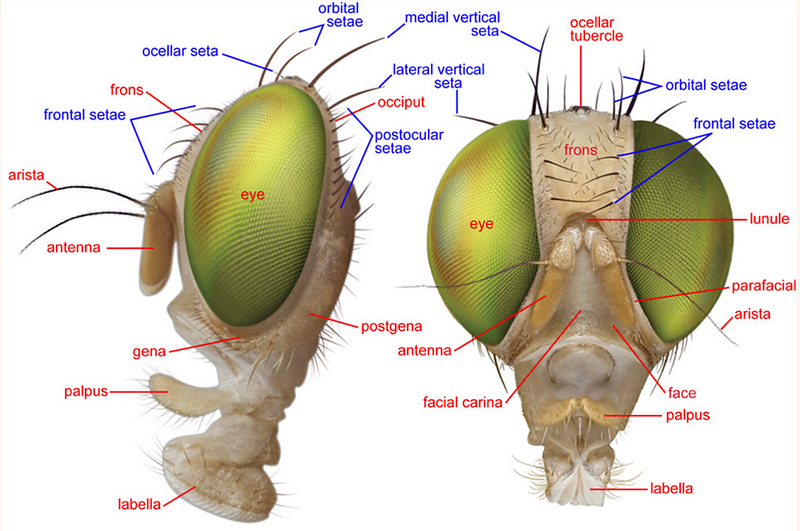
Ironically, there are a ton of words in that picture. The first red one on the far right side is lunule. Were you as surprised as I was to discover that none of the hairs are actually the antennae?
We move on from the heights of the skies to the depths of the oceans. In seashells, the lunule refers to a feature found on the outside of some clams and other bivalve mollusks. Despite its name, these features don’t always have a crescent shape. For example, the one shown here in dark brown:
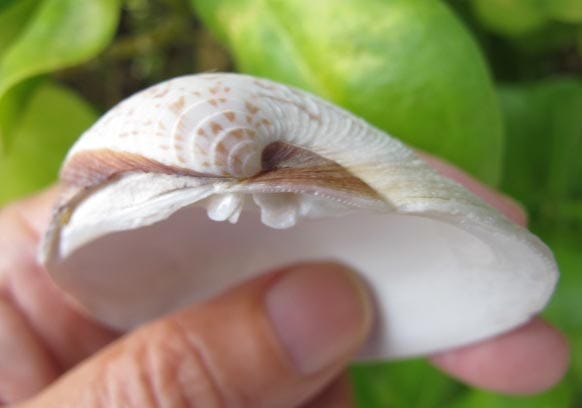
These clam lunules can be considered fingerprints of sorts, as their details can help identify the type of bivalve shell.
Finally, we come to the lunule you were all anxiously awaiting. Cue drumroll, please.
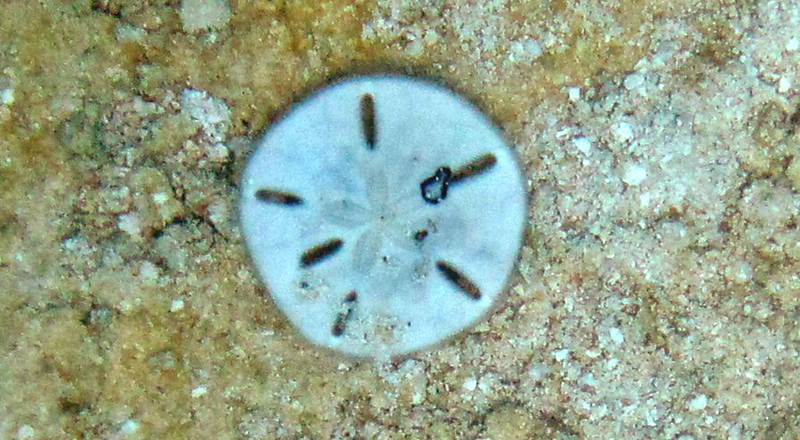
That particular sea animal is Mellita sexiesperforat, a species of sea urchin known for having six lunules. James’s photo seems a bit out of focus, so here’s an 1841 illustration by Swiss-born American biologist and geologist Louis Agassiz, who also happened to be a pretty damn good artist.
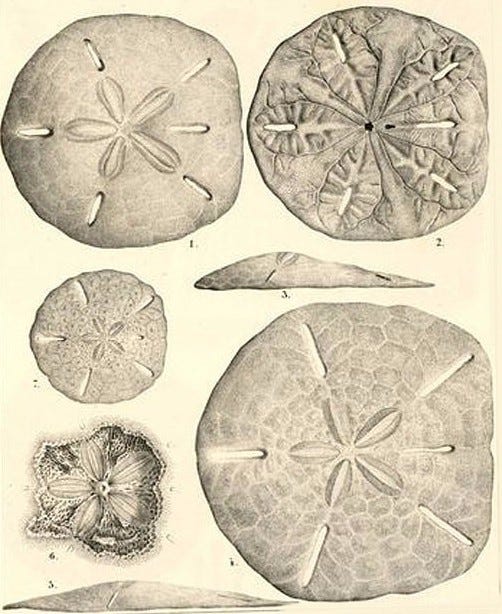
Wait a second! Did I just call this creature a sea urchin? Isn’t a sand dollar, though? Well, yes, it’s both. You see, much like squares and rectangles, all sand dollars are sea urchins, but not all sea urchins are sand dollars. (There are close to one thousand species of sea urchins.)
The Mellita sexiesperforat, or six-holed keyhole urchin, native to tropical and sub-tropical parts of the western Atlantic Ocean. The five petal-like structures in the middle of its test (hard shell) are gills, while the six slits towards the edges are the lunules. These slits help the urchin embed into the sand so that ocean waves don’t swat it around. (The species name sexiesperforat means “six perforations”, not “sexy times”.) One of these lunules is the anus of the sand dollar, but I’m not going to tell you which one. You’ll have to guess next time you have one in your hand. But if you’e going to handle sand dollars, please be very very very careful.
Another sand dollar with lunules is the Mellita quinquiesperfora.
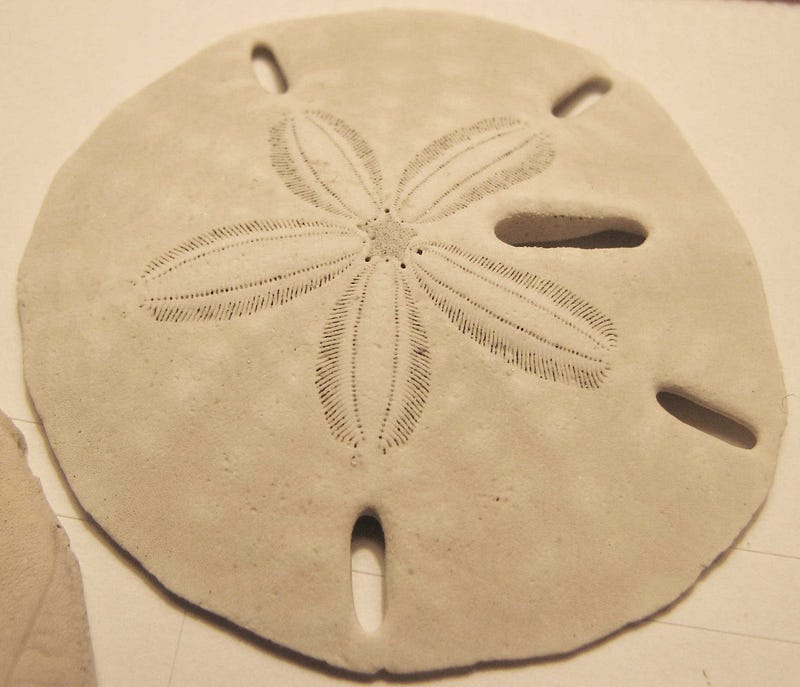
Again, the species name refers to the fact it has five lunules, not that it’s into kinky sex. Get your mind out of the gutter with these sand dollars!
Now you know. Next time you’re on a beach and you decide to pick up a sand dollar… be careful! After you’ve done so, take a picture of it in your hand, making sure both your lunules and the sand dollar’s lunules are visible. You may be surprised when they don’t show up in the photo, however… because the editors of the Spelling Bee decided that lunule is a dord*.
You can check out my previous entry on another dord* here:
*What the heck is a dord, you ask? Here’s the answer: