avatarAvi Kotzer

Free AI web copilot to create summaries, insights and extended knowledge, download it at here

4534

Abstract

ight="480" width="854"> </div> </div> </figure></iframe></div></div></figure><p id="03f4">In the introduction to the book <i>The Naval Shiphandler’s Guide</i>, by Mark B. Templeton, James Alden Barber wrote this:</p><blockquote id="1417"><p>One of the most important principles of ship handling is that there be no ambiguity as to who is controlling the movements of the ship. One person gives orders to the ship’s engine, rudder, lines, and ground tackle. This person is said to have the “conn.”</p></blockquote><p id="6651">I assume that, since the dictionary gives precedence to the verb form over the noun, it was the verb that was coined first, and the noun developed later. But there is some evidence to the contrary. <b>Nathaniel Bowditch</b>, an early American mathematician remembered for his work on ocean navigation, published a book called <i>The New American Practical Navigator</i> in 1802. This guide became the shipping industry standard of the western hemisphere for the next century and a half, and is still carried on board every commissioned U.S. Naval vessel. In that book, Bowditch sums up the concept of the <i>conn</i> thusly:</p><blockquote id="4ef8"><p>In Navy piloting teams, neither the pilot nor the captain usually has the <i>conn</i>. The officer having the conn directs the ship’s movements by rudder and engine order. Another officer of the ship’s company usually fulfills this function. The captain can take the conn immediately simply by issuing an order to the helm should an emergency arise. The conning officer of a merchant vessel can be either the pilot, the captain, or another watch officer. In any event, the officer having the conn must be clearly indicated in the ship’s deck log at all times. Often a single officer will have the deck and the conn. However, sometime a junior officer will take the conn for training. In this case, different officers will have the deck and the conn. The officer who retains the deck retains the responsibility for the vessel’s safe navigation.</p></blockquote><p id="3b66">The word conn originated the term <b>conning tower</b>, an elevated platform on a ship from which a conning officer can view all aspects of a ship’s movement. However, Otto C. Romanelli’s theory is that the opposite happened. In his book about the World War II exploits of the USS <i>Lexington</i>, he writes that “The term conn is derived from the ‘conning tower’ (also called the bridge), the commanding officer sta­tion when the ship is underway, from which he controlled the ship’s move­ments and conditions.”</p><p id="cd07">Here is a picture of the conning tower of the USS <i>Massachusetts</i> when it was still being built in 1892.</p><figure id="8d71"><img src="https://cdn-images-1.readmedium.com/v2/resize:fit:800/0*FUefoABw_eqU7QD9.jpg"><figcaption>Credit: Internet Archive Book Images</figcaption></figure><p id="d788">The <i>Massachusetts</i> was a small battleship that served in the Spanish-American War.</p><p id="9072">In submarines, what is known as the <b>sail</b> or <b>fin</b> ––the small protrusion at the top of the ship–– used to include the conning tower, but no longer do. The sail does serve as an observation platform, but only when the submarine is above the water surface (duh!)</p><h2 id="2b11">Uppercase c</h2><p id="d9be"><b>Charles Gerard Conn</b> (January 29, 1844 — January 5, 1931) was a grocer, baker, newspaper publisher, and even a U.S. Representative for the state of Indiana between 1893 and 1895. But he is best remembered as a manufacturer of band instruments who made the first ever American saxophone.</p><p id="50e1">A music aficionado who played the cornet, his entry into the world of musical instrument making began with a brawl in a bar. Legend has it his lip got split in the fight, after which he found it painful to play the cornet. So he came up with the idea to add rubber to the mouthpiece. It was a success, and Conn began making these new mouthpieces in his grocery store and selling them to high demand.</p><p id="4f0d">Conn expanded his business in 1876 with the help of Eugene Victor Baptiste Dupont, a brass instrument maker and designer. Although their partnership dissolved just three years later, Conn had made enough contacts with other European to create the biggest musical instrument factory in the world at the turn of the century. He began importing instruments and, after seeing a model of Adolphe Sax’s, decided to make his own version.</p><p id="ffeb">American composer Jo

Options

hn Philip Sousa endorsed Conn’s instruments, and in turn Conn perfected the instrument named after the famed bandleader, the <b>sousaphone</b>. But Conn had other interest, including politics. Although he successfully won a seat in Congress, he lost his bids for governor of Indiana and U.S. senator. But Conn kept amassing a lot of debt, and was forced to find a buyer for his assets. In 1915 all of Conn’s holdings, including the horn factory, were bought by a group of investors led by Carl Dimond Greenleaf.</p><p id="3eb6">It was in the 1920s and 30s that the Conn saxophones took off; in later decades the company focused on expanding market for school band instruments and to diversifying their instrument lines. It was in these years that some of their saxophones were engraved with what some call the “lady face” and others refer to as the “naked lady”. Why? Because on the bell of the instrument the company etched a drawing that seems to show a topless woman. Here are some variations of that etching:</p><figure id="d83d"><img src="https://cdn-images-1.readmedium.com/v2/resize:fit:800/1*F1BxsAhVxNetR3zSdwYfGA.png"><figcaption>Credit: connsortia.com</figcaption></figure><p id="e004">Here is <a href="https://www.urbanskimusic.com/">Krysztof Urbanski</a> playing a Naked Lady alto sax:</p> <figure id="b06e"> <div> <div> <img class="ratio" src="http://placehold.it/16x9"> <iframe class="" src="https://cdn.embedly.com/widgets/media.html?src=https%3A%2F%2Fwww.youtube.com%2Fembed%2F5YwQc-lZkKA%3Ffeature%3Doembed&amp;display_name=YouTube&amp;url=https%3A%2F%2Fwww.youtube.com%2Fwatch%3Fv%3D5YwQc-lZkKA&amp;image=https%3A%2F%2Fi.ytimg.com%2Fvi%2F5YwQc-lZkKA%2Fhqdefault.jpg&amp;key=a19fcc184b9711e1b4764040d3dc5c07&amp;type=text%2Fhtml&amp;schema=youtube" allowfullscreen="" frameborder="0" height="480" width="854"> </div> </div> </figure></iframe></div></div></figure><p id="d69a">I began taking sax lessons in 2002 and I can proudly say that, twenty years later, I can play this instrument badly with ease and very little grace. (Through no fault of my teacher, the incredible <a href="https://readmedium.com/gigged-3d3400b4871a">Tim Price</a>.) My main sax is a tenor made by defunct EM Winston (of Bill Clinton fame), but I do have a baritone Naked Lady at a friend’s place in New Jersey. The problem is I now live in Spain. But on a recent trip I was able to spend some quality time with my Conn.</p><figure id="8a6d"><img src="https://cdn-images-1.readmedium.com/v2/resize:fit:800/1*-AHBRcQUbEAoYXzs_o3uGg.png"><figcaption>Yours truly with a naked lady. Photo by someone else.</figcaption></figure><p id="b888">All that’s left it to figure out a way to get that huge thing “across the pond” to Madrid.</p><p id="f313">Now you know. Next time you’re on a battleship and you see a commanding officer on the bridge playing a Naked Lady tenor, you can tell everyone you saw “a <i>conn</i> playing a Conn”. People who don’t read this column will have no idea what you’re talking about, of course… because the editors of the Spelling Bee decided that <i>conn </i>is a dord*.</p><p id="904a">You can check out my previous entry on another <b>dord* </b>here:</p><div id="7098" class="link-block"> <a href="https://readmedium.com/killick-fb6ebc48be7e"> <div> <div> <h2>Killick</h2> <div><h3>This word almost weighed me down</h3></div> <div><p>medium.com</p></div> </div> <div> <div style="background-image: url(https://miro.readmedium.com/v2/resize:fit:320/0*zb3AF1OxY-f2_E8M)"></div> </div> </div> </a> </div><p id="7da4">*What the heck is a <b>dord, </b>you ask? Here’s the answer:</p><div id="4854" class="link-block"> <a href="https://www.merriam-webster.com/words-at-play/dord-a-ghost-word"> <div> <div> <h2>'Dord': A Ghost Word</h2> <div><h3>One of the questions people like to ask lexicographers is this: Can you sneak something into the dictionary? Can you…</h3></div> <div><p>www.merriam-webster.com</p></div> </div> <div> <div style="background-image: url(https://miro.readmedium.com/v2/resize:fit:320/0*gkMG0On7aZU57XXh)"></div> </div> </div> </a> </div></article></body>

Conn

Take control… of the sax!

Photo by Mael BALLAND on Unsplash

Today’s New York Times Spelling Bee letters:
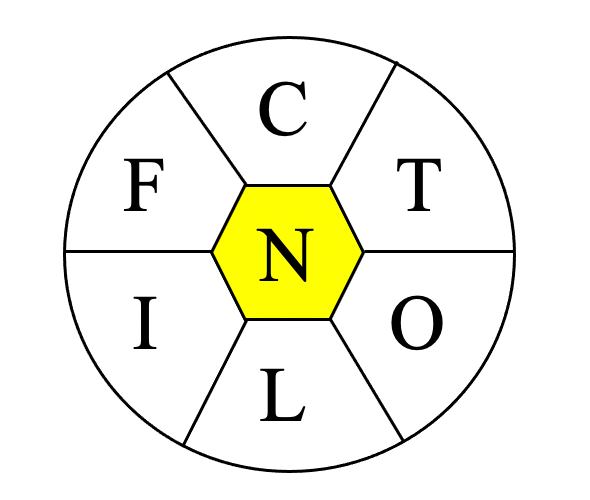
Art: Iva Reztok

C, F, I, L, O, T, and center N (all words must include N)

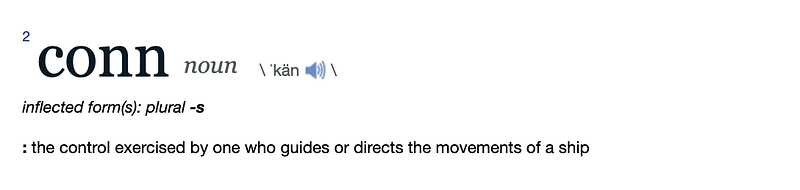
Merriam-Webster says…
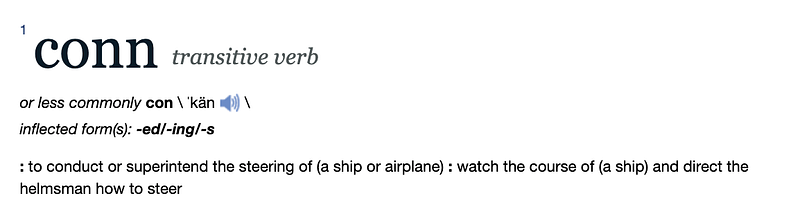
Credit: merriam-webster.com

…and…

Credit: merriam-webster.com

Silly little dictionary! Don’t you know that conn can’t possibly be a word if the New York Times says it ain’t?

For further fascinating facts, check out the Spelling Bee Master.

What’s your favorite dord* from today’s puzzle?

My Two Cents

I think the photo at the top of today’s column shows a conning tower, but I’m not 100% sure. And no, a conning tower is not a place where people gather to run scams on others. You’ll have to read on to find out more about that.

There are certain words that immediately bring up the same image when I hear or read them. Conn is one of them, and this is the image:
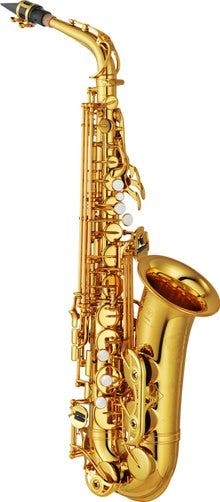
Credit: Yamaha

(No, the irony of the image credit does not escape me.) I am an eternal student of the saxophone ––the “easiest instrument to play badly”, as they say–– and Conn with a capital C was one of the iconic companies that made these musical instruments. Obviously, Conn begins with a capital C and therefore cannot be accepted as answer in any Spelling Bee puzzle. But it turns out conn with a lowercase c is a word, which means we can use it as an excuse to talk about the other Conn.

And we here at Silly Little Dictionary! will take almost any excuse available.

Lowercase c

The origin of the nautical term conn is not 100% clear, but our friends at Merriam-Webster explain that the transitive verb form may have come from an alteration of the word cond, which may have been understood (mistakenly) as the past tense because of its “d” ending. The first known use is given very specifically as 1626.

Cond in and of itself a shortened form or abbreviation of (among other words) conduce, which came from the Middle English conden meaning “to conduct”, an alteration of condien, from theMiddle French conduire, from the Latin conducere. In Spanish, the word conducir comes from the same Latin root and means “to drive”. Although Spanish doesn’t have a conn with double n, it does have con with a single n. But it does not mean the opposite of “pro” or “to swindle”, as it does English. In Spanish con is a preposition roughly equivalent to “with”.

Star Trek fans may be familiar with the term conn as it’s been used more than once over the course of the series. “It’s been some time since I’ve had the conn” is said at the 6-second mark below.

In the introduction to the book The Naval Shiphandler’s Guide, by Mark B. Templeton, James Alden Barber wrote this:

One of the most important principles of ship handling is that there be no ambiguity as to who is controlling the movements of the ship. One person gives orders to the ship’s engine, rudder, lines, and ground tackle. This person is said to have the “conn.”

I assume that, since the dictionary gives precedence to the verb form over the noun, it was the verb that was coined first, and the noun developed later. But there is some evidence to the contrary. Nathaniel Bowditch, an early American mathematician remembered for his work on ocean navigation, published a book called The New American Practical Navigator in 1802. This guide became the shipping industry standard of the western hemisphere for the next century and a half, and is still carried on board every commissioned U.S. Naval vessel. In that book, Bowditch sums up the concept of the conn thusly:

In Navy piloting teams, neither the pilot nor the captain usually has the conn. The officer having the conn directs the ship’s movements by rudder and engine order. Another officer of the ship’s company usually fulfills this function. The captain can take the conn immediately simply by issuing an order to the helm should an emergency arise. The conning officer of a merchant vessel can be either the pilot, the captain, or another watch officer. In any event, the officer having the conn must be clearly indicated in the ship’s deck log at all times. Often a single officer will have the deck and the conn. However, sometime a junior officer will take the conn for training. In this case, different officers will have the deck and the conn. The officer who retains the deck retains the responsibility for the vessel’s safe navigation.

The word conn originated the term conning tower, an elevated platform on a ship from which a conning officer can view all aspects of a ship’s movement. However, Otto C. Romanelli’s theory is that the opposite happened. In his book about the World War II exploits of the USS Lexington, he writes that “The term conn is derived from the ‘conning tower’ (also called the bridge), the commanding officer sta­tion when the ship is underway, from which he controlled the ship’s move­ments and conditions.”

Here is a picture of the conning tower of the USS Massachusetts when it was still being built in 1892.
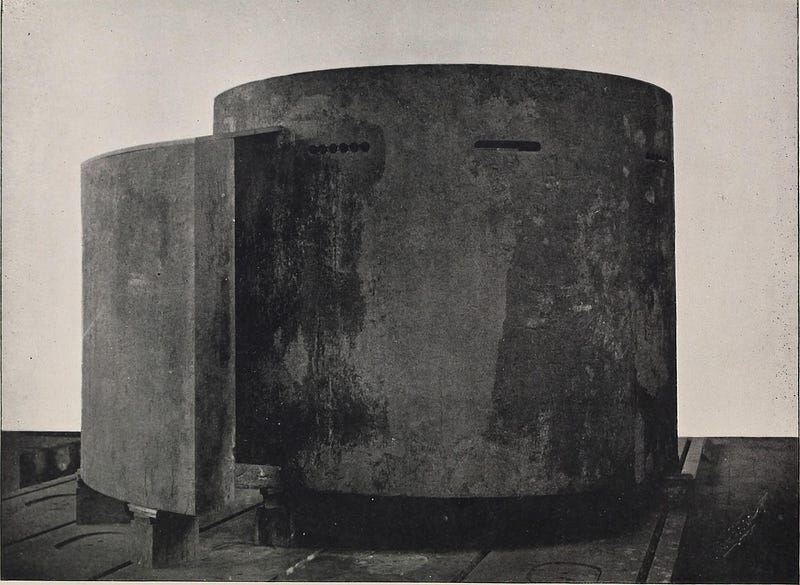
Credit: Internet Archive Book Images

The Massachusetts was a small battleship that served in the Spanish-American War.

In submarines, what is known as the sail or fin ––the small protrusion at the top of the ship–– used to include the conning tower, but no longer do. The sail does serve as an observation platform, but only when the submarine is above the water surface (duh!)

Uppercase c

Charles Gerard Conn (January 29, 1844 — January 5, 1931) was a grocer, baker, newspaper publisher, and even a U.S. Representative for the state of Indiana between 1893 and 1895. But he is best remembered as a manufacturer of band instruments who made the first ever American saxophone.

A music aficionado who played the cornet, his entry into the world of musical instrument making began with a brawl in a bar. Legend has it his lip got split in the fight, after which he found it painful to play the cornet. So he came up with the idea to add rubber to the mouthpiece. It was a success, and Conn began making these new mouthpieces in his grocery store and selling them to high demand.

Conn expanded his business in 1876 with the help of Eugene Victor Baptiste Dupont, a brass instrument maker and designer. Although their partnership dissolved just three years later, Conn had made enough contacts with other European to create the biggest musical instrument factory in the world at the turn of the century. He began importing instruments and, after seeing a model of Adolphe Sax’s, decided to make his own version.

American composer John Philip Sousa endorsed Conn’s instruments, and in turn Conn perfected the instrument named after the famed bandleader, the sousaphone. But Conn had other interest, including politics. Although he successfully won a seat in Congress, he lost his bids for governor of Indiana and U.S. senator. But Conn kept amassing a lot of debt, and was forced to find a buyer for his assets. In 1915 all of Conn’s holdings, including the horn factory, were bought by a group of investors led by Carl Dimond Greenleaf.

It was in the 1920s and 30s that the Conn saxophones took off; in later decades the company focused on expanding market for school band instruments and to diversifying their instrument lines. It was in these years that some of their saxophones were engraved with what some call the “lady face” and others refer to as the “naked lady”. Why? Because on the bell of the instrument the company etched a drawing that seems to show a topless woman. Here are some variations of that etching:
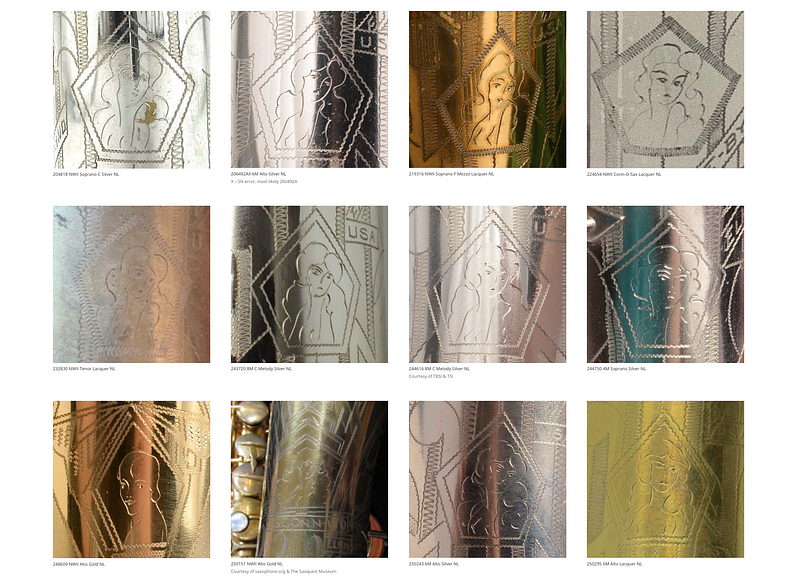
Credit: connsortia.com

Here is Krysztof Urbanski playing a Naked Lady alto sax:

I began taking sax lessons in 2002 and I can proudly say that, twenty years later, I can play this instrument badly with ease and very little grace. (Through no fault of my teacher, the incredible Tim Price.) My main sax is a tenor made by defunct EM Winston (of Bill Clinton fame), but I do have a baritone Naked Lady at a friend’s place in New Jersey. The problem is I now live in Spain. But on a recent trip I was able to spend some quality time with my Conn.
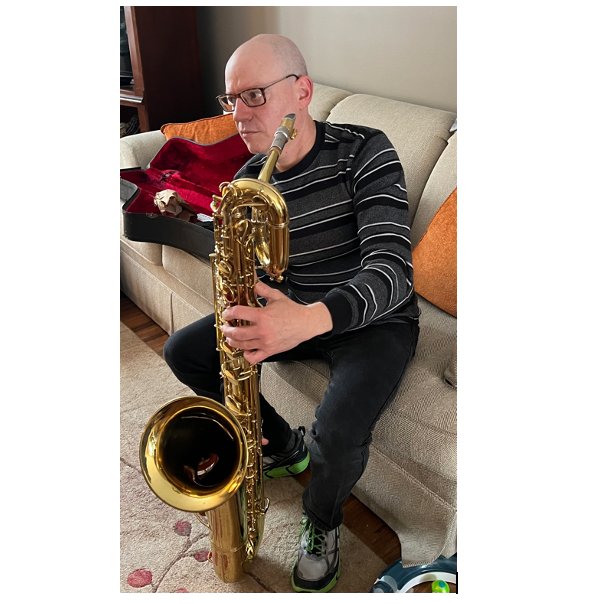
Yours truly with a naked lady. Photo by someone else.

All that’s left it to figure out a way to get that huge thing “across the pond” to Madrid.

Now you know. Next time you’re on a battleship and you see a commanding officer on the bridge playing a Naked Lady tenor, you can tell everyone you saw “a conn playing a Conn”. People who don’t read this column will have no idea what you’re talking about, of course… because the editors of the Spelling Bee decided that conn is a dord*.

You can check out my previous entry on another dord* here:

*What the heck is a dord, you ask? Here’s the answer:

Spelling Bee
Language
Music
History
Navy
Recommended from ReadMedium