
Killick
This word almost weighed me down
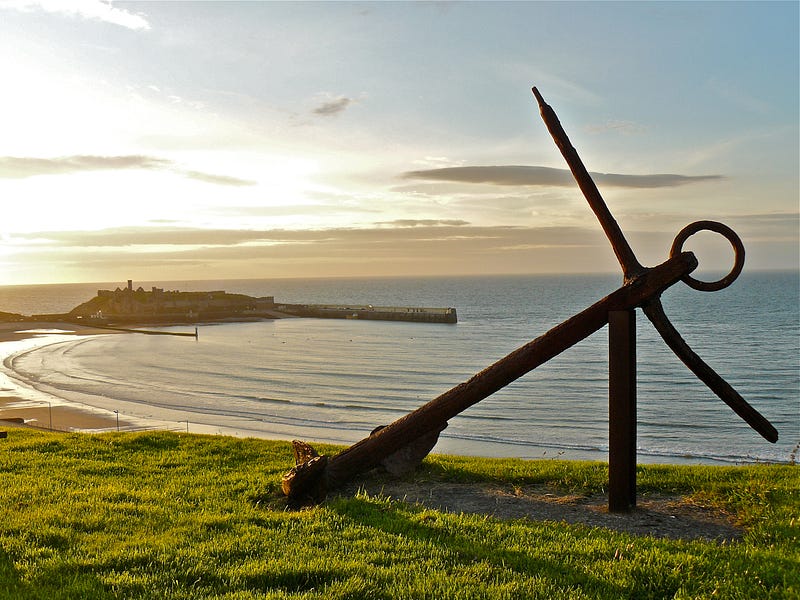
Today’s New York Times Spelling Bee letters:
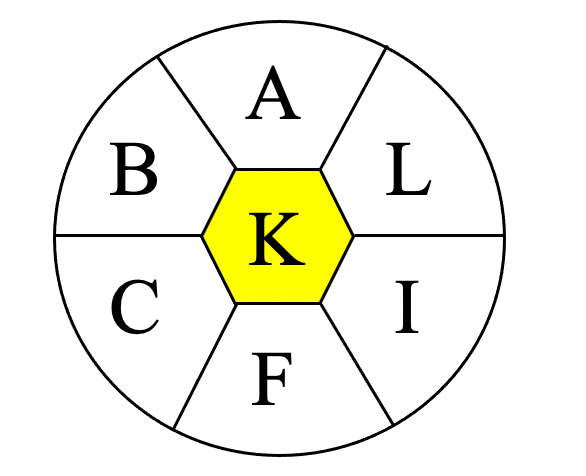
A, B, C, F, I, L, and center K (all words must include K)
Merriam-Webster says…
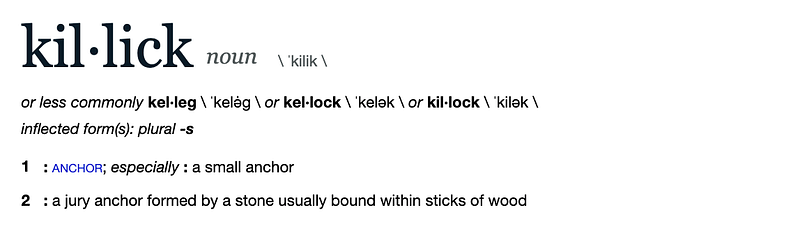
Silly little dictionary! Don’t you know that killick can’t possibly be a word if the New York Times says it ain’t?
For further fascinating facts, check out the Spelling Bee Master.
What’s your favorite dord* from today’s puzzle?
My Two Cents
Very slim picken’s in today’s list of rejected words, although the handful of options did have some quality terms. I’m not sure what dictionary the Spelling Bee Master got their words from, because a bunch of the ones on the list don’t appear in Merriam-Webster.
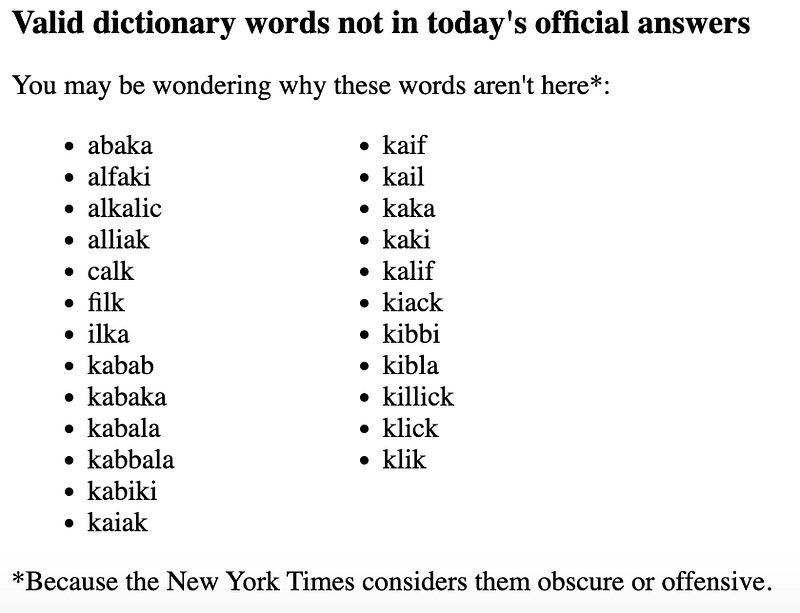
The dictionary did not have entries for abaka, alfaki, alliak, filk, kabab, kabiki, kaiak, kaif, kalif, kiack, and klik.
On the other, kaka (a New Zealand parrot) and kaki (a fruit, and also a bird from New Zealand) were interesting options. But I went with killick.
Killicks aweigh!
Our friends at Merriam-Webster tell us that killick is of unknown origin. Lexico.com, the Oxford English Dictionary’s free online version, adds only that it is from the middle of the 17th century.
I had a really hard time finding a lot of information about killick anchors. The traditional sources like the Britannica (both the 1911 edition and the current online one) came up empty, and Wikipedia’s “History of the anchor” article had only this to say:
Killicks are primitive anchors formed by lashing tree branches to a stone for weight. Greeks were using mushroom anchors by 400 B.C. fashioned from a flattened stone with a hole drilled through the center and a triangular eyebolt at the crown for “tripping” the anchor out of its bed.
(The source is the second edition of Ship modeling hints & tips by Jason H. Crane, published in 1973 by the Arco publishing company.)
And on Wikipedia I also found this neat little illustration of a bunch of different anchor types with their names…
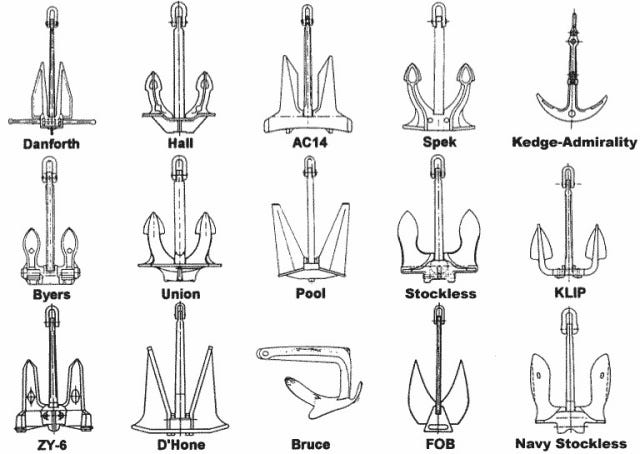
…except that, as you can see, killick is not included.
When I searched Youtube, I found mostly videos about (1) rock-climbing anchors and (2) wall anchors for screws. Oh, and one video actually called “Killick”:
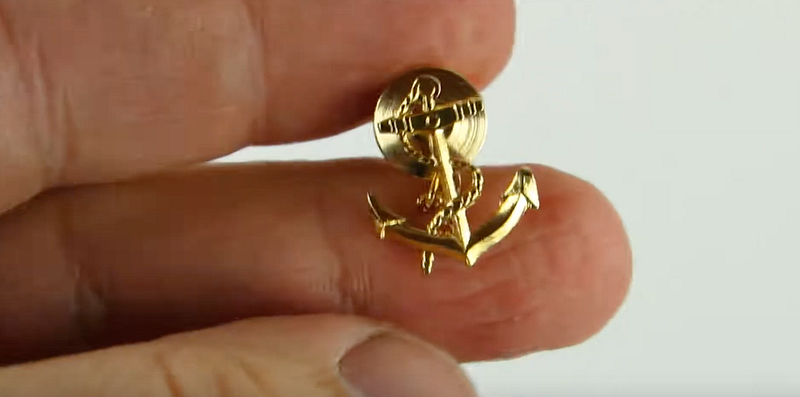
I know the dictionary said they were small anchors, but this is ridiculous!
Doing an image searched let me to Fitz Henry Lane Online, self-described as “a freely-accessible interactive and interdisciplinary online resource created by the Cape Ann Museum. The website is organized around a catalog of the paintings, drawings, and lithographs of nineteenth-century American painter Fitz Henry Lane (1804–1865).”
But there are also objects catalogued on the website, among which I managed to find a killick:
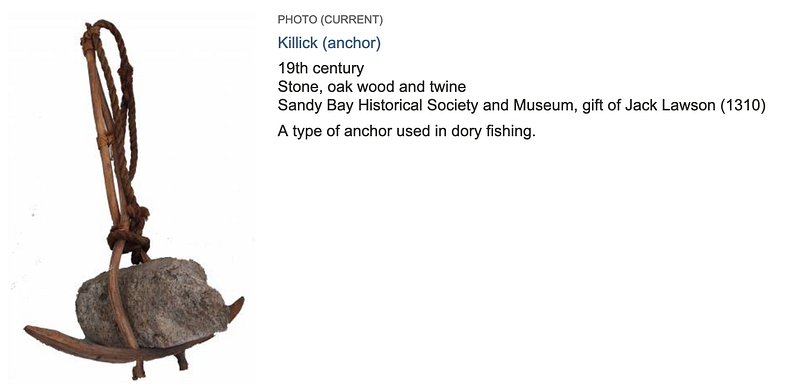
And this killick apparently is from 1310! That’s impressive.
As the old Cunard Cruise ads used to say…
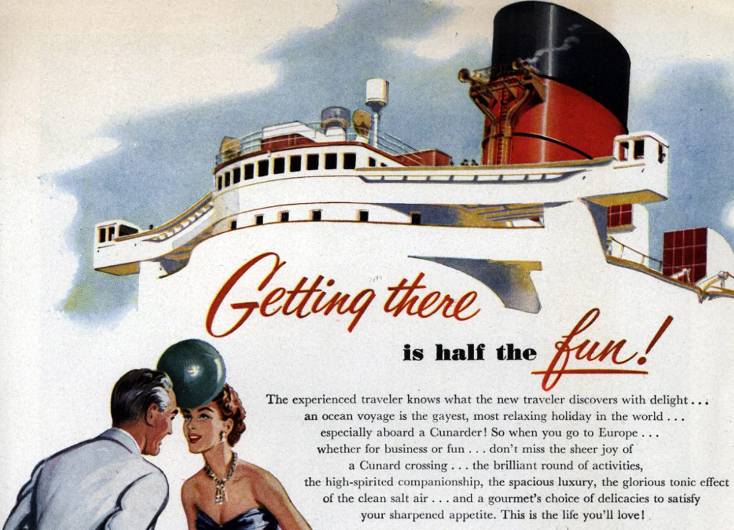
And that would certainly apply to today’s intensive 15-minute online research, which may have taken me an exhausting extra minute or two.
I happened to run into a couple of interesting things during my interwebs surfing. One was another meaning for killick. It is British nautical slang for a leading seaman. The latter is actually a technical term for a sailor first class, and apparently the reason they were called killicks is that their insignia was an anchor.
Also curious is the term anchor when referring to cognitive bias. I ended up reading about this because the dictionary’s second definition of killick is “a jury anchor formed by a stone usually bound within sticks of wood”. In this case, jury is not the noun defined as “a body of persons sworn to give a verdict upon some matter submitted to them”, but instead is the adjective meaning “improvised for temporary use especially in an emergency”.
And when I was trying to find the connection between juries and sea anchors, I ran into this short video by lawyer Brendan Lupetin explaining how the anchoring effect can be used with juries.
Lupetin explains one of the anchoring experiments done by y Amos Tversky and Daniel Kahneman. In another early study, they had two groups of participants that were asked to multiply the numbers one through eight. One group was presented the numbers as 1 × 2 × 3 × 4 × 5 × 6 × 7 × 8, while the other was given 8 × 7 × 6 × 5 × 4 × 3 × 2 × 1. Each group had only 5 seconds to do the math, so the members were forced to estimate the total. People in the group that was given the sequence starting with the smaller numbers consistently had lower estimates, while the ones who were given the reverse sequence (starting with 8, then 7, etc.) had much higher estimates. (The answer is 40,320 in case you were wondering.)
How you can apply this knowledge to your daily life? I’ll leave that up to your clever, devious mind.
Knot what you think
Killick is also the first name of a knot, its last name being Hitch. Or maybe hitch is the middle name, and Knot is the last name. Either way, the killick is practical for tying rope to oddly-shaped objects. It’s actually a combination of two other knots: the timber hitch…
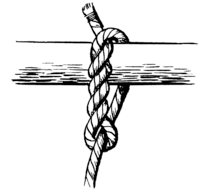
…and the half hitch…
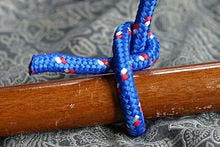
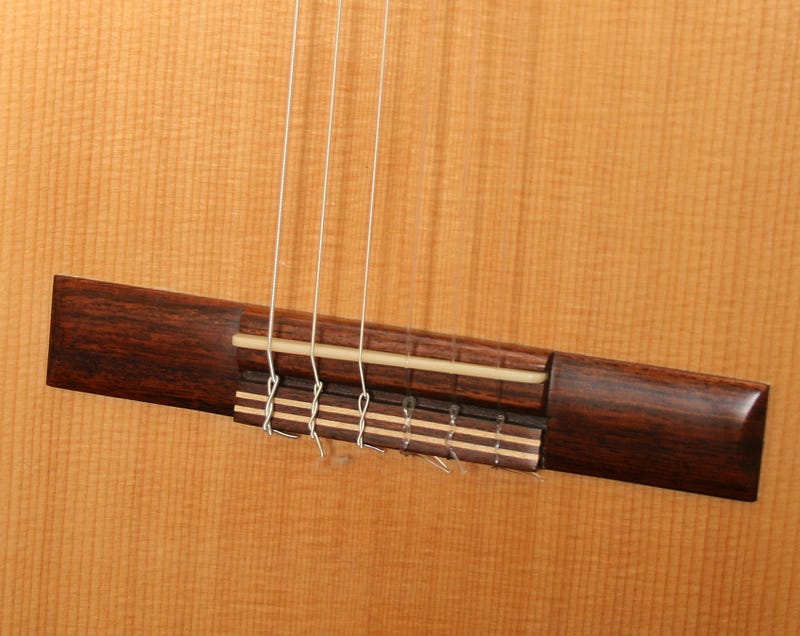
As you can clearly see, the half hitch is both a simpler and more colorful knot than the timber hitch. Timber hitches were given that name because it was often used by lumbermen (lumberpeople?) to attach ropes or chains to tree trunks, branches, and logs. Today it can be seen on guitars:
In the killick hitch, adding the half hitch to the timber hitch gives the knot a bit more stability when pulling an object. And the reason this combo knot is called a killick may be because it is often used to anchor small boats by tying them to oddly-shaped objects. This is particularly useful if you are constantly anchoring and de-anchoring your boat.
In this video, Cyrus John Guevarra teaches us how to tie a killick hitch knot.
And how you can apply this knowledge to your daily life? Again, I’ll leave that up to your clever, devious mind.
Now you know. Next time you’re sailing on a boat, you can show off both your linguistic and physical skills by tying a killick knot to a killick anchor and then proclaiming “Here’s a double killick!” Everyone will be extremely confused, of course… because the editors of the Spelling Bee decided that killick is a dord*.
You can check out my previous entry on another dord* here:
*What the heck is a dord, you ask? Here’s the answer: