
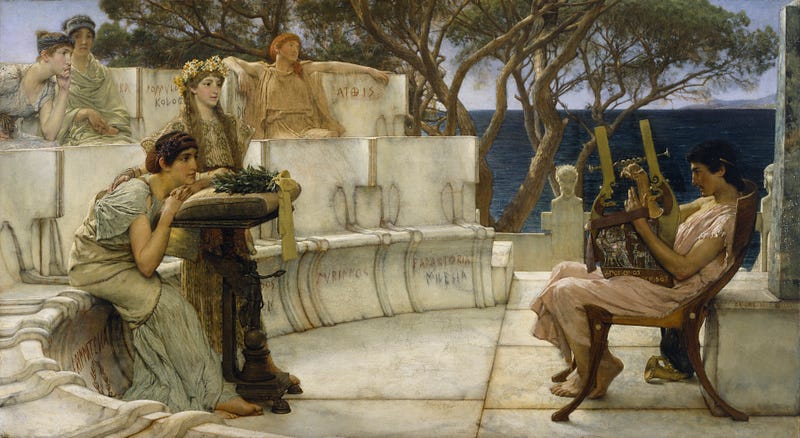
Cithara
This music is all Greek to me
Today’s New York Times Spelling Bee letters:
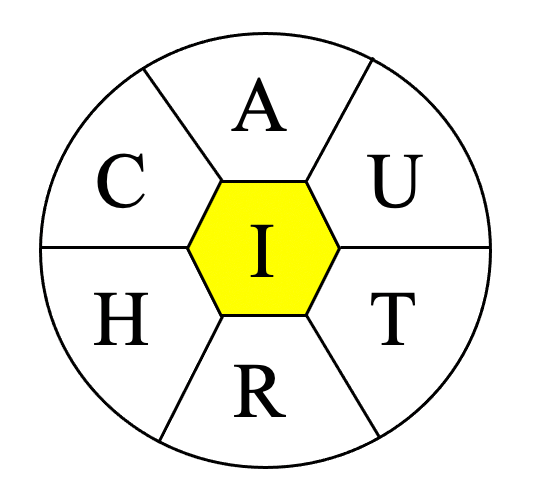
A, C, H, R, T, U, and center I (all words must include I)
Merriam-Webster says…
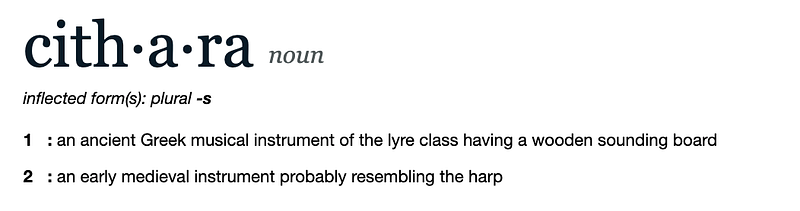
Silly little dictionary! Don’t you know that cithara can’t possibly be a word if the New York Times says it ain’t?
For further fascinating facts, check out the Spelling Bee Master.
What’s your favorite dord* from today’s puzzle?
My Two Cents
If the word cithara sounds vaguely familiar to you (as it did to me), it might be because this musical instrument’s name sounds similar to zither, which, in its more modern version, can have 30 or more strings.
The dictionary defines zither as “a musical instrument consisting of a shallow soundboard set horizontally before the performer and overlaid with 30 to 40 strings some of which pass over a fretted fingerboard, are stopped with the left hand, and are played by a plectrum on the right thumb to produce the melody and the remainder of which are tuned in fourths and plucked by the fingers of the right hand.” And in order to make things easier for our readers, they’ve provided this illustration:
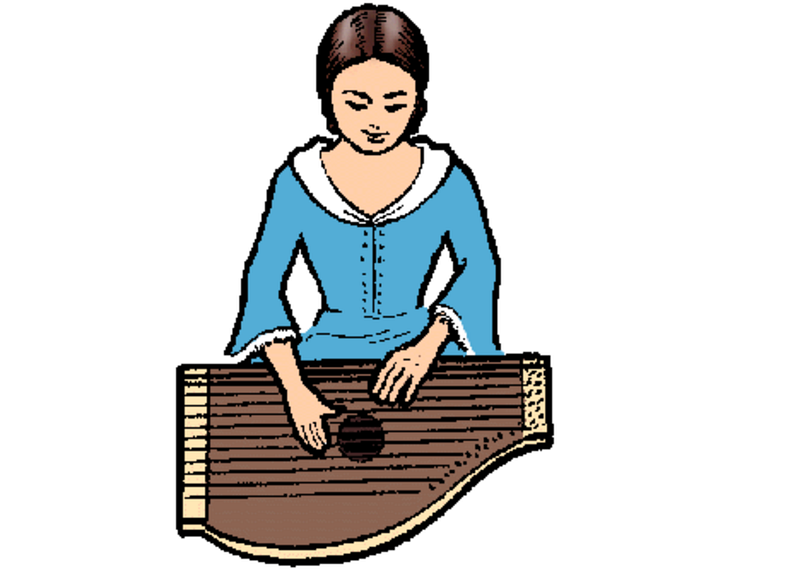
I found this live-version of the illustration:
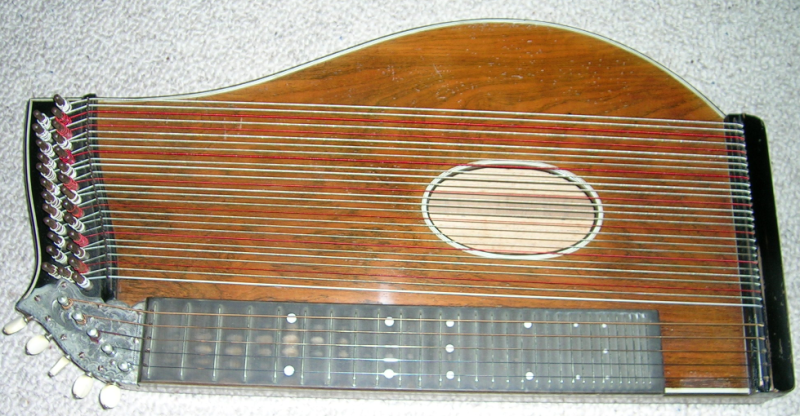
Taking into account the similarity between zither and cithara, along with the fact that there are a few New York Times articles that mention our daily word, I wonder why cithara ended up on the dord* pile.
Play it again, Yanni
Our friends at Merriam-Webster explain that cithara comes to English from the same Latin word. The Greeks used a similar term to describe that ancient instrument, but today kithara means “guitar” in modern Greece. Some experts believe the Latin word may have come from the Hebrew kinnor, which todays is used to refer to violins.
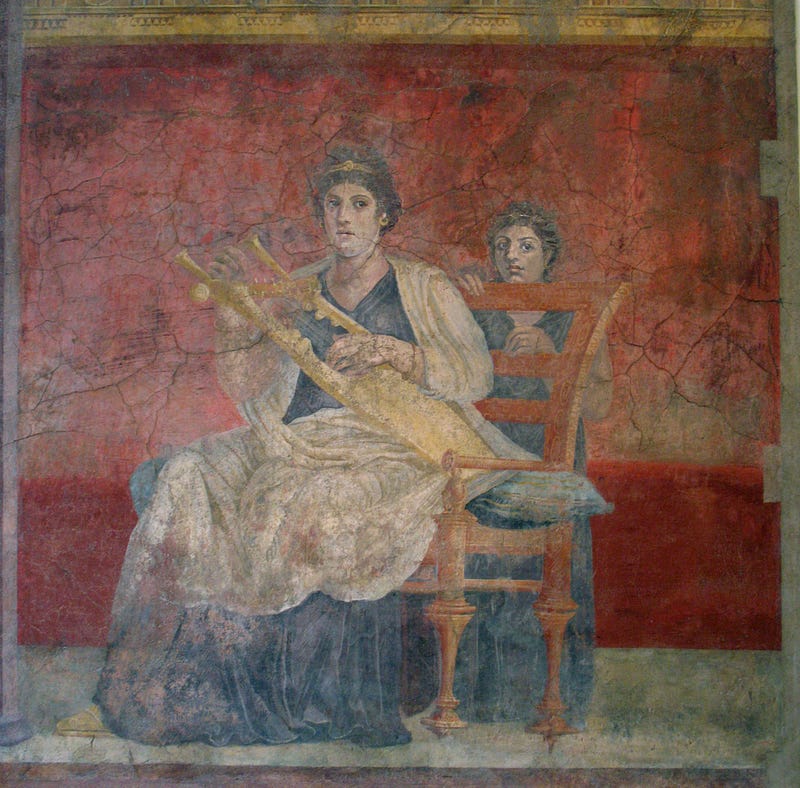
The development of the cithara may have arisen as an attempt to improve on the more primitive lyre while retaining some of its features. This “new and improved” version was mainly played by professional musicians known as kitharodes. It was considered the instrument of virtuoso players, generally requiring a great deal of skill. It was played by strumming the strings with a stiff pick made of dried leather and held in the right hand with elbow outstretched and palm bent inwards. The strings with undesired notes were damped with the straightened fingers of the other hand.
There is a famous statue of Apollo holding the a cithara and wearing the customary singer’s robes. Which makes sense, as Greek mythology claims the god of music to be the inventor of the instrument.
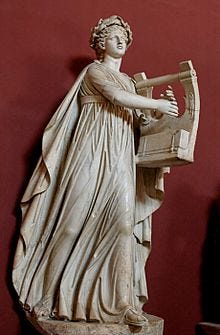
Not to be crude, but from this angle it seems as though he’s doing something entirely different with that poor cithara.
The cithara was played mostly as an accompaniment to dance, epic recitations, rhapsodies, odes, and lyric songs. But it could also be played as a solo instruments at the receptions, banquets, and sporting games.
In the Middle Ages, the word cythara (with a y) was also used generically to refer to stringed instruments, including lyres and other lute-like instruments.
Today the cithara lives on; some luthiers have made replicas in an attempt to produce the sound of classical Greek and Roman times. Here is Canadian musician Peter Pringle (no relation to P&G Pringles) playing one such cithara made in Greece.
Fiddling with an urban legend
Nero playing the fiddle while Rome burned to the ground is one of the oldest urban legends still circulating. Well, okay, the myth about the apple being the fruit that Eve gave Adam is older, but still.
Here is one depiction of Nero playing a string instrument while a fire rages in the background and people run around screaming. In other words, your basic Coachella or Burning Man event.
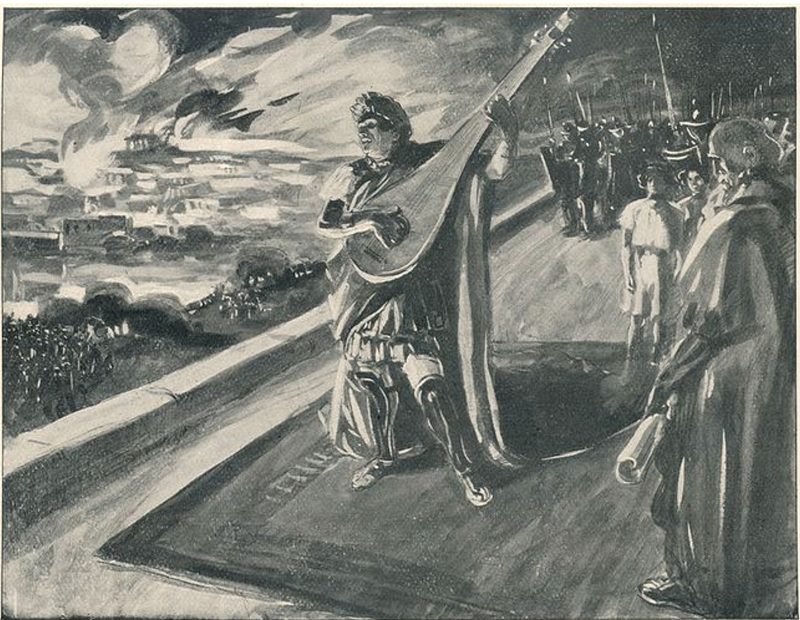
That instrument looks nothing like a fiddle, by the way. Compare the above illustration with the guy below.

No flames, no people panicking. Just the nerve-rattling, high-pitch sound of a cat being tortured.
So how did that urban legend about Nero get started? Well, for starters, the part about the fire is true. So true it merits separate articles in encyclopedias. In the 64 A.D., almost three-quarters of Rome was consumed by a fire that lasted almost an entire week. Roman historian Tacitus wrote that “of Rome’s 14 districts, only four remained intact. Three were leveled to the ground. The other seven were reduced to a few scorched and mangled ruins.”
Obviously someone had to be blamed. Rumors that Nero had either started the fire himself or ordered it began spreading around. This despite the fact that he had been dozens of miles from the city when the fire began, and rushed back to try and implement relief measures. In the face of such damaging accusations, Nero did what many politicians do: he spun things around and found some easy scapegoats: Christians. They were savagely persecuted, tortured, and executed.
But what about that specific imagery of Nero playing the fiddle? Well, the online Encyclopedia Britannica explains it this way:
Ancient tradition has it that Nero was so moved by the sight of the great fire that swept across the capital of his empire… that he climbed to the top of the city walls and declaimed from a now-lost epic poem concerning the destruction of Troy… Suetonius tells us that Nero wore theatrical garb to fit the occasion, while the later historian Dio Cassius added the detail that Nero dressed in “cithara player’s garb”… By the early Middle Ages, stringed instruments generally fell under the categorical term fidicula, from which our word “fiddle” derives. William Shakespeare correctly identified Nero’s instrument of choice when, in the first part of Henry VI, he wrote:
Plantagenet, I will; and like thee, Nero, Play on the lute, beholding the towns burn.
Shakespeare has always been a convenient writer to blame or give credit to, depending on circumstance. Here, he got the short end of the stick.
Nero was known for his artistic pursuits. Besides studying poetry, painting, and sculpture, he also sang and playing the cithara. His emphasis on the arts, chariot-racing and athletics earned him the nickname “actor-emperor”. I guess being a movie or TV star and then becoming leader of a country isn’t such a new thing after all.
Anyway, between 1590 when Shakespeare’s play was written and 1624, when a play called The Tragedy of Nero was published, the Shakespearean lute transformed into a fiddle. There was a direct mention of the instrument in 1649 by playwright George Daniel: “Let Nero fiddle out Rome’s obsequies.” Ever since then Nero has been fiddling as Rome burned.
Author and history expert Mary Francis Gyles has a theory that the phrase is to be taken metaphorically, not literally. As in “Nero fiddling” meant he was an ineffective leader come crunch time. As history.howstuffworks.com explains, “If the measures Nero took following the fire were perceived as misdirected or inadequate, then saying Nero fiddled while Rome burned takes on a whole new meaning.”
And considering Nero’s well-earned fame as a sadistic monster, it’s hard to feel sorry for him at all.
Now you know. Next time someone tries to show off by telling you that Emperor Nero didn’t actually play the fiddle while Rome was burning, you can out-show-them-off by saying: “Duh! It was a cithara!” Don’t be surprised if they make fun of you, though … because the editors of the Spelling Bee decided that cithara is a dord*.
You can check out my previous entry on another dord* here:
*What the heck is a dord, you ask? Here’s the answer: