
Losing My Mind On The Trans-Mongolian Railway
And I haven’t found it since
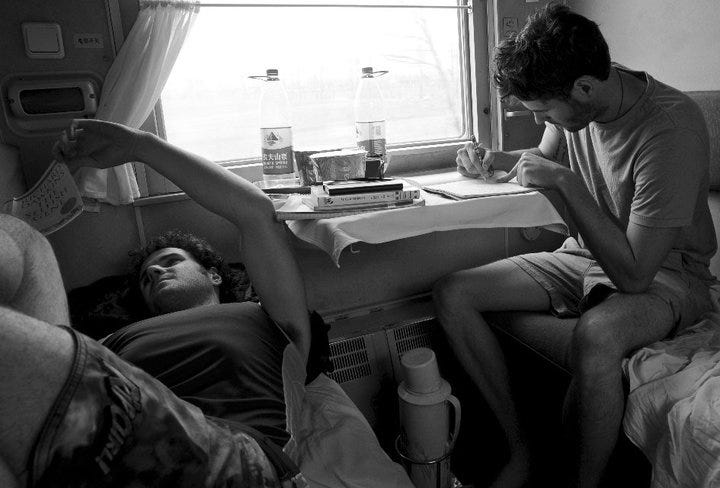
Travelling these days is easy. You get on a plane, watch a movie, fall asleep, and voila, you have arrived at your destination. You might arrive with a sore back and some mild constipation but you made it there in what would historically be record time. My brother always hated this about flying. He believed that it robs us of one of the best parts of travel; the gradual movement from one place to another.
So in 2010 when my brother said he was moving to Paris and I told him I was going backpacking around Europe, he came up with a plan for us to take the long way there.
Starting in China.
Look at it there, on a map. It’s quite a long way from Europe and yet it was there in Beijing that we started our journey. China welcomed us like celebrities. Everywhere we went, people would stop and ask us for photos. I think this was because they weren’t used to seeing tall white guys with afros like my brother and my cousin, while I was relegated to taking the photos most of the time.
From China, we travelled to Mongolia which, above all else, was cold. Sure, I could talk about the majesty of the steppe, that we always felt on the verge of being mugged in Ulaanbaatar, or how I almost died on a camel, yet the thing that sticks out to me about my time there was that I had never been so cold in my life.
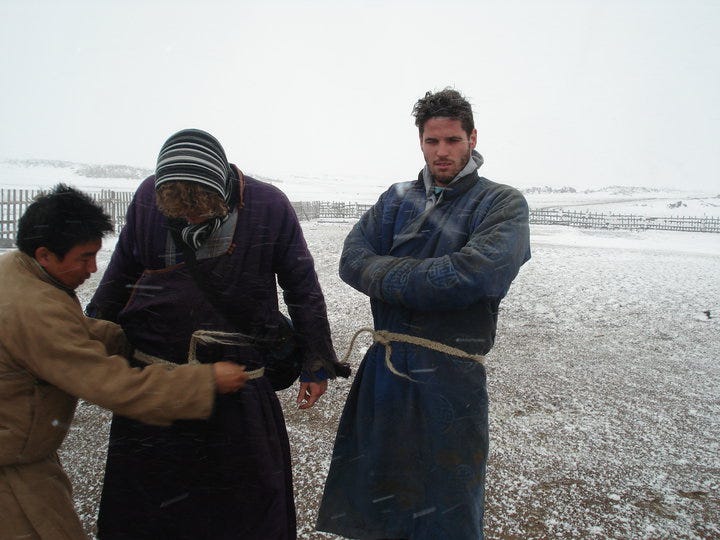
It was May.
According to my maths, that should be spring or almost-summer, and yet we got caught in a blizzard that we were woefully unprepared for. I survived by wearing underpants around my head, at which point we returned to Ulaanbaatar and boarded a train that we would be on for five days. I didn’t have to worry about the cold then. The train was heated to about a thousand degrees which meant the second we stepped inside, we began dripping with sweat.
Our carriage was occupied by Mongolians and blue jeans. There were blue jeans everywhere and no, that’s not a euphemism for something else. I’m talking about plastic-wrapped blue jeans. They were tucked under our pillows and wedged between our sheets and when we confronted the Mongolian man in our cabin about it, he simply shrugged and took his jeans back.
It was only after our journey that we learned Mongolians smuggle blue jeans across the border and sell them in Russia, where they were banned. But we didn’t know this at the time. We simply assumed the man in our cabin really liked his pants.
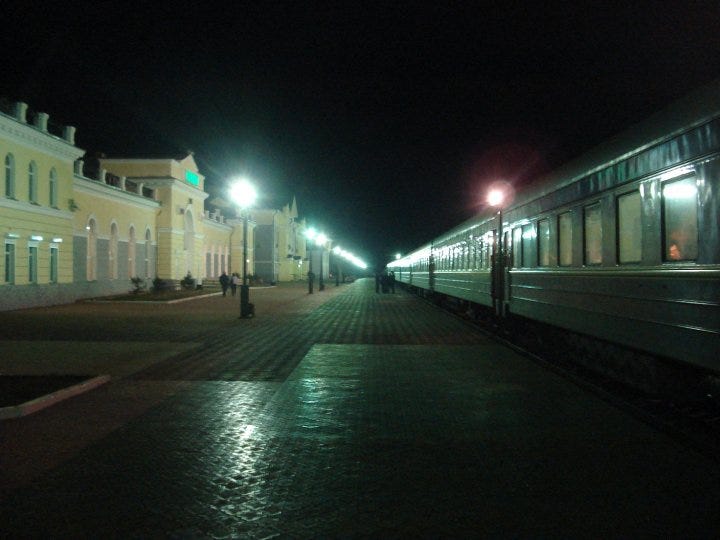
At the border, there was a mass Mongolian exodus as they gathered on the platform with their jeans and an assortment of other smuggled goods while the Russian guards pretended not to notice them. We were ushered into a waiting room while our visas were checked [getting a Russian visa was the worst headache I’ve ever had, followed closely by an India visa] and we were permitted to return to our train, on which we would remain on for a long, long time.
Most people get a ticket that allows them to hop on and off the train between Ulaanbaatar and their inevitable destination of Moscow or St Petersburg.
Amateurs.
We were doing it the long way, the hard way, five days trapped inside that sweaty little rail rocket as it ambled to its destination. My brother likes to say this was to give us an appreciation for travel as it once was but I know it was because it was cheaper this way, and he was the one who paid for my ticket.
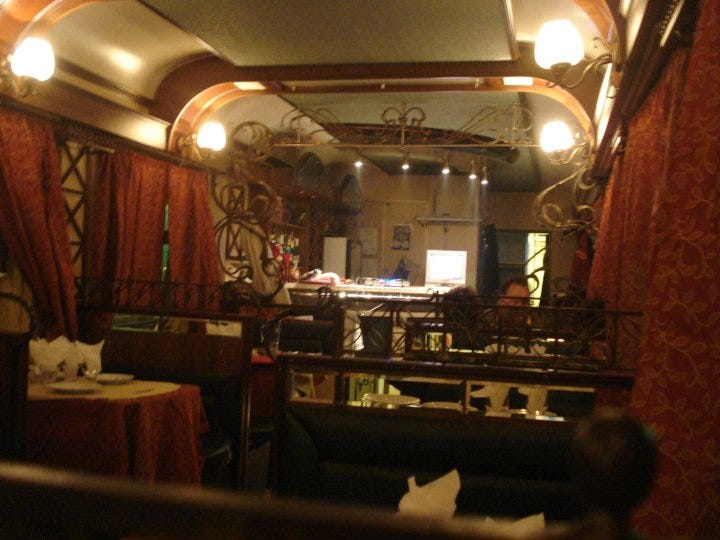
The epicentre of the train was the dining carriage. It was here that people would come for their much needed booze and undercooked chicken. Apparently, it didn’t matter that the chicken was undercooked because the amount of vodka you were drinking would kill any bacteria in your stomach before the bacteria in your stomach had a chance to kill you.
It was a terrifying place where the Russians would spend most of their time staring at us as they silently pounded their drinks. This was until they got drunk enough to come over to talk to us, at which point they would join our table and proceed to yell at us in Russian that we couldn’t understand. We would have to sit there, smiling, nodding, being yelled at by Russians who hadn’t showered in days. As such, we kept our visits to the dining car down to once a day.
Once.
A day?
What is a day again?
Sorry, it’s hard to tell when you’re travelling across eleven time zones with no way to keep track of them. It was a near-endless day punctuated by the occasional night. We would only sleep when we were tired and we were tired all the time on account of our diet of alcohol, peanut butter, and undercooked chicken.
The in-train entertainment options were rather limited. There was alcohol, of course, and plenty of it, procured from the dining carriage or the babushkas selling it on the platforms of the stations we passed. There was a deck of cards, which we played in accompaniment with the aforementioned alcohol.
There was also an iPod, too, as this was at a time before smartphones killed travel. We had to take turns listening to it and to this day, I can’t listen to Wolfgang Amadeus Phoenix without being transported back to those five days of madness.
One of the biggest challenges we had was buying water. The babushkas on the platforms sell it but the majority of water they sell is sparkling. Given that the train was heated to a million degrees, that sparkling water would very quickly become warm and undrinkable.
Nothing felt worse than getting back on the train, cracking a bottle, and hearing the pssshhhh of the bubbles within.
My cousin did this on day three and proceeded to invert the bottle, pouring it all over himself as he giggled and bathed himself like a Roman king. That was the moment when I knew I had lost my mind. I looked at him and thought, yep, this is normal behaviour, carry on good sir!
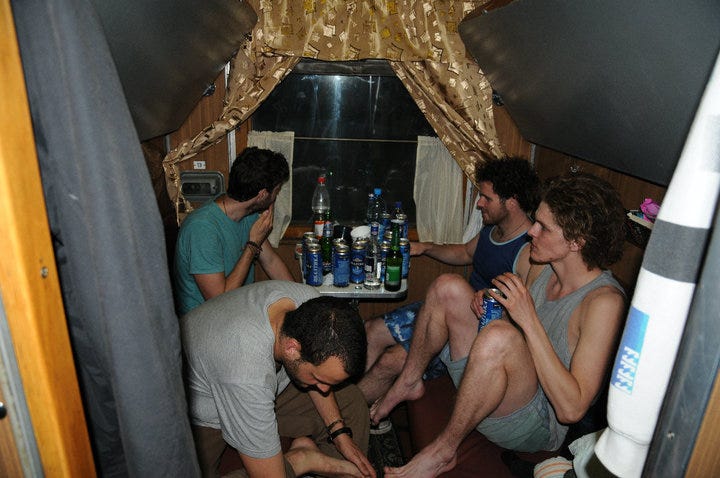
Another reason that I could tell we were losing our minds was that we started to view the world beyond the train as a hostile place. We had become institutionalised in that little carriage of ours and the closer we got to Moscow, the more we dreaded leaving it. There were people on the platforms who weren’t just babushkas but real, living, breathing humans, staring at us like lepers as we stared back at them with our faces pressed up against the dirty glass.
The train did, inevitably, arrive in Moscow, where we shuffled outside, winced against the sunlight, and said farewell to what had been our home in motion. The whole experience had given me a new appreciation for what travel must have been like back in the days before airlines dominated the skies. It also gave me an appreciation of showers and fresh food to fight off the scurvy that was creeping up on me.
Was Russia beautiful?
I don’t know, maybe, the windows were dirty and it was hard to see out of them. The only time you could get a good view outside was in the smokers’ box at the end of each carriage and as a non-smoker, I think I must have smoked at least two hundred cigarettes just standing there. I think if the experience taught me anything it’s that when you’re travelling over two thousand kilometres, sometimes flying really is the best option.