avatarManasi Kudtarkar

Free AI web copilot to create summaries, insights and extended knowledge, download it at here

4253

Abstract

<b>David Frawley.</b></p></blockquote><p id="aff2">Ram is the seventh avatar of Lord Vishnu — considered one of the Trinity — the three main gods from the pantheon of Indian Gods. <i>It is believed that whenever evil forces in the world cross a threshold, Vishnu reincarnates (takes physical form) on earth to destroy evil and, steer humanity back to virtue. </i>Ram was one such avatar (incarnation).</p><p id="16bb">Although born to royalty (King of Ayodhya, Dasarath and his first wife Kaushalya), and having grown-up amidst riches, Ram’s life was rife with trials and tribulations.</p><ul><li>His reluctant father asked Ram to forfeit his kingdom, on the insistence of his second wife (Kaikeyi), who wanted her own child (Bharat) to be the king. Courtesy of a promise he had once given Kaikeyi, Dashrath, although heartbroken, was honor-bound to abide by Kaikeyi’s wishes and had to banish Ram away. Dashrath died of heartbreak due to his separation from Ram soon after.</li><li>Ram spent 14 years in vanvas (lit. stay in the forest) during his exile, with his wife Sita, brother Lakshman and his foremost and beloved devotee Hanuman. During this time, Sita was kidnapped by an evil asura (demon) called Ravan — the King of Lanka (present-day Sri Lanka). Ram had to wage a brutal war and kill Ravan to win Sita back.</li><li>After returning to Ayodhya, post-victory, Ram was crowned king; but his good fortunes were short-lived. Due to aspersions on Sita’s fidelity to him, Ram abandoned her in the care of a saint in a forest.</li><li>Sita was pregnant at the time and soon gave birth to twin boys, Luv and Kush. But Ram never met his twin sons, until one day he was unwittingly caught in a battle with them — unaware of their true identities — and Sita intervened to stop the fight.</li><li>Ram questioned Sita about the legitimacy of their children. Sita, a proud woman and the daughter of Mother Earth, descended back into the earth’s womb. So, Ram lost Sita and soon after that he himself died.</li></ul><p id="2891">Despite the hardships and grief that life rained on him, Ram never once wavered from his chosen path of righteousness, truthfulness, compassion, and mercy. He never lost his composure, always conducted himself with grace and honor, and upheld the principles he stood by until his last breathe.</p><ul><li>He followed his father’s orders to forfeit his claim to the kingdom, without question or complaint, and without any malice towards his step-mother or brother.</li><li>He fought bravely with Ravan, who was a mighty asura himself. There was a time in Ramayana when Ram was a little despondent and weary from battle. Ravan’s energetic attacks made him begun to lose hope. At that time, a mantra (Sanskrit incantation with the power to affect one’s consciousness and sometimes even the Universe, in case of a particularly powerful one) was revealed to him. That mantra lifted his spirits, and he then went on to defeat Ravan.</li></ul> <figure id="3392"> <div> <div> <img class="ratio" src="http://placehold.it/16x9"> <iframe class="" src="https://cdn.embedly.com/widgets/media.html?src=https%3A%2F%2Fwww.youtube.com%2Fembed%2FO00BFBR6hoM%3Ffeature%3Doembed&amp;display_name=YouTube&amp;url=https%3A%2F%2Fwww.youtube.com%2Fwatch%3Fv%3DO00BFBR6hoM&amp;image=https%3A%2F%2Fi.ytimg.com%2Fvi%2FO00BFBR6hoM%2Fhqdefault.jpg&amp;key=a19fcc184b9711e1b4764040d3dc5c07&amp;type=text%2Fhtml&amp;schema=youtube" allowfullscreen="" frameborder="0" height="480" width="854"> </div> </div> </figure></iframe></div></div></figure><ul><li>After killing Ravan, Ram went in penance for a year because he had killed a great devotee of God.</li><li>He was a just and compassionate king, loved, respected, and worshipped by his subjects. His mercy extended to animals and birds as well.</li></ul><p id="c84d">Ram was an ideal king, an ideal son, an ideal brother, and an ideal husband. He was heroism personified and was aptly known as Purushottam (lit. excellent or superior man). That is his legacy, that is why — 7000 years later — he still reigns supreme in the hearts of his devotees. That is why the ideal of Ram is immortal!</p><h1 id="92e

Options

3">Ramayana — Fact or Fiction?</h1><p id="bf82">The appeal of Ramayana lies not only in its esotericism and mystique, but much more in its relatability to man’s eternal life-problems, and how they should be handled, as exemplified by not only Ram but also various other characters from Ramayana. Dashrath, the ideal king, Sita, the perfect wife, Lakshman, an obedient and loyal younger brother, Hanuman, the specimen of a perfect devotee, Ravan, the learned and wise man, albeit, the villain of the tale. That is why the message of Ramayana is universal and resonates with many even today.</p><p id="f42e">The veracity of the actual events from Ramayana has been a subject of much controversy and debate. Poets and authors throughout history have been guilty of employing hyperbole to stress on notable points, but that doesn’t negate the verity of those points.</p><p id="2398">Despite being branded as a myth by some, we cannot overlook several historical facts that point to its real occurrence. Whether fact or fiction, Ramayana is still a beloved scripture of the Indian Hindus and Ram, as heroic a character today as he was yesterday.</p><h1 id="d9e1">Ram Navami Celebrations</h1><p id="1c34">Ram Navami is Ram’s birth anniversary and falls on the ninth day of the waxing moon phase of the Indian month <a href="https://readmedium.com/festivals-of-india-a-sneak-peek-f5e96f18b4cb">Chaitra</a>.</p><div id="7c04" class="link-block"> <a href="https://readmedium.com/festivals-of-india-a-sneak-peek-f5e96f18b4cb"> <div> <div> <h2>Festivals of India — A Sneak Peek</h2> <div><h3>A brief history and an overview of the multitudes of festivals celebrated in India.</h3></div> <div><p>medium.com</p></div> </div> <div> <div style="background-image: url(https://miro.readmedium.com/v2/resize:fit:320/1*1HM_vyitKqDanwkjSJtmxQ.jpeg)"></div> </div> </div> </a> </div><p id="8e72">Devotees from all over India flock to Ayodhya on this day and flung themselves at Ram’s symbolic altar — his birthplace. They bathe in the holy Sarayu river, sing devotional songs all day, fast from sunrise to sunrise.</p><p id="8754">Many perform Ramlila (lit. Ram’s play) — a dramatic re-enactment of Ramayana — to spread the message of Ram and the ideals he upheld.</p><figure id="c6d6"><img src="https://cdn-images-1.readmedium.com/v2/resize:fit:800/1*8olyd8ajp3YLnLi-9HX3-w.jpeg"><figcaption></figcaption></figure><figure id="f968"><img src="https://cdn-images-1.readmedium.com/v2/resize:fit:800/1*_6JBOStmpvQy2EAtc5qnXQ.jpeg"><figcaption>Image of a Ram Lila performance (dramatic re-enactment of Ramayana), by <a href="https://pixabay.com/users/Tanuj_handa-5848532/?utm_source=link-attribution&amp;utm_medium=referral&amp;utm_campaign=image&amp;utm_content=2803390">Tanuj Handa</a> from <a href="https://pixabay.com/?utm_source=link-attribution&amp;utm_medium=referral&amp;utm_campaign=image&amp;utm_content=2803390">Pixabay</a></figcaption></figure><p id="8332">Many a Hindu, in India and abroad, from Ayodhya to New York to D.C, unanimously echoed the sentiment of deep love and complete devotion towards Ram, as they were seen fervently uttering the words “Jai Shri Ram” (Hail Ram).</p><p id="9249">With the commencement of the building of the Ram Mandir in Ayodhya, for all the true-blue devotees of Ram, the symbolic <i>altar of their beloved Lord will finally assume a brick and mortar form.</i></p><h1 id="3cc9">References</h1><ol><li><a href="https://www.dlshq.org/download/download.htm#spotlights">Spotlights on Ramayana — By Shri Swami Premanand</a></li><li><a href="https://isha.sadhguru.org/us/en/wisdom/article/sri-rama-navami-conducting-yourself-gracefully">https://isha.sadhguru.org/us/en/wisdom/article/sri-rama-navami-conducting-yourself-gracefully</a></li><li><a href="https://www.drikpanchang.com/dashavatara/rama-navami/rama-navami-date-time.html?year=2020">https://www.drikpanchang.com/dashavatara/rama-navami/rama-navami-date-time.html?year=2020</a></li></ol><p id="9662"><a href="https://exciting-teacher-6474.ck.page/912886dc82">Keep in touch, friends</a>.</p></article></body>

Lord Ram Lights up Times Square in a Digital Extravaganza

But, what is an Indian deity doing on New York’s billboard?

What happened on 5th August 2020, in two completely different parts of the world — New York and Ayodhya, India — is modern history in the making.

I’m referring to the largest-ever digital display of an India deity, Lord Ram, in New York’s Times Square to commemorate the groundbreaking ceremony (“Bhoomi Pujan”) of the planned temple of Lord Ram (Ram Mandir) in Ayodhya, India — a whooping 7k miles away. But on 5th August, both venues marched to the beat of the same drum.

These two events will go down in the annals of history as monumental — a turning point in history that reeks of violence and blood, and has left hundreds dead and shattered in its wake of around five hundred years, all over a disputed piece of land!

History

Hindus regard the land in question as the birthplace of Lord Ram, the seventh avatar of Vishnu (one of the three principal deities of India). It is also where once stood Babri Masjid (a Muslim mosque built by the Mughal emperor, Babar).

The crux of the dispute revolves around whether a temple or a mosque was the foremost inhabitant of one of the most disputed lands inside the territories of India.

The Babri Masjid was demolished in a political rally turned riot on 6th December 1992. The act led to the widespread Hindu-Muslim riots all over the country with a death toll to the tune of 2K. The Hindus allege that the Babri Masjid was built by destroying a temple that once stood there.

The catharsis of a longstanding feud.

On 9th November 2019, the Supreme Court of India settled the painstakingly long-running case. The decision was based on archaeological evidence of the existence of a non-Islamic structure on land in question, before the construction of Babri Masjid. In the catharsis of a longstanding feud, the court ordered the land to be handed over to a trust to build the Ram Mandir and asked the Government to allocate an alternate 5 acres of land to the Muslims to build a mosque.

That stipulation of the ruling finally came to fruition on this celebrated day — 5th August 2020 — with the laying of the foundation of the new Ram Mandir.
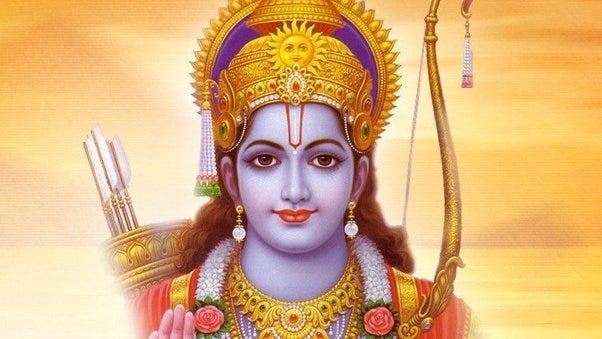
Image of Lord Ram by Mohalimunda from Wikimedia Commons

Who is Ram? And why is he so important?

Ramayana or the tale of Ram was written 7000 years ago by a sage Valmiki, in the form of a poem — considered the first Sanskrit poem ever written. It is an epic and exquisite account of the protagonist — Ram’s — life, written with an unparalleled finesse that has made it a masterpiece of religious and spiritual literature worshipped with fervent reverence even today.

It has been translated in both prose and poetry countless times, not only in Indian languages but also in English, French, Italian, Latin, Russian to name a few.

“No ancient story, not even Homer’s Iliad or Odyssey, has remained as popular through the course of time. The story of Ram appears as old as civilization and has a fresh appeal for every generation.” ― David Frawley.

Ram is the seventh avatar of Lord Vishnu — considered one of the Trinity — the three main gods from the pantheon of Indian Gods. It is believed that whenever evil forces in the world cross a threshold, Vishnu reincarnates (takes physical form) on earth to destroy evil and, steer humanity back to virtue. Ram was one such avatar (incarnation).

Although born to royalty (King of Ayodhya, Dasarath and his first wife Kaushalya), and having grown-up amidst riches, Ram’s life was rife with trials and tribulations.

  • His reluctant father asked Ram to forfeit his kingdom, on the insistence of his second wife (Kaikeyi), who wanted her own child (Bharat) to be the king. Courtesy of a promise he had once given Kaikeyi, Dashrath, although heartbroken, was honor-bound to abide by Kaikeyi’s wishes and had to banish Ram away. Dashrath died of heartbreak due to his separation from Ram soon after.
  • Ram spent 14 years in vanvas (lit. stay in the forest) during his exile, with his wife Sita, brother Lakshman and his foremost and beloved devotee Hanuman. During this time, Sita was kidnapped by an evil asura (demon) called Ravan — the King of Lanka (present-day Sri Lanka). Ram had to wage a brutal war and kill Ravan to win Sita back.
  • After returning to Ayodhya, post-victory, Ram was crowned king; but his good fortunes were short-lived. Due to aspersions on Sita’s fidelity to him, Ram abandoned her in the care of a saint in a forest.
  • Sita was pregnant at the time and soon gave birth to twin boys, Luv and Kush. But Ram never met his twin sons, until one day he was unwittingly caught in a battle with them — unaware of their true identities — and Sita intervened to stop the fight.
  • Ram questioned Sita about the legitimacy of their children. Sita, a proud woman and the daughter of Mother Earth, descended back into the earth’s womb. So, Ram lost Sita and soon after that he himself died.

Despite the hardships and grief that life rained on him, Ram never once wavered from his chosen path of righteousness, truthfulness, compassion, and mercy. He never lost his composure, always conducted himself with grace and honor, and upheld the principles he stood by until his last breathe.

  • He followed his father’s orders to forfeit his claim to the kingdom, without question or complaint, and without any malice towards his step-mother or brother.
  • He fought bravely with Ravan, who was a mighty asura himself. There was a time in Ramayana when Ram was a little despondent and weary from battle. Ravan’s energetic attacks made him begun to lose hope. At that time, a mantra (Sanskrit incantation with the power to affect one’s consciousness and sometimes even the Universe, in case of a particularly powerful one) was revealed to him. That mantra lifted his spirits, and he then went on to defeat Ravan.
  • After killing Ravan, Ram went in penance for a year because he had killed a great devotee of God.
  • He was a just and compassionate king, loved, respected, and worshipped by his subjects. His mercy extended to animals and birds as well.

Ram was an ideal king, an ideal son, an ideal brother, and an ideal husband. He was heroism personified and was aptly known as Purushottam (lit. excellent or superior man). That is his legacy, that is why — 7000 years later — he still reigns supreme in the hearts of his devotees. That is why the ideal of Ram is immortal!

Ramayana — Fact or Fiction?

The appeal of Ramayana lies not only in its esotericism and mystique, but much more in its relatability to man’s eternal life-problems, and how they should be handled, as exemplified by not only Ram but also various other characters from Ramayana. Dashrath, the ideal king, Sita, the perfect wife, Lakshman, an obedient and loyal younger brother, Hanuman, the specimen of a perfect devotee, Ravan, the learned and wise man, albeit, the villain of the tale. That is why the message of Ramayana is universal and resonates with many even today.

The veracity of the actual events from Ramayana has been a subject of much controversy and debate. Poets and authors throughout history have been guilty of employing hyperbole to stress on notable points, but that doesn’t negate the verity of those points.

Despite being branded as a myth by some, we cannot overlook several historical facts that point to its real occurrence. Whether fact or fiction, Ramayana is still a beloved scripture of the Indian Hindus and Ram, as heroic a character today as he was yesterday.

Ram Navami Celebrations

Ram Navami is Ram’s birth anniversary and falls on the ninth day of the waxing moon phase of the Indian month Chaitra.

Devotees from all over India flock to Ayodhya on this day and flung themselves at Ram’s symbolic altar — his birthplace. They bathe in the holy Sarayu river, sing devotional songs all day, fast from sunrise to sunrise.

Many perform Ramlila (lit. Ram’s play) — a dramatic re-enactment of Ramayana — to spread the message of Ram and the ideals he upheld.
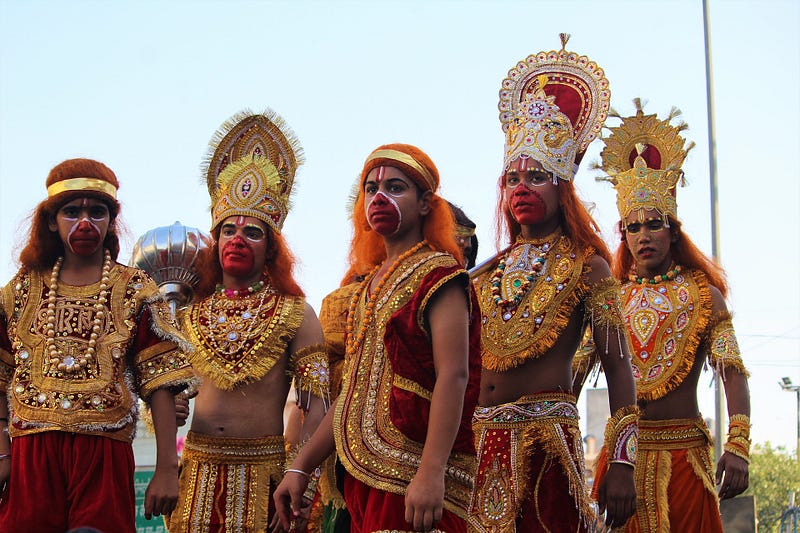
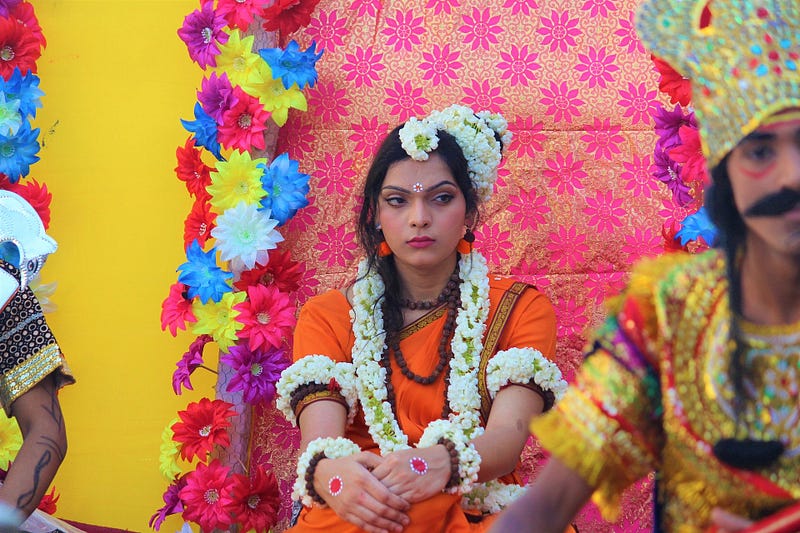
Image of a Ram Lila performance (dramatic re-enactment of Ramayana), by Tanuj Handa from Pixabay

Many a Hindu, in India and abroad, from Ayodhya to New York to D.C, unanimously echoed the sentiment of deep love and complete devotion towards Ram, as they were seen fervently uttering the words “Jai Shri Ram” (Hail Ram).

With the commencement of the building of the Ram Mandir in Ayodhya, for all the true-blue devotees of Ram, the symbolic altar of their beloved Lord will finally assume a brick and mortar form.

References

  1. Spotlights on Ramayana — By Shri Swami Premanand
  2. https://isha.sadhguru.org/us/en/wisdom/article/sri-rama-navami-conducting-yourself-gracefully
  3. https://www.drikpanchang.com/dashavatara/rama-navami/rama-navami-date-time.html?year=2020

Keep in touch, friends.

India
History
Spirituality
Travel
Politics
Recommended from ReadMedium