Logic is Just a Very Complex Emotion
Thoughts on Adrian Tchaikovsky’s “Children of Ruin”
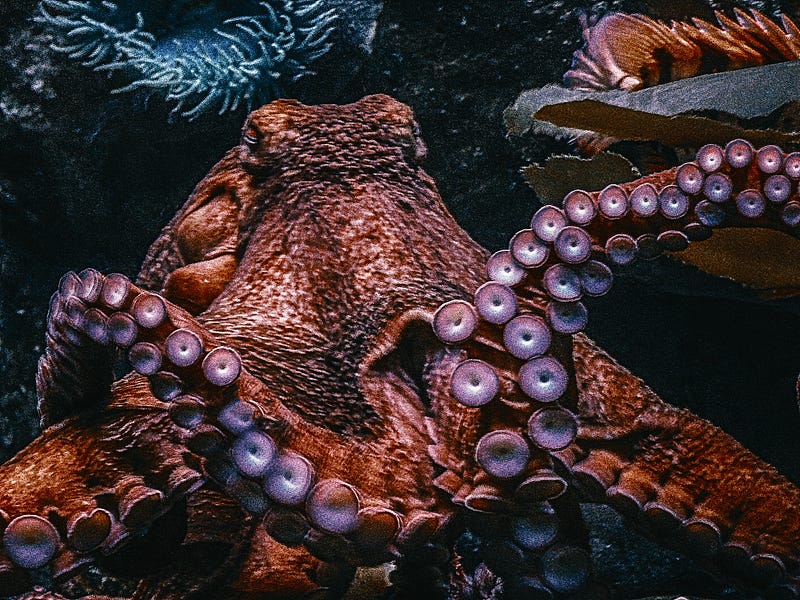
Last week I wrote a review of Children of Time, the first book in Adrian Tchaikovsky’s Children of Time trilogy. This week, I’m back with some thoughts on the second installment, Children of Ruin.
Plot
Ruin picks up a couple generations after Time. Humans and spiders have developed a common civilization on Kern’s World, though some humans resist the new arrangement. The hold-outs live on reservations, but the younger generation takes much more easily to life with the Portiids, so the reservation culture is dying off.
As Ruin opens, a crew of human and spider astronauts has just reached the outer reaches of another solar system, following a signal broadcast from one of its inner planets. They soon discover a spacefaring civilization of octopuses living in orbit around an ocean planet.
The octopuses had been brought to this solar system by ancient human terraformers, and had been infected with a version of the uplift nano virus we encountered in Time. When the cataclysm that destroyed human civilization came, the octopuses inherited the terraformers’ project.
But their watery world — which the humans called Damascus — was not the only candidate planet for terraforming. The next planet in toward the sun — dubbed Nod by the humans — seemed at first blush to be an even more promising new home.
It was a rocky planet teeming with life, but one of the organisms was a relentless parasite. This parasite essentially copies the external and internal mechanics of every creature it infects, and when it gets inside a human, the act of copying a human’s cognition gives it sentience.
One of the infected humans on Nod brings the parasite to Damascus. For a long time, his crashed shuttle sits at the bottom of the sea, as the octopus civilization evolves for thousands of years. But eventually, the parasite gets loose, and soon the surviving octopuses have to flee into their space elevators and their home-ships, massive moon-sized crafts filled with water.
When the Human/Portiid crew arrives, the octopuses intercept them. There ensues a series of tense exchanges, and some lethal space warfare, as the two civilizations try in fits and starts to understand one another’s motives. The octopuses are rightly worried about anyone making contact with Nod, and once again unleashing the deadly parasite. But can they make the humans and spiders understand?

Themes
The action in Ruin revolves around two story lines: the Human/Portiid interactions with the Octopus civilization, and the interactions of all three species with the parasite from Nod.
Let’s start with the Human/Portiid/Octopus storyline. The main themes here have to do with how octopus intelligence differs from human and spider intelligence, and how that affects their ability to communicate with one another.
In his book “Other Minds: The Octopus, the Sea, and the Deep Origins of Consciousness,” philosopher Peter Godfrey-Smith describes the many ways that octopuses and other cephalopods differ from mammals, despite being very intelligent animals in their own right.
One key difference has to do with how diffuse their nervous systems are. Most of our neurons are concentrated in our brains. But while octopuses have brains, a much larger share of their neurons are spread out among their tentacles. It’s as if the organism is less a single being and more like a confederation acting under the influence of a relatively weak central government.
I suspect Tchaikovsky has read Godfrey-Smith, or some other expert on cephalopod intelligence, because he has a lot of fun with this idea. The octopuses in Ruin have a consciousness that’s distributed between what he calls the Crown and the Reach.
The Crown is not the seat of reason, as you might expect if you imagine them to be like us. Rather, logical operations are performed by the Reach. The Crown is the seat of emotion. And in octopus society, it is the richness of feeling that is believed to be the marker of intelligence. That feeling is conveyed from one octopus to another through complex color patterns displayed on the skin.
When the Humans and Portiids encounter octopuses for the first time, the former are stumped by the latter’s chromatic communication. The human linguist is for a long time unable to see anything more than simple emotions like anger, curiosity, or fear. The octopuses, for their part, wonder whether these bland creatures have much of an inner life at all, given how shallow their emotional displays appear to be.
Reading these parts of Ruin reminded me of philosopher David Hume, who argued, contra Descartes, that “reason is and ought only to be a slave of the passions.”
It also reminded me of Lewis Carroll’s essay, “What the Tortoise said to Achilles.” My takeaway from that story, which I’ve developed at greater length here, is that logic and emotion are not distinct. Rather, a logical inference just is the triangulation of complex emotions. Those emotions are encoded in the symbols that make up language. If we couldn’t feel, we couldn’t think.
The other major storyline centers around the dangerous mimicking parasite from Nod. Until it gets hold of a human, this parasite was content to move from one simple organism to another in the shifting tide pools of Nod. But once it infects a sentient creature, it realizes just how vast the cosmos is. This realization, coupled with its innate drive to spread, gives it an insatiable wanderlust.
But it also has no self-discipline. It can only temporarily sate its wanderlust by spreading to new creatures, and as soon as the novelty wears off, it has to spread to still others. And every time it spreads, its new host is essentially consumed from the inside out.
The humans, spiders, and octopuses are all at a loss. It seems the only option is to contain the parasite if possible. But Avrana Kern, the digitally uploaded consciousness of the human of the same name, hits upon a more optimal solution.
I don’t want to say what that solution is, or how she arrives at it, since that would spoil the readers’ enjoyment. This part of the novel weaves in concepts from Buddhist philosophy, such as the idea that possessing the object of our desire never brings the satisfaction we think it will, and this disconnect is the root of our suffering. It also makes a strong case for the importance of all kinds of diversity in any society.
Next week, I’ll write up a review of the final installment of the trilogy, Children of Memory. Thanks for reading!