What is It Like To Be a Spider?
Adrian Tchaikovsky’s “Children of Time” is a philosophical page-turner.
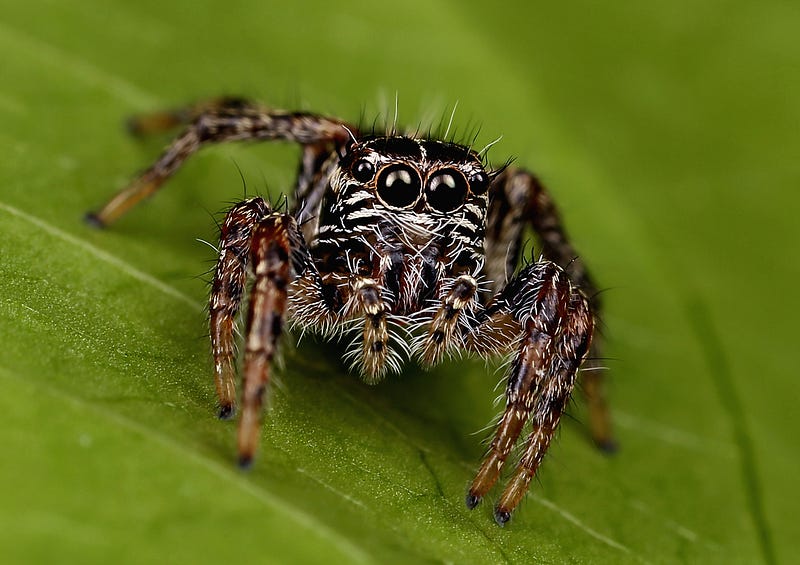
In 1974, the philosopher Thomas Nagel famously asked, “What is it like to be a bat?” Could we even imagine what consciousness is like for another kind of being, or do we just kid ourselves that we could? Is it the case, as Wittgenstein declared, that “if a lion could speak, we could not understand him”?
In his engrossing sci-fi trilogy “Children of Time,” Adrian Tchaikovsky takes a more optimistic stance. Not only can we overcome difficulties of communication and become intelligible to one another, we must. Our survival depends on it.
The first book in the series, Children of Time is set thousands of years in the future. A remnant of humanity has survived a global holocaust and an ice age, but is forced to take to the stars to escape an Earth that has become unlivable.
Their ancient ancestors had once ventured to the stars as well, trying to find worlds that would be suitable candidates for terraforming. Their descendants are now seeking out those worlds, hoping to find some refuge somewhere in the cosmos.
On one such world, the Ancients had undertaken a project to “uplift” monkeys by infecting them with a nanovirus that would alter their DNA, accelerating their evolution and making them bigger, smarter, and more social.
The idea was to seed the planet with beings who could carry on the terraforming for them, so that humans could return centuries later to find a ready-made Eden where they would be welcomed as gods. Only things didn’t work out that way.
Before the monkeys could be infected and sent to the planet, a global civil war erupted on Earth. The monkeys and most of the humans crashed unceremoniously when insurgents on Earth sent out a computer virus to destroy human spacecraft in other solar systems.
But some organisms that had already been seeded on the planet did get infected, in particular a species of jumping spider called Portia labata. Over thousands of years, we see the evolution of these spiders into conscious beings creating a complex society.
And it’s this complex society that the remnant of humanity eventually finds. Who will inherit this new Earth, spiders or humans? Is there any way they could learn to live together? And given how much we learn about spider society, how many characters’ lives we share along the way, if it does come to war, who are we the readers really rooting for?
I don’t want to give away any spoilers about the end. Instead, I want to talk about some interesting themes and ideas Tchaikovsky raises over the course of the novel.
One interesting theme is feminism, or perhaps I should say masculinism. You see, in almost all spider species the female is significantly larger than the male, and often kills and eats the male during or after copulation. This becomes an interesting theme throughout the story.
In their early evolution, the spiders experience the insight of learning to see each other not just as “mate” or “rival” or “prey,” but also sometimes as “ally.” They, in particular the females, have to suppress their cannibalistic urges.
But their superior size and strength mean that they still structure their society so that females run the show. Early on, male lives have little value. Wealthier females often hunt them for sport. Over the ages, these behaviors are gradually shunned enough that outright killings become rare, though male spiders still retain their ancestral fear of female violence.
But even after their lives are protected by custom, males are not afforded the same opportunities as females. They are not believed to have the same capacity for rational thought. We meet males who are brilliant scientists, but to be allowed to do their work they must “dance” for powerful females. The experience is degrading. And often, they must let powerful females get the credit for their work.
Reading this novel, I was reminded of former Justice Ruth Bader Ginsburg who, as a litigator, often brought cases on behalf of men harmed by laws that discriminated on the basis of sex. Surmising that the all-male panels of judges she argued in front of would have more empathy for a male plaintiff, she helped establish precedents that could then be turned around to protect women’s equality too.
Tchaikovsky is doing something similar. Male readers who might not empathize with the aims of feminism are asked to put the shoe on the other foot. By asking what it might be like to be a male spider in Portiid society, he gets us to think about what it has been like to be a woman throughout most of human history.
Another interesting theme in the novel is communication. Spider anatomy is obviously very different from that of humans. For one thing, they lack the ears and the vocal chords that make human speech possible.
But they are very sensitive to touch and vibrations. Not surprisingly, as the spiders grow more intelligent they begin to develop a system of communication based on sending signals along their webs. Spider cities are massive networks of webs, and when any two spiders are in close proximity to one another, communication becomes a matter of tapping their thoughts onto the web like a telegraph operator sending a message in Morse code.
But the Portiids aren’t just able to communicate directly with each other. They’re also able to communicate, in a way, with their ancestors. The Portiid brain is smaller than that of humans, and more reliant on fixed neural pathways. So rather than learn most new skills the way humans do, Portiids largely inherent “Understandings” from their parents.
Eventually, Portiid scientists figure out how to distill Understandings so that they can acquire the Understandings even of spiders who aren’t their direct ancestors.
In fact, spider science is geared much more to biotech and bioengineering, rather than physics. One of the most fascinating parts of the book comes when Portiid scientists discover how to use chemical signals to control their main rival, the ants. Subsequently the ants, whose relentless march nearly wiped out Portiid society, become their living tools. Portiid scientists develop all kinds of chemical compounds specifically tailored to make the ants perform different tasks.
And then something very interesting happens. For many years ant husbandry assumes that a given subcolony can only be used for one kind of task, since training them takes time. But recognizing a kind of logical structure to the ants’ behavior, one Portiid scientist (a male, incidentally), comes up with the idea of “programming” ants to be universally programmable.
In other words, the spiders hit upon the idea of a universal Turing machine, but instantiated in a colony of ants rather than silicon chips. They turn the supercolony into a supercomputer, the tech that eventually allows them to build radio, broadcast images, and build spacecrafts.
I want to end this review by saying one last thing about what I think is the most important topic in the book: empathy.
Humans have an instinctive aversion to spiders. The great challenge and great joy of this book is overcoming that aversion. And as the two species meet for the first time, and tensions are running high, that’s when our empathy is really put to the test.
If you’ve been paying attention, you might have already guessed the twist, the clever way that Tchaikovsky resolves the conflict between human and spider. If not, I won’t spoil it.
Next week I’ll publish a review of the second book in the trilogy, Children of Ruin.