
Post Critical Theory
Lobster: The Deliciously Cooked Useful Idiot of the Corporatocracy
If Jordan Peterson had never existed, Corporatocracy would have had to concoct him

A Self-Made Celebrity… Or Not?
First and foremost, let’s not delve into conspiracy theories (we’ll leave that prerogative to the venerable Alex Jones) — Jordan Peterson made himself. In this sense, he embodies the myth of capitalism, which suggests that everything depends solely on your talents and perseverance as you climb the career ladder.
However, a couple of sensitive questions arise here: 1) why did no one know about him for most of his life? Why didn’t he stand out in academic circles if he’s such a genius? And secondly, why did his rapid rise come to such an abrupt halt?
These are by no means idle questions, but first, let’s understand why Jordan Peterson is still relevant and will remain so in the foreseeable future.
It’s because he has garnered an immense following for his fruitless beliefs, effectively excluding them from those who could contribute to the fight against the domination of corporatocracy.
Proselytes of Lobsterism
That is problematic because many of them are perfectly decent people. As a researcher who has studied the phenomenon of Peterson’s cult extensively, I speak with confidence. These people, like the majority, are entirely disoriented by the realities of a neoliberal society. Peterson provides them with the most congruent set of answers to their troubling questions. He keeps them on a leash, preventing them from seeing the whole picture in its entirety.
There’s nothing new about this. Nature abhors a vacuum, and an ideological void must be filled with something. Peterson’s audience consists of those who have been rejected by everyone who supposedly knows the answers to why society no longer functions. These people just want to live a normal life. They want to be respected citizens. They want their damn opinions to be heard instead of just being told how to live and what to believe is right or wrong. They don’t want to be judged by their race, gender, sexual orientation, or political beliefs. Because let’s just acknowledge it — no one wants that.
I understand these people perfectly, and I sympathize with them. I myself fell under Dr. Peterson’s spell for a while, partly because of his love for Russia, Dostoevsky, Solzhenitsyn, his perception of the tragic fate of the country where I spent most of my life; in short, everything that resonates in the heart of a Russian with love, excitement, and pain.
But it all is over, and it happened because this path leads nowhere. It’s a dead-end, spinning in place while what is happening to Western society demands conscious and responsible actions from everyone who cares about its fate.
Does this not matter to his followers? I am convinced that the answer for most of them would be positive.
Does it not matter to him? Well, that depends on what we mean by “society.” We should never forget that the creed of conservatives, candidly and clearly expressed by M. Thatcher, is that there is no such thing as society; there are only men, women, and their families.
The Problem with Peterson
So, what is the problem with Peterson?
Overall, I would call it “intentional ignorance.” And when a person wields enormous influence over minds, this ignorance turns into dishonesty.
Notice, I’m not saying that Peterson is stupid. He certainly cannot be equated with Noam Chomsky, Thomas Sowell, Slavoj Žižek (as it was hard not to notice during their debates), and even (please forgive me) Yuval Harari. But to win over the masses to one’s beliefs, that’s not necessary. All you need is to be smarter and persuasive.
And he was excellent at it. After all, the work of a clinical psychologist implies an understanding of human psyche, and this knowledge leaves an imprint on the mentality of the message transmitter. And, of course, Peterson always appears sincere. I am not going to accuse him of acting. He believes in what he says and deeply feels it inside himself. That is impossible to fake, and when he cries on camera, it’s hard not to be moved to tears himself.
Some people hate Peterson, but I don’t support them. There’s no reason to hate him; there are much worse people out there.
However, we’re not here to defend him. We want to understand what to do with the teachings of a man who holds those deserving of a better fate within the orbit of his false promises.
Peterson’s Quasi-Philosophy
In Peterson’s philosophy, there’s nothing complicated, although it confuses many people. All its contradictions are explained by projecting his unresolved existential dread onto irreversible social processes that scare him with their inexplicability.
Undoubtedly, he keenly feels his own finitude, and his lack of understanding of the true reasons behind social changes burdens this feeling even more. This sensation is particularly strong among conservatives. Why? Perhaps because of their inherent mindset that a priori excludes any substantial change in human condition. For them, there is simply no future; it is forever trapped in the present. This static picture is not disrupted by the apparent fact that this present radically differs from the past, even 50 years ago, which, in historical terms, is an insignificant period.
Of course, they understand that everything evolves and that society is moving somewhere. The problem is that they refuse to acknowledge this process as natural and incorporate any positive vision into it. For them, all the best has forever remained in the past. It doesn’t matter how it actually was or how much injustice existed back then. For them, the future is always worse. Because it is more dangerous; because they keep their imagination in darkness and can only see dangers in any change, but not opportunities.
Essentially, they want their privileges to be untouched without the need to ever prove their validity.
But here, they contradict the corrupt order they staunchly defend with a persistence worthy of a better cause. The corporate capitalist system couldn’t care less about their privileges and moral virtues, whether real or imagined. The corporatocracy operates on the principle of commercial utility, not morality. Therefore, it uses conservatives as long as they bring it some benefit, but it will just as easily discard them when they no longer serve any purpose.
Peterson and company don’t necessarily fail to understand that; they simply refuse to acknowledge it. They endlessly repeat their idiotic mantra about the “wisdom of the free market,” which, in their static minds, is equivalent to freedom itself.
Their fear of reality is so great that they will convince themselves of this fiction, no matter what happens or how much contempt is directed towards them by those who engage in serious business rather than indulging in all this foolish moralizing.
So, it’s not surprising how persistently Peterson sought Elon Musk’s favor and how indifferent the latter is to all these amorous attempts.

Peterson craves to have a public conversation with Musk, hoping to demonstrate to the conservative cohort that capitalist magnates are ideologically aligned with them. But all his efforts are in vain. Their enthusiasm over Musk acquiring Twitter was in vain as well. For Musk, it’s just another business venture, although there’s more than just financial interest behind it. He has strategic plans to maximize his influence over the societal system. However, in this system, conservatives, if they are allowed a place at all, are nothing more than court jesters. Occasionally, they may be permitted to speak the truth, and corporate bosses might even pretend to pay attention to the wisdom of ideological heirs to Burke, Thatcher, and Reagan.
Useful Idiot
Belief in his moral authority before the capitalist guardians of social order has firmly settled in Peterson’s mind. In this scheme of things, everything works as it should. Everyone is doing their own business, and nobody suffers.
Here’s how our moral guru proposes to solve the problem of inequality, benevolently acknowledging, albeit with some reservations, that this problem is, indeed, real:
… I would say that the long-term solution assuming that there is one to the problem of inequality is that people who are disproportionately fortunate … or successful, or both, take the moral duty of doing the best possible good that they can with the money that they generate. …I actually don’t think there’s anything more interesting to do with your money … than to find a really difficult problem that causes a bunch of people suffering and then try to fix it it’s like amazing if you have a clue. That’s got to be a little better than a third yacht…
(https://www.youtube.com/watch?v=8sSe6FSrylc&t=3841s)
Of course, this “solution” is nothing more than a fruitless fantasy, though it’s not easy to believe that he sincerely thinks those people will heed his advice on using their money. To understand how much they are motivated indeed of doing the best possible good that they can with the money that they “generate,” one only needs to analyze their statistics on donations to fight COVID-19 and compare those figures with the growth of their wealth during the pandemic. For these individuals, money is their God or idol, call it what you will, and anyone who thinks differently is disregarded as a sober-thinking being.
Hence, they can benevolently nod at Peterson’s proposal to be virtuous while continuing to view him precisely as he is — their useful idiot.
Without social justice
And what to do when potentially virtuous billionaires actually prefer buying their third yacht over selflessly solving problems that cause people suffering?
Dr. Peterson does not address this question. Apparently, one should not expect any ideas from him that go beyond the call to “clean up your room.” Alright, let’s assume they cleaned up, and then what? What about what’s happening in the whole house? Wouldn’t problems in the house require joint efforts from its occupants? If there’s a fire in the house (arson, riots, looting), will tidying up the rooms help?
But since “there is simply no such thing as ‘social’ justice,” this option is impossible. Conservatives simply cannot allow anyone other than themselves to make decisions that determine the arrangement of this “non-existent” society. Well, because God has revealed the truth only to them.
No wonder they view the word “solidarity” with such aversion if not disgust. After all, this word precisely signifies people uniting to defend their interests against those who enjoy privileges at the expense of citizens. Therefore, there should be no society or solidarity. There should be absolutely nothing that could question the order of things favored by the ruling class. Thus, when Peterson claims,
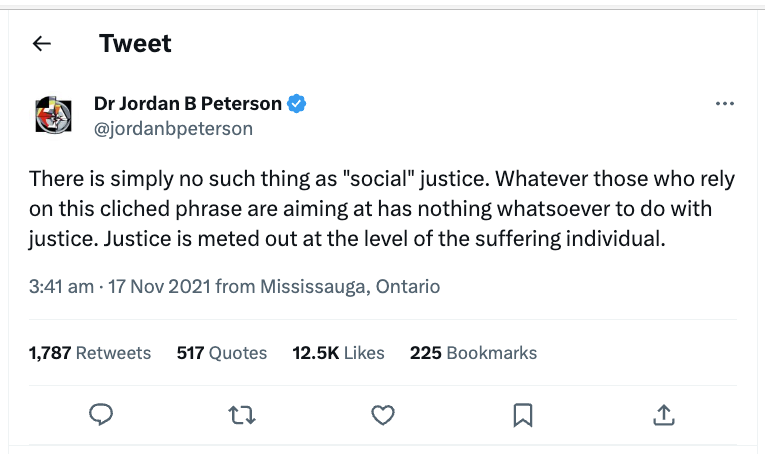
There is simply no such thing as “social” justice. Whatever those who rely on this cliched phrase are aiming at has nothing whatsoever to do with justice. Justice is meted out at the level of the suffering individual.
He echoes Thatcher’s thesis (again, “there is simply no such thing”!).
Conservatives refer to the fact that the demand for social justice has always been at the heart of bloody social revolutions, so the very word should be taboo. But here again, they mistake the wicked for the righteous. The course of history is not determined by how phenomena are labeled. The development of events depends on people’s willingness and readiness to come to a peaceful consensus rather than engaging in bloodshed over where to put a comma.
Yes, social justice may not be objectively measurable, but politics deals with human convictions and prejudices, not scientifically proven facts. Conservatives, of course, are aware of this and refuse to discuss this problem not because of its ‘subjectivity.’ They realize that they won’t be able to convince ordinary people that the current arrangement of the societal system meets the original ideals that were initially embedded within it. The transformation it underwent over the past half-century leaves no doubt that it is not the case. In reality, this system serves the interests of a handful of super-rich capitalists and corrupt political elites.
Thus, just as the rule of law cannot exist without civil society, a free and prosperous society cannot exist without discussing social justice. It is precisely because “objective” justice is unattainable in a world of delicate balances of subjective human perceptions that people cannot view each other in isolation from others and disregard the question of whether it is justified for some to acquire greater wealth than others. Dr. Peterson’s conservative comrade, Thomas Sowell, who looks at things more realistically, rightly noted that “all justice is inherently social.” But if we agree not with him but with Peterson, we will replace the discussion of a real problem with meaningless quibbling over words.
All in one heap
And there’s no escaping from it. As I mentioned earlier, Peterson is not stupid but deliberately ignorant. He will safeguard this ignorance simply to avoid losing the ground beneath his feet. He needs a coherent picture of reality; if something in this picture doesn’t fit, the only way to keep it all together is to cover the gaps with ignorance.
That explains the nonsense he persistently spouts about the connection between Marxism and Postmodernism. Presumably, his followers either have to believe him blindly or believe that he doesn’t have the time to delve into a question that would be within the grasp of a university graduate, let alone a Ph.D. degree holder.
So, he repeatedly asserts that “postmodernism is a transformation of Marxism.” His entire logic boils down to two points: 1) both Marxists and Postmodernists aimed to destroy Western society, and 2) the latter did what they did because Marxism no longer worked.
While the first point can be debated, the second one is more of a conspiracy theory than a result of critical reflection. Peterson hasn’t bothered to provide any evidence that the intentions of the Postmodernists were the same as those of the Marxists.
I am highly critical of Postmodernism because it destroys everything without offering anything in return. In this sense, it is essentially not a branch of philosophy but anti-philosophy. But the situation is different with Marxism. Regardless of one’s opinion of it, it must be acknowledged that it is organically embedded in European philosophy’s DNA (forgive me for using corporate jargon) and is inseparable from it. European thought cannot be fully understood without adequate comprehension of Marxist philosophy. And the significant problem for opponents of the left lies in the fact that despite the misuse of Marx’s ideas, the moral demand underlying it cannot be dismissed as malicious. This idea is simple: the purpose of a person is not mindless labor that exhausts itself in purely utilitarian function but the realization of their creative potential. Everything else — all those vast arrays of philosophical reasoning, economic analysis, and political appeals accompanying Marx’s work — are nothing more than means of implementing this idea.
I suspect Dr. Peterson designates Postmodernists as latent Marxists because they occasionally referred to Marxism. However, in this case, as some philosophers put it, he confuses correlation with causation. Furthermore, he unexpectedly claims (unfortunately, I don’t remember in which video, so that I will paraphrase from memory) that “Marxism at least envisioned a future goal, a utopian society, while Postmodernism only destroys.” But what then is the ontological connection between the two if they have entirely different ultimate goals?!
Postmodernists flirted with Marxism not to develop it but to advance their doctrine by exploiting trendy ideas among the left (they weren’t going to gather their first harvest on the ascetic fields of conservatism!). After all, the foundation of any “liberating” doctrine is always the same. However, while Marxism indeed sought to change the world, Postmodernists only sought to make the world love them. As for the world itself and what will happen to it after their death, they couldn’t care less. It is clearly expressed in Jacques Derrida’s Feu la cendre, a kind of Gospel of the Antichrist of philosophy — you don’t even need to read his On Grammatology: the apparent meaninglessness of the main text, combined with the refrain of the header text, fully reflects the essence of his Deconstruction.

Thus, saying that “postmodernism is a transformation of Marxism” is roughly the same as claiming that Nazism is an evolved form of Buddhism because the Nazis made the swastika their symbol. One can assume that Peterson does this not because he cannot understand the difference between the two but out of fear that a detailed public analysis of Marxism will lead to the need for the exact analysis of the problems of late corporate capitalism. And then, he will be challenged to answer questions for which he has no answers. That threatens to disrupt the integrity of the Conservative Scheme of Things.
Conclusion
So, Peterson’s era ended when he ran out of ideas. But this specter of a faded star will continue to flicker in the restless public sky for a long time. There is no hope that people like him will ever critically examine their beliefs. Because these convictions do not stem from empirical observations; on the contrary, they impose significance onto those observations that don’t extend beyond these beliefs. The irony lies in that Peterson expressed this best with a quote from C.G. Jung: “People don’t have ideas; ideas have people.”
In this, he was right, but he merely repeated someone else’s words. I cannot shake off the feeling that Peterson simply has no ideas of his own. He has a uniquely perceptive way of transmitting information to his audience, intensified by his passionate interest in specific aspects of human nature. I must admit that here, one should listen to him and learn a lot, especially from his lectures delivered to his students (available on YouTube).
But trouble arises when a person becomes a victim of circumstances, whether positive or negative. Dr. Peterson’s fate has been strange and undoubtedly dramatic. From an ordinary person, he suddenly became a superstar, the hope and idol of millions. However, unfortunately, their hopes were not fulfilled. Dr. Peterson never managed to surpass the constrains of his limited conservative mindset, and this is unlikely ever to happen.
Well, as they say, everyone has their own path. Let each one go in peace.
P.S. I have long intended to write this article but, like all of us, suffered from a catastrophic lack of time. The final impetus came from the article “Intellectual Conservatives” and their Harmless Boogeymen by Benjamin Cain, which addresses a similar problem. Therefore, I express my gratitude to the author for inadvertently accelerating my own efforts. :)
Related stories:
Dear reader, subscribe to my updates and get the latest stories on politics, justice, and philosophy!