
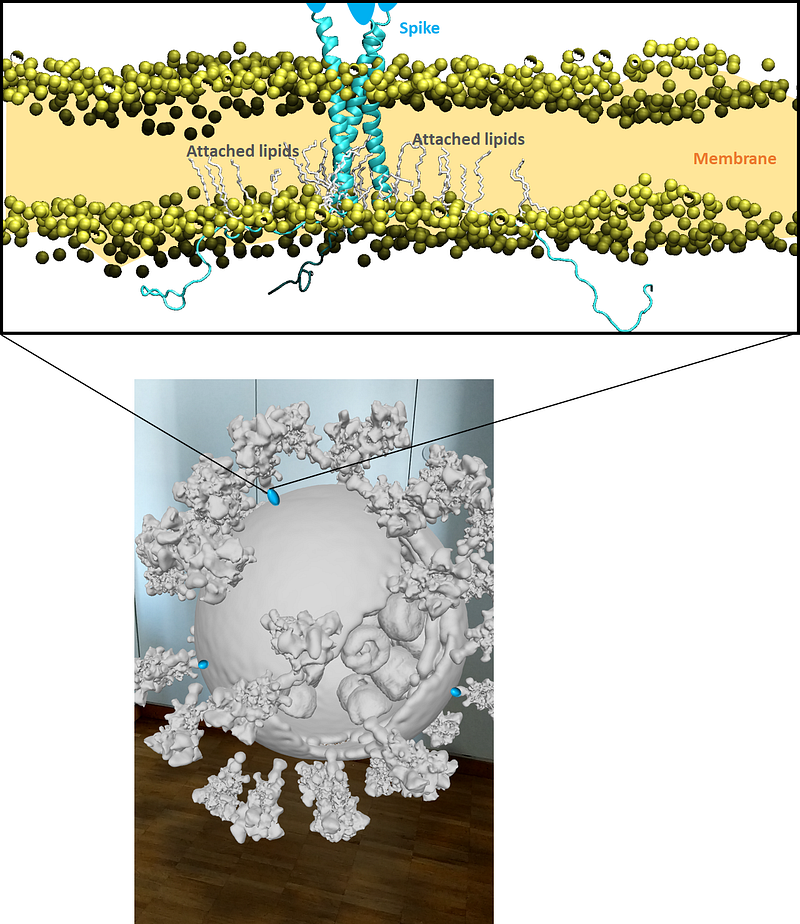
Lipid modifications of SARS-CoV-2’s spike protein are essential for its virulence
Explained first-hand by one of its authors
Original paper: Mesquita et al Developmental Cell 2021 [here]
Viruses need to make use of their host’s biology for a successful life cycle, and SARS-CoV-2 is no different. How viruses manage to subvert our own biology is often less clear. In a new study by Mesquita et al., scientists from the Global Health Institute at EPFL in Switzerland including a small participation from myself, reported that SARS-CoV-2 requires lipid modifications to organize its membrane structures and coordinate the function of its virulence proteins. Since the virus itself carries no lipid-modifying enzymes, nor genes that encode them, it relies entirely on an enzyme dubbed zDHHC that is provided by the host (infected) cells. More specifically, this is an S-acyltransferase enzyme. Of utmost relevance, this reliance on human acyltransferases, that many different viruses share, could be used in the future to devise novel strategies against them. I here summarize the main findings we report in the paper.
In this work, the main team of cell biologists studied to what extent the Spike protein of SARS-CoV-2 undergoes lipid modifications, and which of the human enzymes that normally attach lipids to membrane proteins (“zDHHC-acetyltransferases”) were exploited by the virus to achieve this. The question began when our colleagues realized that the Spike protein has 10 cysteine amino acids in a very short loop right after the domain that anchors it to the membrane. Usually, cysteines that are close to membranes get lipids attached, and very often this has a functional consequence. The membrane we are talking about here refers to the virus’ own membrane when in free infective particles; or the host’s membranes when the virus is being assembled. In fact, the viral membrane is made up of lipids of the host cells where it replicates.
SARS-CoV-2’s Spike protein is crucial for infectivity, as it is the one that binds the human ACE2 protein, exposed on the surface of target cells, in the first step of the infection. What this research showed is that all 10 cysteines of Spike get modified (that means, lipids are attached to them) and that the modification is carried out especially by one particular DHHC enzyme, that kind of “confuses” the Spike protein for a natural substrate.
Our paper further reports that the attachment of lipids to Spike also determines the lipid composition and organization of the viral membranes. Through molecular dynamics simulations, my contribution to the work was to show that lipid attachment to Spike modulates how it partitions in the membrane and possibly even helps to reshape it, to help in the budding of membrane capsids out of the host cell’s own membrane. Moreover, part of the experimental work showed that viral particles produced in test cells lacking the specific zDHHC enzyme involved (and hence having Spike proteins that are much less modified with lipids) have abnormal membrane compositions and much-reduced ability to fuse to host cell membranes. In other words, the Spike protein must undergo full lipidation for the virus to achieve full infectivity. This is in my opinion the most interesting part of our study, because it implies that if one could design a drug that blocks the action of the specific zDHHC on Spike, one could then probably begin to think about a way to treat the viral infection -and not only for this virus but also for others that hijack the lipid attachment system of the host for their own benefit. Following this idea, we tried blocking lipid addition to the spike protein with various chemicals, and found they were capable of preventing the virus from infecting cells. These chemicals are not safe enough to be used right away to treat viral infections, and none of this will result in immediate clinical drugs; in fact, there isn’t even any guarantee that this will lead to a working medicament. However, in this work we have at least identified a potential target where a drug could act -the first step in any campaign to develop new clinical drugs, that most often academic labs (and not as much the pharma) pursue.
Viral life cycles are complicated and highly diverse because viruses co-opt the biology of host organisms for their own ends, in various ways. Understanding how that co-opting happens on a molecular level can expand our repertoire of ways to fight back. Our work uncovered a new potential vulnerability on SARS-CoV-2 and other viruses. I hope that future work in the field will find a way to exploit it for our good.
You can see the SARS-Cov-2 virus from the lead picture in augmented reality on your phone by navigating to https://molecularweb.epfl.ch/pdb2ar/sarscov2experimental/ . For more augmented reality views of viruses, visit this story:
Key reads
To read the full technical, peer-reviewed article:
https://www.sciencedirect.com/science/article/pii/S1534580721007346
And here EPFL’s own cover of the paper in its news page:
https://actu.epfl.ch/news/s-acylation-enhances-covid-19-infection/
I am a nature, science, technology, programming, and DIY enthusiast. Biotechnologist and chemist, in the wet lab and with computers. I write about everything that lies within my broad sphere of interests. Check out my lists for more stories. Become a Medium member to access all its stories and subscribe to get my new stories by email (original affiliate links of the platform for which I get small revenues without special costs to you).


