avatarDark Energy Articles

Free AI web copilot to create summaries, insights and extended knowledge, download it at here

3337

Abstract

he Library of Alexandria contained about <b>200,000 manuscripts</b> in its first centuries of operation. More than a hundred scholars were engaged in the study of these collections, and young people were invited by them to learn the secrets of knowledge.</p><p id="f53c">The most famous bookstore of antiquity at the end of the reign of the Ptolemies reportedly contained <b>700,000 scrolls</b>. According to Strabon, it was a building surrounded by a portico, housing a hall with benches. The papyrus scrolls were probably stored in chests.</p><h1 id="41b2">Who was in charge of the library?</h1><p id="b99a">The library was headed by an administrator, who was also the tutor of the heir to the throne. This function was performed by:</p><ul><li>Zenodotus of Ephesus,</li><li>Eratosthenes,</li><li>Aristophanes of Byzantium,</li><li>Aristarchus of Samothrace.</li></ul><p id="1efc">A team of copyists worked at the library, transcribing texts and maintaining the library catalog. The creator of the first history of literature — <b>Callimachus of Cyrene </b>— played a major role in this process. He is the creator of the first object catalog of the Library of Alexandria.</p><figure id="ab66"><img src="https://cdn-images-1.readmedium.com/v2/resize:fit:800/1*a2BgwRJoHYBHp3qVukozpw.jpeg"><figcaption>Ptolemy II Philadelphus talking withJ ewish savants who translated the Bible for the great library of Alexandria — [Photo: Jean Baptiste de Champaigne, Public domain, via <a href="https://commons.wikimedia.org/wiki/File:Ptoleme_2_by_Jean-Baptiste_de_Champaigne.jpg">Wikimedia Commons</a>]</figcaption></figure><h1 id="a947">A well-known object of Alexandria is the Musaeon</h1><p id="3964">Ptolemy had the temple of the Muses, or Musæon, erected. <i>“The Museion is part of the palace; it contains a place with seats for holding meetings and a great hall where the scholars — the members of the Museion — take their meals together,”</i> Strabon wrote.</p><p id="10b0">In Ptolemaic times, writers, physicians, architects, mathematicians, to name Callimachus, Theocritus, Euclid or Archimedes were created here. Members of the Museion were guaranteed food, salaries were paid from the royal treasury. Alexandria gave them opportunities to develop and explore the secrets of knowledge.</p><p id="463a">Also established were gardens (botanical and zoological), an astronomical observatory and surgical laboratories where dissections were performed. The luxuriant flourishing of various fields of science was made possible by rulers acting as guardians and sponsors.</p><p id="abb4">Patronage strengthened their power. An institution was then created that not only outlived its initiators. It survived in nomenclature until our time — as a “museum”.</p><h1 id="7b98">Who destroyed the Library of Alexandria?</h1><p id="fa8b"><b>The library at the palace was burned during the capture of the city by Caesar in 47 BC.</b> Several hundred thousand works were burned then. Including the library catalog, without which it is impossible to reconstruct the list of works there. Mark Antony, wanting to please Cleopatra, partially compensated for the loss. He had 200,000 volumes from the collection of the Pergamon Library transported to Alexandria.</p><p id="783d"><b>In 273, Lucius Domitius Aurelian completely destroyed the palace library.</b>

Options

The complete destruction of the public library at the Serapeion is believed to have occurred around 391. At the time, Patriarch Theophilus of Alexandria received permission from Emperor Theodosius I to destroy pagan temples. The Serapejon was demolished.</p><figure id="776e"><img src="https://cdn-images-1.readmedium.com/v2/resize:fit:800/1*IZJzFUaFucQd7gY6PQe88A.jpeg"><figcaption>The Burning of the Library at Alexandria in 391 AD — [Photo: Ambrose Dudley, Public domain, via <a href="https://commons.wikimedia.org/wiki/File:The_Burning_of_the_Library_at_Alexandria_in_391_AD.jpg">Wikimedia Commons</a>]</figcaption></figure><p id="eff0">The library, on the other hand, certainly no longer existed in 641, when Alexandria was captured by the caliph Omar. And it was to him that the bestial act was traditionally attributed.</p><p id="5cc4">The Library of Alexandria has become a symbol of knowledge and culture, as well as a symbol of the transience of existence. It appeared in the historical films “Cleopatra” (1963) and “Agora” (2009).</p><h1 id="1c32">Alexandria Library today</h1><p id="c2d6">The new Alexandria Library was brought to life thanks to a decision in 1974.Construction work began in 1995 and lasted 7 years. A total of about $220 million was spent on the construction.</p><p id="636b">It was opened in 2002 near where its predecessor from Ptolemaic times stood. It is the Bibliotheca Alexandrina cultural center.</p><h2 id="e170">There are among others:</h2><ul><li>a reading room for the blind,</li><li>two children’s reading rooms,</li><li>scientific and research centers,</li><li>archaeological museum,</li><li>art galleries,</li><li>planetarium,</li><li>a supercomputer.</li></ul><p id="9893">There are 1 million 240,000 volumes in storage and room for another 6 million. The book collection includes items banned in other Middle Eastern countries. It is an oasis of free thought in the region, where people are put in their heads what they should think and learn. The library also hosts tours for tourists.</p><div id="7946" class="link-block"> <a href="https://readmedium.com/too-much-co2-lets-eat-it-a0230474b8ac"> <div> <div> <h2>Too much CO2? Let’s eat it!</h2> <div><h3>We are entering an era of generating food from chemical processes, bypassing agricultural crops and animal husbandry…</h3></div> <div><p>medium.com</p></div> </div> <div> <div style="background-image: url(https://miro.readmedium.com/v2/resize:fit:320/1*hINy_0cb8Gm7wJXntZymig.jpeg)"></div> </div> </div> </a> </div><p id="c57b"><b>Cool that you made it to the end of this article. I will be very pleased if you appreciate the effort of creating it and leave some claps here, or maybe even start following me. It would be nice if you also left a tip! Thank you!</b></p><figure id="e494"><img src="https://cdn-images-1.readmedium.com/v2/resize:fit:800/1*QCQqlZr6doDP-cszzpaSpw.png"><figcaption><a href="https://www.buymeacoffee.com/oconnel">https://www.buymeacoffee.com/oconnel</a></figcaption></figure><figure id="92a2"><img src="https://cdn-images-1.readmedium.com/v2/resize:fit:800/1*fxkd_sjXknSGRO4TY0S9Mg.png"><figcaption></figcaption></figure></article></body>

Library of Alexandria. How was the greatest book collection of antiquity created and who destroyed it?

It is the most important library of the ancient world. The Library of Alexandria was founded by the king of Egypt, Ptolemy I. It was the world’s first and the largest library in antiquity.
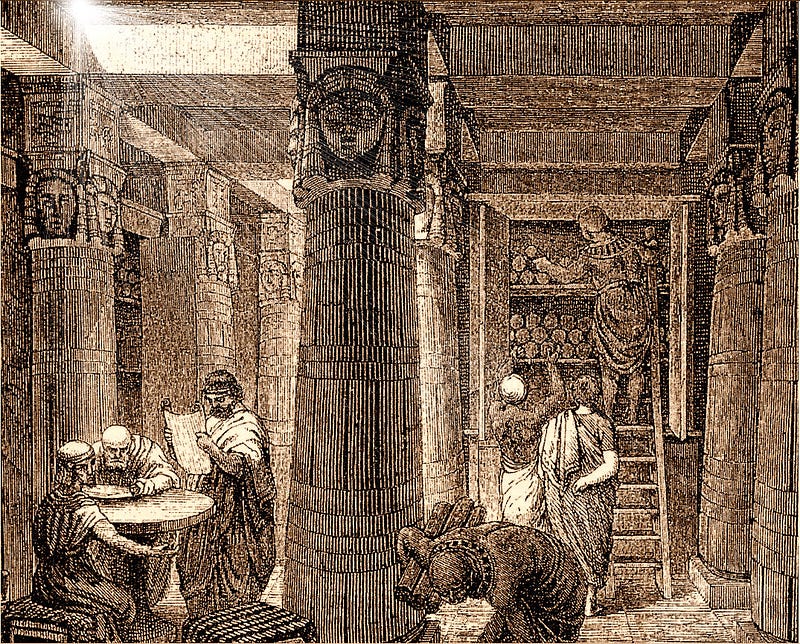
Library of Alexandria — [Photo: Wikimedia, CC BY-SA 4.0, via Wikimedia Commons]

Alexandria was named after its creator and ruler. It was Alexander of Macedon between 332 and 323 B.C. who laid the foundation for a cosmopolitan, wealthy and almost immortal metropolis. In ancient times it was called “Alexandria by Egypt” to emphasize its distinctiveness from the rest of Egypt.

Alexander himself determined the outline of the city’s boundaries and decided on the location of individual buildings, such as the agora, temples of Greek deities, etc. The leader was also the author of the division of Alexandria into five districts. However, Macedonius had no connection with the famous Library of Alexandria.

How was the Library of Alexandria created?

The probable builder of the famous bookstore was Ptolemy I Soter. He was one of Alexander the Great’s generals, founder of the Ptolemaic dynasty and ruler of Egypt from 323–283 BC. Alexandria was the country’s capital at the time.

Ptolemy decided to build a scientific institute (the Alexandrian Museum) in Alexandria. It included a library, which was the hallmark of ancient Alexandria. It was located in the Royal Quarter. However, the exact location of the Library of Alexandria is uncertain.
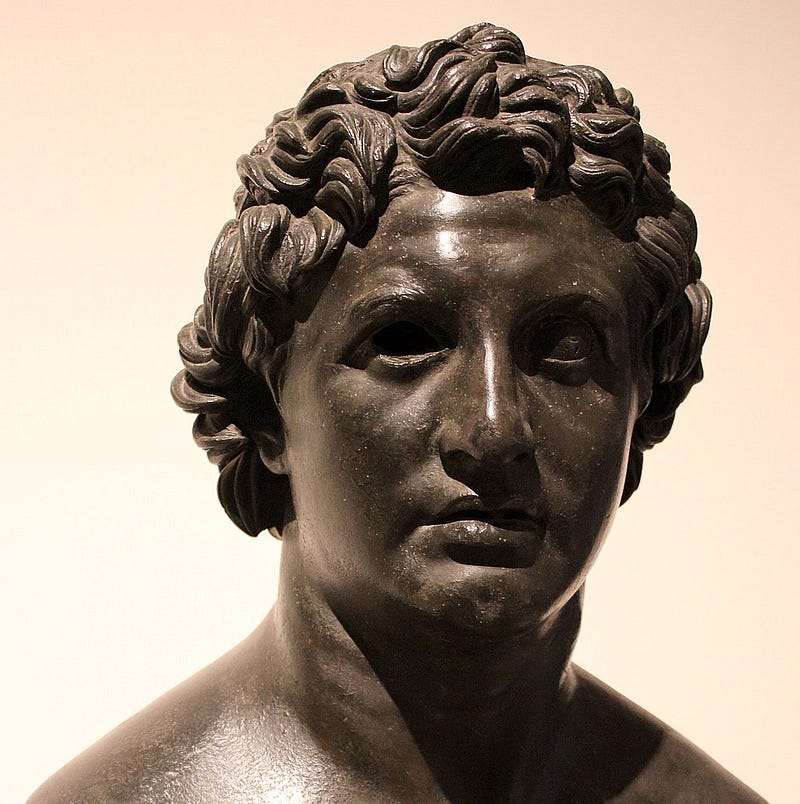
Ptolemy I Soter — [Photo: Miguel Hermoso Cuesta, CC BY-SA 3.0, via Wikimedia Commons]

The Library of Alexandria had two parts

The library was divided into two separate facilities. The main collection was located on the grounds of the royal palace in Bruchejon. It was used primarily by scholars. Among them were Archimedes, Heron and Euclid, among others. The second part of the library was open to the public and was located in the temple of Serapis, the so-called Serapeion. It was used by the citizens of the city.

The basis of the library collection was the library of Aristotle, purchased by Ptolemy. It is said that all ships visiting the Alexandrian port had to hand over their scrolls, which went to the library, and received copies in return. By the same token, anyone entering Alexandria with a book of any kind had to leave it in the library’s depository. He could pick it up only after it had been copied.

As a result, the collection grew rapidly. The Library of Alexandria contained about 200,000 manuscripts in its first centuries of operation. More than a hundred scholars were engaged in the study of these collections, and young people were invited by them to learn the secrets of knowledge.

The most famous bookstore of antiquity at the end of the reign of the Ptolemies reportedly contained 700,000 scrolls. According to Strabon, it was a building surrounded by a portico, housing a hall with benches. The papyrus scrolls were probably stored in chests.

Who was in charge of the library?

The library was headed by an administrator, who was also the tutor of the heir to the throne. This function was performed by:

  • Zenodotus of Ephesus,
  • Eratosthenes,
  • Aristophanes of Byzantium,
  • Aristarchus of Samothrace.

A team of copyists worked at the library, transcribing texts and maintaining the library catalog. The creator of the first history of literature — Callimachus of Cyrene — played a major role in this process. He is the creator of the first object catalog of the Library of Alexandria.
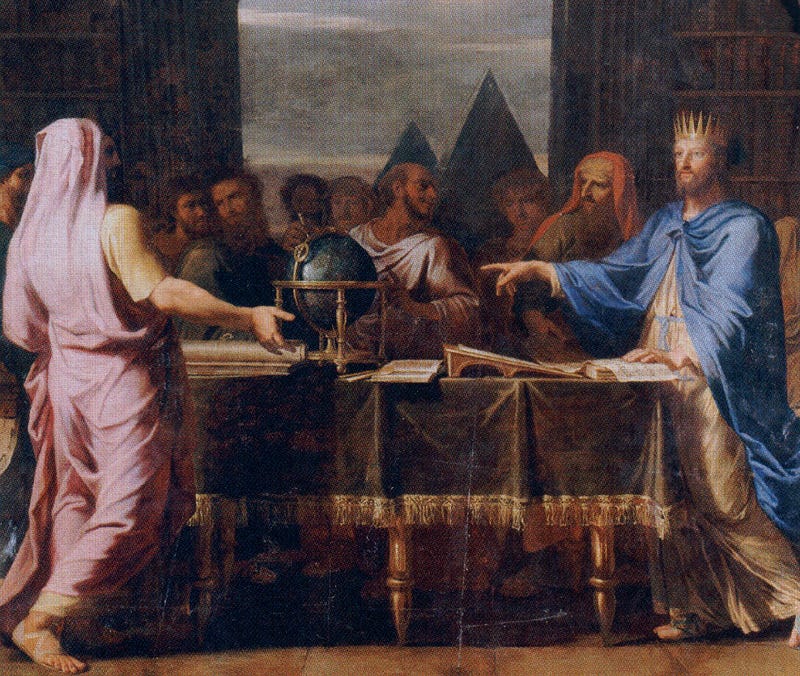
Ptolemy II Philadelphus talking withJ ewish savants who translated the Bible for the great library of Alexandria — [Photo: Jean Baptiste de Champaigne, Public domain, via Wikimedia Commons]

A well-known object of Alexandria is the Musaeon

Ptolemy had the temple of the Muses, or Musæon, erected. “The Museion is part of the palace; it contains a place with seats for holding meetings and a great hall where the scholars — the members of the Museion — take their meals together,” Strabon wrote.

In Ptolemaic times, writers, physicians, architects, mathematicians, to name Callimachus, Theocritus, Euclid or Archimedes were created here. Members of the Museion were guaranteed food, salaries were paid from the royal treasury. Alexandria gave them opportunities to develop and explore the secrets of knowledge.

Also established were gardens (botanical and zoological), an astronomical observatory and surgical laboratories where dissections were performed. The luxuriant flourishing of various fields of science was made possible by rulers acting as guardians and sponsors.

Patronage strengthened their power. An institution was then created that not only outlived its initiators. It survived in nomenclature until our time — as a “museum”.

Who destroyed the Library of Alexandria?

The library at the palace was burned during the capture of the city by Caesar in 47 BC. Several hundred thousand works were burned then. Including the library catalog, without which it is impossible to reconstruct the list of works there. Mark Antony, wanting to please Cleopatra, partially compensated for the loss. He had 200,000 volumes from the collection of the Pergamon Library transported to Alexandria.

In 273, Lucius Domitius Aurelian completely destroyed the palace library. The complete destruction of the public library at the Serapeion is believed to have occurred around 391. At the time, Patriarch Theophilus of Alexandria received permission from Emperor Theodosius I to destroy pagan temples. The Serapejon was demolished.
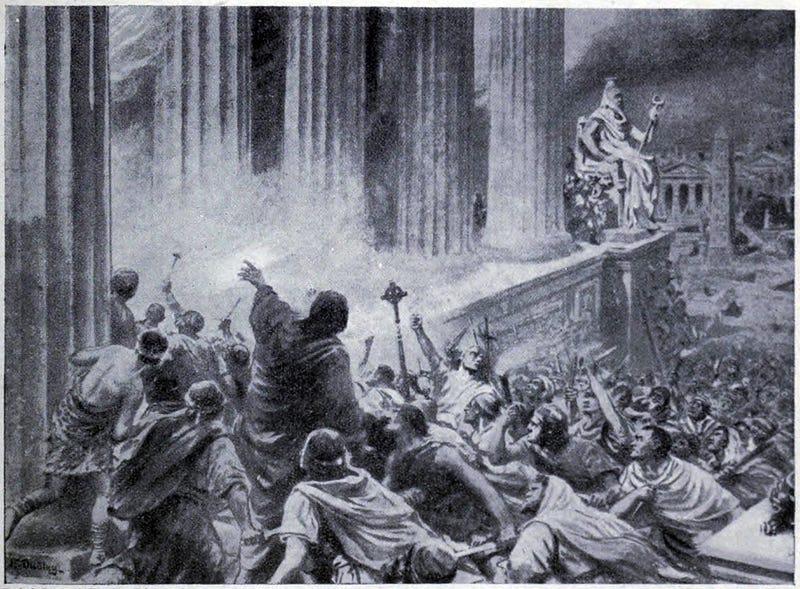
The Burning of the Library at Alexandria in 391 AD — [Photo: Ambrose Dudley, Public domain, via Wikimedia Commons]

The library, on the other hand, certainly no longer existed in 641, when Alexandria was captured by the caliph Omar. And it was to him that the bestial act was traditionally attributed.

The Library of Alexandria has become a symbol of knowledge and culture, as well as a symbol of the transience of existence. It appeared in the historical films “Cleopatra” (1963) and “Agora” (2009).

Alexandria Library today

The new Alexandria Library was brought to life thanks to a decision in 1974.Construction work began in 1995 and lasted 7 years. A total of about $220 million was spent on the construction.

It was opened in 2002 near where its predecessor from Ptolemaic times stood. It is the Bibliotheca Alexandrina cultural center.

There are among others:

  • a reading room for the blind,
  • two children’s reading rooms,
  • scientific and research centers,
  • archaeological museum,
  • art galleries,
  • planetarium,
  • a supercomputer.

There are 1 million 240,000 volumes in storage and room for another 6 million. The book collection includes items banned in other Middle Eastern countries. It is an oasis of free thought in the region, where people are put in their heads what they should think and learn. The library also hosts tours for tourists.

Cool that you made it to the end of this article. I will be very pleased if you appreciate the effort of creating it and leave some claps here, or maybe even start following me. It would be nice if you also left a tip! Thank you!


https://www.buymeacoffee.com/oconnel
History
Books
Life
Science
Ancient History
Recommended from ReadMedium