
Letter To The Author In Thanks For An Unforgettable Book
Robert Pirsig’s Lila: An Inquiry Into Morals
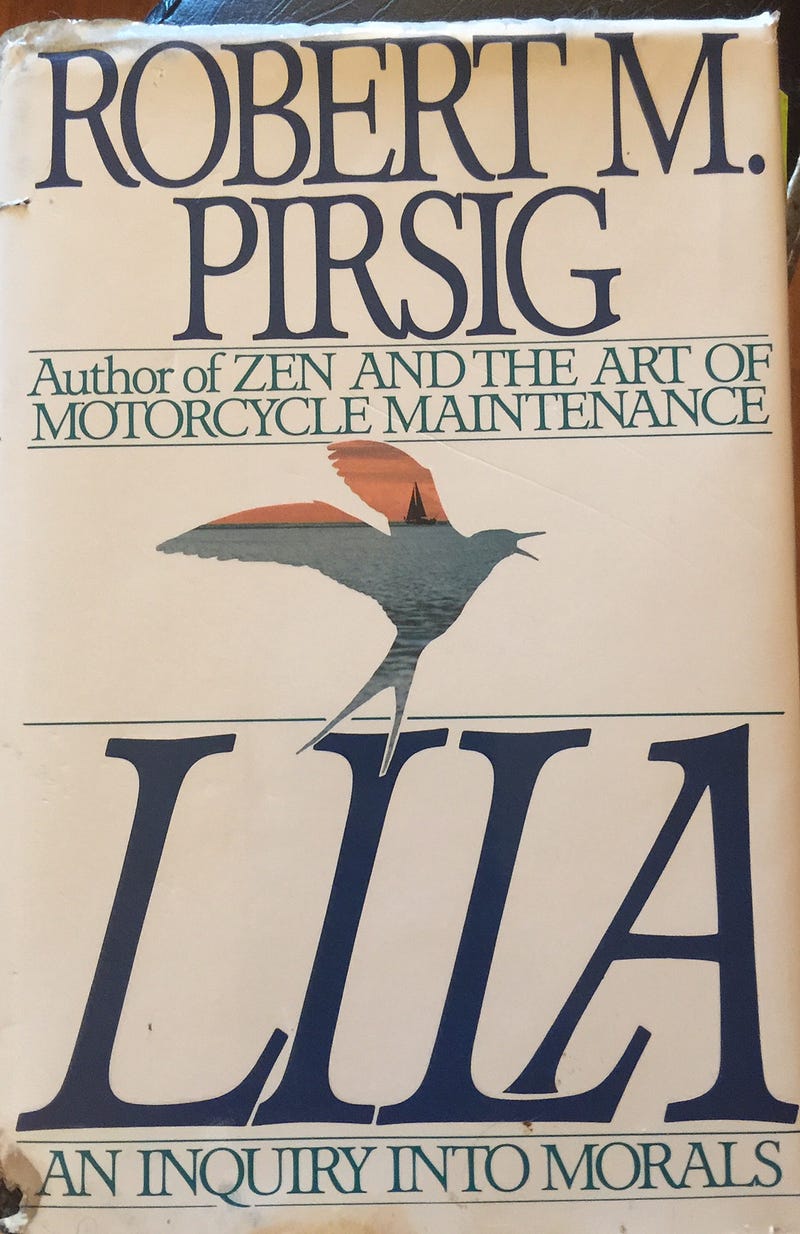
“This is a book about morals, “ the author commented in a 1991 interview, Zen and the Art of Pirsig (washingtonpost.com)
Shortly after reading Lila, I happened upon the publicist promoting the book. My husband and I had been spending a leisurely Sunday walking in Hermann Park. I approached her — not sure what alerted me she was a fellow Lila fan. (That memory is lost somewhere in my basal ganglia). We spoke at length. I was thrilled. I got a tee-shirt.
I called my brother (a fellow bibliophile) to share the experience; he commented, “you’re the only one that read it.”
I was honestly surprised to see it included as an Oprah Book Club selection. So would my brother, I’m sure.
It was also nominated finalist for the Pulitzer Prize in Fiction in 1992 (www.pulitzer.org).
In preparing this piece, I tried to discover exactly how many copies were sold since publication in 1991. Millions of sales of his first book were recorded, but not for this, his second book. He only wrote two in his lifetime. I read both.
I found my copy of Lila in the bookcase, pages colorfully marked with post-its for future reference.

I have only penned two fan letters to authors, this was my first. The second shall remain nameless, as I was duped (as were others) that it was a true story.
Happening upon a partial draft(handwritten) of my letter tucked inside the book as a page marker, I’ll share it here:
Your book Lila is dynamic quality. It is the song on the radio that mesmerized me that I bragged about to my friends. Pages and passages are marked with posits. I love Walker Percy’s [on page 118 he quotes a passage from an essay by Percy] of writings, he had the same effect on me. Like a gift. I can’t carry this dynamic quality with me all the time. I can only take it out to remind me of something. How could you carry it long enough to write it down? I am always amazed when I read something I think I wrote. It fills me with something. Only I love to see the castles on the Hudson.
The rest is lost, I’m sure long disposed of in his cache of fan mail (he died in 2017). But he wrote back. Sent me a handwritten postcard with a comment about a guru he had met in India. I cherished it for years propped up on my desk. Somehow it got lost in a move. I looked.
The book inspired me to read Plato’s Phaedrus. Phaedrus is Pirsigs’ alter ego and the protagonist of sorts in this philosophical novel. The essence of Lila is Phaedrus trying to reckon with the metaphysics of quality, static and dynamic. He examines moral codes, values, and science.
They use morals to make someone look inferior and that way look better themselves. It doesn’t matter what the moral code is — religious morals, political morals, racist morals, capitalist morals, feminist morals, hippie morals — they’re all the same. The moral codes change but the meanness and the egotism stay the same.
Lila is a prostitute that accompanies Phaedrus on a sailing trip down the Hudson River. A philosophical journey of exploration ensues, including the concept of goodness. Pirsig himself noted the book as being born from grief after the loss of his son.
All these years later my main takeaway from Lila is that dynamic quality is a force of change, not sustainable; static quality is when the dynamic becomes repeated and then patterned. Two parts of the whole; he opined in Lila that ultimately quality can’t be defined.
Please read other book commentaries in Prompt Time! If you are a book lover, you will find gems. I am interested in moral codes as you can see from this choice and my last, Atlas Shrugged.
Please also check out the following from Marrisa W.
As ever, thank you for reading.