
An Homage to Atlas Shrugged
A love story for life
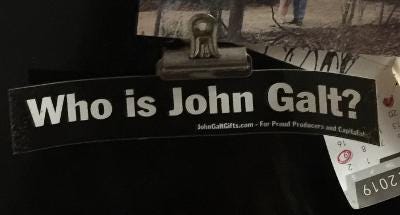
Smacked in the middle of my refrigerator door, stuck by magnet clip amidst pictures, calendars, and reminders, is a black and white bumper sticker, asking the age-old question, “Who is John Galt?”. That is also a query I often pose to new acquaintances, colleagues, or potential friends when the subject of favorite books come up in conversation. If they didn’t know the answer, I wouldn’t share it, and feigned sorrow at their ignorance. When in the company of others who did know, we would just glance knowingly at each other, and shake our heads.
I don’t remember the first Ayn Rand (A.R.) book I’ve read (I have since read them all). What I do remember is a bus trip from New Jersey to Massachusetts to visit my oldest sister (who told me A.R. was a Russian communist!) and not being able to put down Atlas Shrugged. In fact, I almost missed my stop in Springfield. And upon arrival, I ignored family pleasantries, conversation, and dinner, and continued reading well into the early morning hours to finish it — all 1,168 pages — without skimming through any of the lengthy speeches. I was sixteen.
And since that day, I have re-read it ten more times.
In my high school yearbook, Laurie wrote, “thanks for A.R. and all the talks.”
When I discovered in Swoosh: The Unauthorized Story of Nike and the Men Who Played There, that all new hires had to read it, I was so proud, you would have thought I wrote the book myself.
Atlas Shrugged informed my core beliefs — the way I viewed the world, other people, myself, and relationships. My husband had gold dollar sign earrings made for our tenth anniversary, gave me the 50th-anniversary edition as a Christmas gift in 2007, and bought Ayn Rand: A Sense of Life for another. She was as original, uncompromising, and controversial as the book proclaims, and wrote her personal life was a postscript to her novels, “And I mean it.” She proclaimed there are men and women who exist that live her philosophy. Reading this book gave me hope that she was right. Among other things, she presented a strong woman in the workplace. Think of these 1957 words:
“Dagny Taggart was nine years old when she decided that she would run the Taggart Transcontinental Railroad someday.”
“She was twelve years old when she told Eddie Willers that she would run the railroad when she grew up.”
“She was fifteen when it occurred to her for the first time that women did not run railroads and the people might object. To hell with that, she thought — and never worried about it again.”
She was sixteen when she went to work there and thirty-five when she took it over. There are multiple male characters presented in the pages (reflecting more real-world corporate life), not the least of which is John Galt; however, Dagny is the central protagonist of this novel. She drives the storyline. As Vice President of Operations, she eventually stepped in to save the corporation from the incompetence of her brother. Her drive, commitment, and strength inspired me to respect, appreciate, and demand quality in people, products, and business. Even in her downtime, she was thinking, creating, and “idly” building a better way. Attracted to like-minded doers, she instilled in me a hope that there were others in the world that thought like me. Who hated slackers.
This book influenced my work life, appreciation of money, and intolerance for incompetence. I would like to tell you that I rose to the top of the corporate world as a result — I did not. It is my guideline, touchtone, and template for living much like the Bible is for believers. Every position that I quit, I left secondary to the ineptitude of either of my direct superiors, peers, or administration. I strove to hold to the ideals espoused and which I believe to be true, “there is no such thing as a lousy job — only lousy men who don’t care to do it.” No matter the position, work the hardest, be productive, do your best. I am reminded of a time at one company when I addressed all the department heads — including the chief of staff — by detailing all the roadblocks to success. The roadblocks erected by the leaders in attendance. I named names; gave specific examples of ignoring the particular problems. Exposing people in positions of power that allowed the perpetuation of mediocrity. After the meeting, my boss said to me, “but you have to work with these people.” I didn’t care, I no longer could blindly tolerate the intentional protection of individual fiefdoms at the cost of providing quality outcomes. I got what I wanted in the short term — but in the long run, the environment was made too toxic for me. I shrugged. I left. Who is John Galt?
There have been biographies, books, and blogs written about Objectivism — A.R.’s philosophic, political, and economic theory, and I am not adding to that bibliography in this brief homage. I tried to explain to my sister when I embarked on this piece (mind you, who has not read the book) that the book is a love story for life. A.R.’s passion for every aspect of what defines humanity pops off the pages. I picked up a copy to search for two particular sentences I wanted to quote accurately for this essay and again got caught up in the power of the words — and once more the hours were devoured. Not only passionately espousing a fast held ideology, but the underlying relationship tensions build so that — and even though I knew it was coming — when Francisco says, “of course I love you,” I felt the hunger of his love, “There it is your earth, your kingdom, your kind of world — Dagny, I’ve always loved you and I deserted you, that was my love.” Defining love as tacit knowledge culminating in the explicit expression of shared values. Shared passion.
Love is the expression of one’s values.
I have met few who have the courage of their convictions — to live in accordance with their core beliefs. Dagny made me try. I am reminded of once being asked (when in an untenable position) “would you rather be right or have a job?” There were times when having a job trumped convictions — but ultimately, standing for what was right won out in the end. You move on but not necessarily up. But I want to live my mind supported by my heart. I want to hear “well done,” without exceptions. I want to live with passion. I want the best and the brightest to rise to the top, not drop out. I want that world where atlas doesn’t have to shrug off the slackers, the sycophants, and the shylocks to succeed.
(1,168 words, one for each page of the book.)