
Let’s Celebrate All Forms of Love
Not just the committed, romantic kind
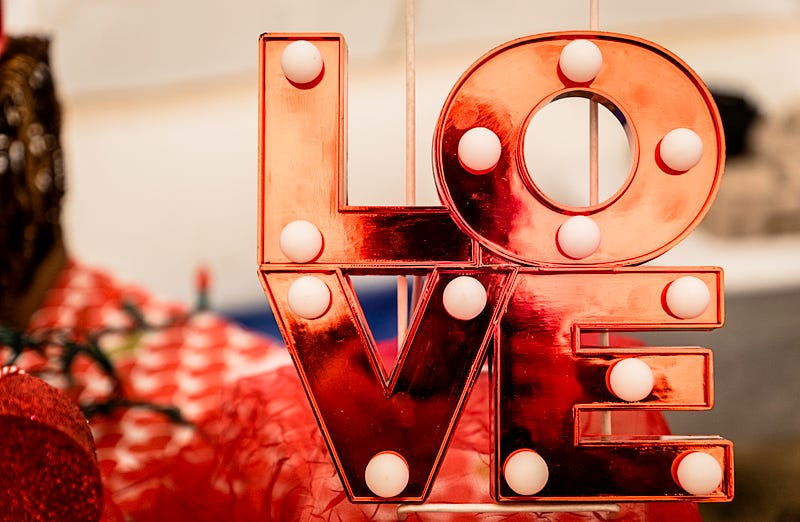
Valentine’s Day is a celebration of love, but mostly it’s to honor traditional sorts of relationships, where two people express their commitment to each other by engaging in conspicuous consumption. Chocolates, roses, jewelry, dinner out at a nice restaurant — these are the sorts of things that are expected — oh, and cards, don’t forget cards expressing how much you love your mate or the person you are dating.
There’s nothing wrong with this, I suppose (except for the conspicuous consumption that is required), but it celebrates only one kind of love, and I think that’s a shame. The romantic love between a couple is only one sort of love, in only one type of relationship. There are so many other kinds of love out there, and we really ought to be acknowledging and celebrating them all, because although it’s trite to say it, the world needs all the love it can get.
The love between committed couples is great, but it’s also not the be-all, end-all of love. There are other forms of romantic or erotic love, and then there are myriad other ways to feel or express love — for family, for friends, or for animal companions even. Those aren’t inherently lesser kinds of love just because they don’t revolve around coupledom. Loving someone whom you have pledged to spend your life with or whom you hope to someday make that commitment to is not the pinnacle of love. It’s simply one kind.
We are taught from childhood by our culture that romantic love is the most important thing (particularly for women) and that finding that one special someone ought to be one of the main focuses of our existence. Once that person has been identified, the maintenance of the relationships should be the primary goal in life, taking precedence over everything else (once again, particularly for women).
This results in the “relationship escalator” where every date is an opportunity to see if this person is someone you can take things “to the next level” with. But fundamentally, the relationship escalator is about insecurity and often a type of co-dependency. It tells people that they are not alright on their own — that it’s better to have the wrong person than to have no-one. It also says that every relationship must be headed towards monogamous marriage, even if that isn’t what everybody wants. It means that every relationship is just a try-out for a long-term commitment, and if that doesn’t pan out, you’ve got to go find somebody else, rather than enjoy what you have for the time that you have it.
As Elizabeth Brake points out in her book Minimizing Marriage, “The belief that marriage and companionate romantic love have special value leads to overlooking the value of other caring relationships.” It essentially condones discrimination against non-amorous or non-exclusive caring relationships such as friendships, adult care networks, or polyamorous relationships. It also teaches people that they are not whole until they find someone else to complete them. This is harmful and disempowering rhetoric.
Love is beautiful and powerful. It enriches our lives and by the metrics of many spiritual traditions, it is the essence of what God is. But it’s also bigger and wider than just the feelings that two people who have made a romantic commitment to each other have. One type of love is not inherently better or stronger than another type, and although it is a worthy goal to cultivate love in your life, that need not look like a long-term monogamous romantic relationship in order to be valid.
At this point in my life, I have many loving connections that don’t even have adequate terms for them, and that suits me fine. Some are with lovers, some are with friends who are as important to me as sisters. There are people that I love whom I’ve made the conscious choice not to have in my life any longer. My love for my son or my pets doesn’t need to be ranked against the love I have for other people in my life. Yes, some of these relationships are deeper and more fundamental than others, but as the saying goes, love is love. It doesn’t have to fit into any particular boxes in order to be legitimate or powerful.
I’m all in favor of celebrating love, in whatever ways feel most joyful to you, but that doesn’t necessarily need to include champagne or even kisses. As a polyamorist, I believe in lots of different types of romantic and erotic love, and as a human being, I believe in all sorts of non-romantic love as well. My life is enriched by love, and I want all the kinds I can get. I think it would be a better world if that were more widely embraced.
© Copyright, Elle Beau 2021 Elle Beau writes on Medium.com about sex, life, relationships, society, anthropology, spirituality, and love.