
Lessons From Our Small Friends
The ants | GiaB prompt #20 animalia
If all humans disappeared today, the earth would start improving tomorrow. If all the ants disappeared today, the earth would start dying tomorrow. —David Suzuki
Unexpected Discovery
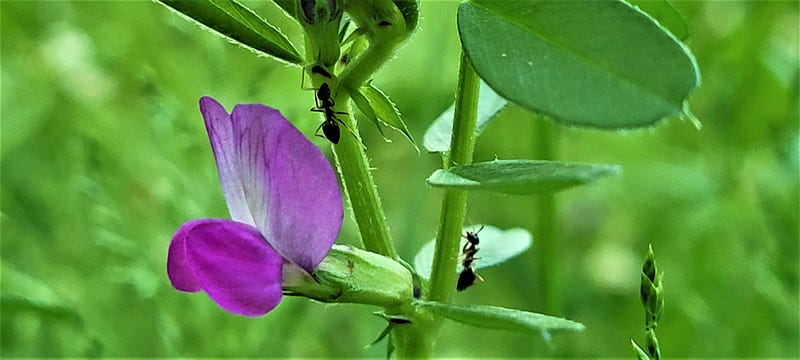
As I walked aimlessly through the park taking in nature and photographing my finds, I noticed these ants hard at work. I wondered, what work are they doing? They marched around with a confident carefulness as if on a most important mission. I didn’t expect to find these little friends today, I especially didn’t expect to be so intrigued that I came home and researched to learn more about them.
Fun Facts
- The weight of all the ants on Earth combined would be about the same as the weight of all the humans on Earth. — San Diego Zoo
- Argentine ants have a super-colony that spreads over 560 miles along the California coast. Scientists who are studying these colonies realize that, unlike other ant colonies, Argentine ants can recognize each other as part of the same species and not attack other colonies. Instead, they’ll work together to keep building their nests larger and taking over more land. Ants.com
- Ants form closely knit colonies that communicate so efficiently they’re often referred to as superorganisms. Ants communicate through pheromones. They secrete these distinct chemicals throughout the day and use different formulas to convey different messages. (Ants.com)
- Ants must plan and prepare for the future, constantly foraging, collecting, storing, defending, nurturing, and providing for the colony. The ant is arguably one of the most productive and hardworking creatures on this planet. (Ant Wisdom)
- Ants play an important role in the environment. Ants turn and aerate the soil, allowing water and oxygen to reach plant roots. Ants take seeds down into their tunnel to eat the nutritious elaiosomes that are part of the seed. These seeds often sprout and grow new plants (seed dispersal). (Harvard Forest)
Lessons From Our Small Friends the Ants
- Be a team player. Ants are successful creatures; they are successful because they know very well that the mind of the team is superior to the mind of the individual! (Mehmet M. Ildan)
- Work hard. Like humans, it has been found that ants find greater value in things they work hard for —effort affects value perception in ants. (American Psy. Association)
- Don’t underestimate your power. An ant can lift 20 times its own body weight. (Pest World)
- Take your time to do your best work. All good work is done the way ants do things: Little by little. (Lafcadio Hearn)
- Communication is important. Ants use the antennae to communicate with one another and keep the colony running smoothly. (San Diego Zoo)
- Be in tune with the needs of others. Scientists are finding that an ant can sweep her antennae over the body of her sister and determine things like her reproductive status and whether or not she should help with a particular task for the colony! (San Diego Zoo)
- Keeping our home (Earth) clean is an important group effort. Keeping the nest clean of waste and the bodies of dead members is important for the health of all in ant colonies. (San Diego Zoo)
A.N.T.S
The first thing I thought of when I saw the ants in this picture was the acronym A.N.T.S — cognitive distortion in the form of automatic negative thoughts. I have given presentations on strategies to notice and immediately combat A.N.T.S with positive affirmations.
My more recent studies have led to a shift in my perspective about A.N.T.S. In the past, I have helped people work hard to quickly dismiss them. I now take the approach of analyzing them more closely first. It is important to pay attention and learn what beliefs stand behind our automatic negative thoughts. Until we change those beliefs, killing the A.N.T.S can be an overwhelming and neverending job. Each time we stamp some out, an army from the colony returns.
When we take time to analyze these beliefs, we find that we don’t really even believe many of them but we still allow them to operate our thoughts. The true way to kill the A.N.T.S is to eliminate or change the belief that is behind them.
For example, I found myself thinking, you are so stupid, quite often throughout the day automatically each time I made a tiny misstep or mistake. When I got to the bottom of analyzing the belief behind this A.N.T, I don’t believe I am stupid in any sense of the word. This A.N.T was just a habit. It’s not a healthy habit or one I should keep. With my new knowledge and attention to that inner voice, I was able to stop that habit and give myself more positive thoughts to feed my growth.
Just like carpenter ants that can tunnel through and destroy the wooden foundation of your home, A.N.T.S can tear down your self-esteem, the foundation of your health and happiness.
Final Thoughts
Both A.N.T.S and ants deserve our attention. In some situations, they can both be damaging. We can learn from both of them. There are lessons everywhere in the world if we are looking.
Thanks for reading! I hope everyone pays attention to the little things and that you learn something daily about the world and about yourself.
Thank you to Victor Sarkin for the prompt: Animalia