
Leonardo Da Vinci Revealed 3 Routine Secrets You Can Use to Become One of the Top 1% Thinkers.
Da Vinci was a scientist, not an artist.
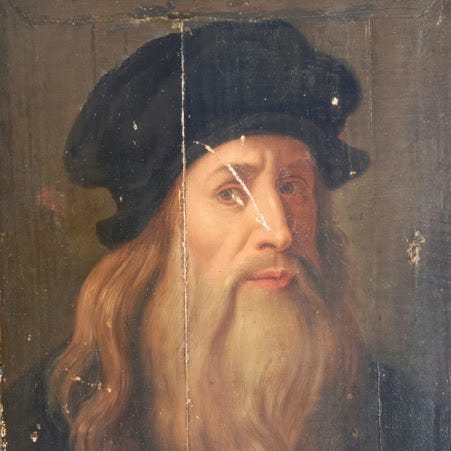
We all know Vinci for painting the famous artwork “Mona Lisa.” Since 1797, the Louvre gallery has housed many works by da Vinci, including the Mona Lisa.
But Vinci wasn’t just a usual painter that you could purchase for $50.
Leonardo Vinci was a scientist, thinker, artist, and philosophical painter. His inspiration arose from being different, as he never went to school. As societal norms challenged him, Vinci educated himself using writing, reading, and learning.
Vinci benefitted from his lifestyle and reshaped his looks, turning into an athletic, handsome man with a beard down to his chest and wearing brightly colored clothes.
Vinci did everything to make himself stand out. But people of that time weren’t surprised by village men. Unfortunately, 504 years after the death of Vinci, we learned his leaked routine secrets: if people knew at the time what Vinci was capable of, they would have named the throne after him. But it’s not too late.
Da Vinci was a polymath: a man of many different talents.
His routine is a perfect pancake mixture for people belonging to different occupations.
Whether you’re an artist or a stock broker, it’s not too late to try Vinci habits and turn yourself into Vinci 2.0. For that reason, below are 3 of Vinci’s practices that we can immediately apply to our lives with just a pinch of remodeling.
Let’s get started.
1. An unfocused polymath
I can hardly sleep at night.
(… but I can in the afternoon and evening.)
As Hemingway’s story teaches us, most thinkers and philosophers have insomnia — a condition that keeps them up all night.
Insomnia and sleep cycles are topics many philosophers have explored throughout history. Thomas Edison woke up in the middle of the night to think, and Buddha would wake up to meditate.
However, da Vinci applied an entirely different method to cope with insomnia.
He introduced multiple sleeping intervals in his day. Da Vinci treated his life like a 24-hour film with 20 minutes of sleep every 4 hours.
This means Vinci slept for:
- 2 hours and 40 minutes in a total of 24 hours.
Through this, da Vinci had 21+ hours to himself without a beginning or end. This type of sleep is also known as a “polyphasic sleep routine,” where a person sleeps multiple times a day.
On the other hand, we sleep for 8 hours and work 16 hours, naming it a “monophasic sleeping routine.”
Is this applicable?
All of us have different genes and different sleeping cycles.
Most people (like my dad) also follow the polyphasic sleeping routine — he tends to sleep only when tired.
The reason?
- He prays.
For praying 5 times a day, my dad has automated the sleep according to the praying times.
Practice made him perfect.
On the other hand, I felt tired and exhausted following multiple sleeping intervals. Here is the thing, the polyphasic sleep cycle comes with many benefits that make it an exceptional routine, followed by Buddha, Thomas Edison, and Vinci, such as:
- You have a whole lot of 21.5 hours to yourself
- Take a break only when you feel tired
- You seem to enjoy life when the world is sleeping
But to follow this route, you must be a work-from-home or business owner. Otherwise, this routine can meddle with your work life.
2. Made himself laugh
- We should be strict with ourselves (lie).
- We should strictly follow a strict routine and build self-discipline (true).
Da Vinci was a master of daily routine, ranging from getting rest, deep working, and eating on time. However, he also took out time to have some fun.
For that reason, Vinci used to do the following:
- Journaling: writing everything that matters, including jokes, ideas, information, or anything that can later prove important.
- Self-affirmation: writing motivating sentences such as “I can do this” and “I shall continue.”
Da Vinci was not a man of excuses, so he wrote everything that came to his mind.
Vinci was a man of his thinking. He wanted to be unique, requiring a tiny cut in your brain. A cut from where you can pull out great ideas before it disappears into oblivion.
For future use, da Vinci wrote down everything that came to mind.
Is this applicable?
When reading a book, I highlight every sentence.
Now that’s just reading a book.
There are many leanings in life you hopefully miss during:
- A one-on-one discussion with parents
- Teaching your younger siblings
- In a course/class
- Reading a book/ listening to a podcast
- Going on a picnic alone to keep mind clear
- During exercise
- Praying
Most of my good ideas come when I read the book, pray and exercise.
The information comes like streaming waterfalls when you’re away from noting your ideas.
But you need to save them. Why? Because these ideas came to your mind for a reason. Save them.
Trust your mind and save everything. The ideas weren’t planted into your mind and dream into your heart for no reason.
3. The healthy body
You do understand the difference between an athletic and a fit body, don’t you?
But da Vinci wanted something more, a fit athletic body. For that, he was ready to make sacrifices.
Seeing the workings of the human body and anatomical structures fascinated da Vinci. That’s when he abides by some fitness rules he practices daily:
As written by markwwollacott.com, da Vinci used to:
- Eat in moderation
- Dine with a disciple
- Savor the flavors, texture, and smell
- Minimize fat, sugar, salt, etc
- Eat water-rich foods
- Consume vegetables and fiber-rich foods
His eating style was strict because he had an unusual sleeping cycle.
If da Vinci ate all the time after waking up, he’d intentionally gain weight and look like a 5.8 ft hulk obese man.
Instead, Vinci did right by his food routine.
According to Vinci, our eating habits are the first step towards building self disciples that last.
Is this applicable?
You must go ahead and oppose only some of the laws of nature.
You need to do right by doing (at least one thing.)
Da Vinci did right by the eating routines, though he opposed sleeping patterns.
As for you, you can jumble with your habits and your routine but keep a share of ordinary habits. Why?
- You have friends to connect with
- Family to run
- Stomach to feed
We’re no longer living in the Renaissance era where the kings would recognize our worth through our brush’s thickness. We live in an era of networking and communication.
If you spend too much time changing your routine and cycles, it’s not late until you detach from the people around you.
For that reason, keep it slow and straightforward.
One unusual habit at a time.
Final thoughts:
Da Vinci’s life is a slice of incompleteness.
Vinci hardly finished anything. He was more into abandoning things that give the perfect 100% into anything.
Da Vinci believed a piece of art is never finished. The same as:
- 1 multiplied by 0 is 0
An artistic person is always imperfect and incomplete. So why should society judge him to become a perfect all-in-one package?
If you oppose the above statement, you’ve been lied.
Join 1,260+ writers and get your next writing inspiration right now.
Or join Medium with my referral link.


