
‘Legends & Lattes’ by Travis Baldree
A Counter Arts Book Club review
“Things don’t have to stay as what they started as.”
‘Legends & Lattes’ was the book I chose to be February’s title when I compiled my new list for the Counter Arts Book Club. Described as ‘cozy’ fantasy, with a nice minor element of queer romance, I thought it would be the perfect choice. And in those respects it certainly was.
Professional audiobook narrator and game developer, Travis Baldree, certainly created quite a storm in response to his own first book— and I’ve seen it mentioned many times in book lists and reviews…. it has been something of an unmitigated success.
The central protagonist in this short novel is a female, Orcish warrior called Viv, who we first join as she is wrapping up the last quest she and her band of bounty hunting miscreants will ever undertake. The rest of the group don’t know it yet, but Viv is retiring — she has a dream she wants to fulfil in her future and with this final act, killing a monstrous creature and removing something from it’s body (the details aren’t really important), she now holds a fabled ‘stone’ which she believes will bring her all the luck she needs in her new endeavour. So without a word of explanation or goodbye, Viv splits.
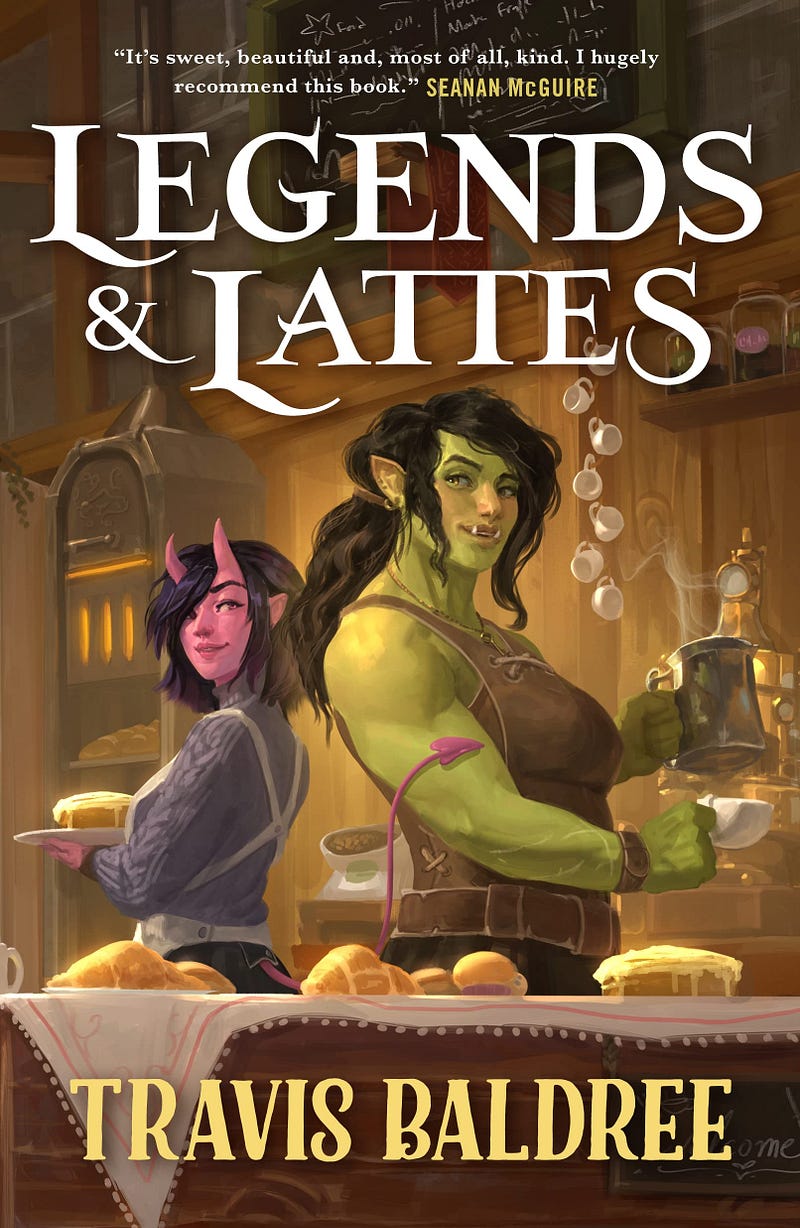
We next catch up with her as she enters the town of Thune, alone. But she soon gathers a new group of characters around her, as the plot progresses and we learn that her grand plan was to open a coffee shop. Not a spoiler, I mean just look at the title, blurb and cover art, but this is also not as common as such an establishment is for us. Coffee isn’t known in those parts, Viv discovered it in another far off place on her travels, where the taste and smell captured her to such an extent she has been dreaming of bringing it here and owning a place of her own ever since.
Her good luck talisman seems to work, buried under a flagstone at the centre of the old farrier’s shop she converts, with the help of Cal, a carpenter she hires on the shipbuilder’s dockside. She hires Tandi, a succubus, as customer service rep/business partner (and possible romantic interest); soon to be followed by a lumbering farmboy, Gandry, to provide ambient music; and ‘ratkin’ Thimble as in-house baker of delectable delights which prove as successfully in demand as Viv’s coffee.
Each of the characters whom Viv hires, very quickly transforms into a fast friend who is willing to stand with Viv and help not only run, but defend and as a new ‘found family’ rebuild the cafe (sorry, I am trying not to give too much plot away). Each is a character who, like Viv herself, is far from the stereotypical image held regarding their race — and here we are looking at races from high fantasy, but much could also be surmised about Baldree’s intentions here as there is much in this ‘cozy’, “high fantasy, low stakes” story which holds entirely true were we to switch out the world and characters he has created with human inhabited reality. I actually did find myself thinking about the kind of cozy crime which has always been particularly popular here in the UK. And I could see this entire premise transposed into a rural English location, character tropes, old friends/new friend, old enemies/new enemies, retired police officer or soldier as the main character moving into a new phase of life pursuing quieter dreams, but having unfinished business come trailing in on her coat-tails. I’ve definitely read and watched that before. More than once and from authors new and old. Baldree’s version does work though and the reader will receive the message loud and clear that one should not make assumptions based on race, or any other outward appearance or stereotype.
Making a bit more effort to mark this novel out as belonging to the fantasy genre (besides the large green orc and purplish pink succubus centre stage, and a ratkin in the kitchen, that is), Baldree introduces Thune as a place rich in thaumic (or magical) energy and has Viv locate the intersection of ley lines at which to bury her Scalvert’s Stone and open her business. An old crew mate turned adversary is an elf who uses magic to track her, find the stone and steal it. One of her first regular customer’s is a student at the local university where he is studying the use of thaumic magic too and pitches in to help her by setting up ‘wards’ (burglar alarms to the uninitiated). I personally found this aspect more interesting, it adds colour and otherworldliness to the story, moreso than the mix of creature races assigned to the characters.
Thaumic magic is not a construct of Baldree’s, or even of the world of fantasy writing. Thaumaturgy is a magical term taken from western ‘new age’ beliefs like Wicca, Theosophy and The Hermetic Order of the Golden Dawn:
“A word based on the ancient Greek and often translated as “wonderworking.” Some people equate this with practical magick: magick that helps a practitioner obtain money, health, etc.” — Encyclopedia Term: thaumaturgy (llewellyn.com)
He uses a lot of old beliefs like dowsing for ley lines, believed to be veins of natural power which criss-cross the planet and can be tapped into for luck and influence.
“Ley lines were first suggested to the general public by an amateur archaeologist named Alfred Watkins in the early 1920s. Watkins was out wandering around one day in Herefordshire and noticed that many of the local footpaths connected the surrounding hilltops in a straight line. After looking at a map, he saw a pattern of alignment. He posited that in ancient times, Britain had been crossed by a network of straight travel routes, using various hilltops and other physical features as landmarks, needed in order to navigate the once densely-forested countryside. His book, The Old Straight Track, was a bit of a hit in England’s metaphysical community, although archaeologists dismissed it as a bunch of puffery.” — Ley Lines: Magical Energy of the Earth (learnreligions.com)
I do find all of this interesting and I feel Baldree’s use of ‘real life’ belief rather than a self-created world-building of a fantastical magic system, again points to a story made to relate closely to ‘real life’. That said, it’s all just kind of dropped into the background of this novel, not really explained or given much attention. I can understand the desire to keep the reader focused on the ordinary aspects of this story, perhaps the author intends to develop the details of the place of magic in other novels, but if not, it’s a wasted opportunity.
Generally speaking, I find this book to be somewhat …bland? It’s “neither nowt nor summat” as you might hear said around here. Baldree has obviously taken two well known and widely loved genres and combined them into something new — and people have really enjoyed it! It’s just not really my ‘bag’; but as a ‘cozy’, easy read, it’s quite comforting I guess, like steaming hot coffee and a freshly baked cinnamon roll.
For more information about the Counter Arts Book Club book list for 2024, and links to some review essays written so far this year (and continuing to update), please look here:
For a great review essay focused on another aspect of the writing in this novel, try Amanda Melheim here:
And if you’re interested in learning more about the idea of pathways and ley lines, you could try another essay we published on Counter Arts not too long ago, by How&Why:
Thank you for reading, you are appreciated as always. Stay safe. Stay well. With love — Sadie


