
Learning to Love by Observing the Art of Dying Well
An acrostic poem melding of the concepts of ars moriendi and ars amandi
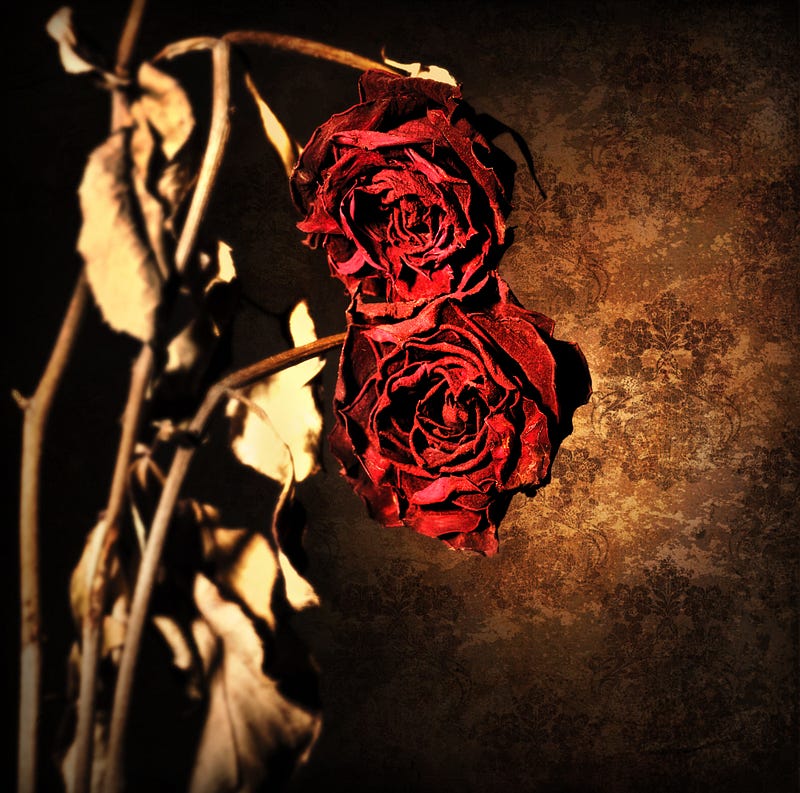
I begin this post with passages from Hermann Hesse’s fabulous first novel, Peter Camenzind, that sparked the initial flames within me to create this piece.
“That’s the way it is when you love. It makes you suffer, and I have suffered much in the years since. But it matters little that you suffer, so long as you feel alive with a close bond that connects all living things, so long as love does not die!! I would gladly exchange every happy day of my life, all my infatuations and great plans, provided I could exchange them for gazing deeply once more into this most sacred experience. It bitterly hurts your eyes and heart, and your pride and self-esteem don’t get off scot-free either, but afterwards you feel so calm and serene, so much wiser and alive.
Little fair-haired Aggie had taken one part of my old self with her into the grave. Now I saw my dear hunch-back, whom I had given all of my love and with whom I had shared my whole life, suffer and die bit by bit. I suffered with him and partook of all of the terror and sanctity of death. I was still an apprentice in the ars amandi and now I had one of my first sad lessons in the ars moriendi.
…
I watched a man die whose entire life had consisted of love and pain. I listened to him make jokes like a child, while death was at work within him. I saw his pained eyes seek out mine, not to beg for pity but to strengthen me and show me that his pain and agonies had not touched the best in him. At those moments his eyes grew wide. You no longer saw his withered face, only the glow in his eyes.”
Now My Acrostic Poem
Art of dying well Realize infinity Serene humbleness
Momento mori vivere sides same coin Oneness and duality both ring true Reductionist views deprive and purloin Illness of separation spreads like flu
Emancipate from binary thinking Nurture courageousness patience and love Display these virtues upon departing Ignite in loved ones divine spark they glove
Art of loving transcends Ovid’s eros Recognize pure philia agape Skillfully navigate landscape of pathos
Agony and ecstasy shan’t escape Mortal existence we experience Alas we architect karmic landscape
Not life nor death have I indifference Deep evolutionary dives soul takes In ignorance there is no cosmic bliss
Notes on Form:
As “ars” has three letters, it begins with a senryu stanza, then as “moriendi” has eight letters, moves onto two quatrains with half of the rhyme scheme of a Shakespearean sonnet, and then as “ars amandi” has nine letters, ends with three stanzas that would begin the four three-line stanzas and rhyme scheme of a terza rima sonnet.
Additional Inspirational Notes and Joseph Lieungh Loop Pedal:
Claire Kelly has recently posted two poems that embody and epitomize the essence of ars moriendi, whether or not she consciously intended to do so, and I urge you to read both of them.
In that one, I commented:
My chest is tight from reading this, yet know it is beautiful, as are you, and this song popped into my head:
“And now the end is here
And so I face that final curtain
My friend I’ll make it clear
I’ll state my case, of which I’m certain
I’ve lived a life that’s full
I traveled each and every highway
And more, much more
I did it, I did it my way”
In that one, I commented in part:
Beautiful poem describes your lucid dream, describing so well life, death, and reincarnation. This and your last two poems all are wonderful examples of a term I read recently in Hermann Hesse’s novel, Peter Camenzind. The term is ars moriendi — the art of dying well, without fear, which many can do when they see it coming slowly and prepare.
PS: the Latin word “ars” is better understood in these contexts as “skill”
It is important to me that my readers understand what I mean by “architect karmic landscape.” As I discuss in some detail in my Revisiting Karma and the Law of Attraction, They are the same but too many do not understand either so please allow me to clarify them and shoot the materialistic messengers selling their books and products, DL Nemeril wrote in her channeled Your Soul Knows Why You Are Here:
Here, we would like to add that we do not agree with karma meaning you have to ‘pay’ for what you did in another lifetime. That is a very human perception, of life being a court system meting out reward and punishment. Karma is a vibrational level that draws the experiences needed for healing and growth to a soul. Nothing more.
Then I connected that thought to the only definition of the “law of attraction” that I accept as this one neither victim blames nor shames, and has nothing to do with the MLM bull shit of manifesting happiness from attachments to creature comforts:
I realized after reading NL’s guides’ thoughts on karma that the law of attraction describes the vibrational pulls of our soul contracts, not what we humans consciously or subconsciously emit.
Tagging my subscriber list as I “believe” the platform cheats all of us. DJ Hopkins G.R. MELVIN Kelly Priyanka Priyadarshini Benighted Jenine “Jeni” Baines jules — Miz Mindful Scott Tarlo Josh Balerite Acol Diana Meresc Shirley Willett Subhasinghe SPS Kelley Murphy Francisco Iglesias Millenium voice T. V. Knight Ufrancis Joe Merkle John Cunningham Ejm Rebecca Romanelli SAP5683 Patricia Ross Rip Parker ANDRIA ANDERSON Donald Gibson Anthi Psomiadou KaliAvatar.com Cabbage1ady Raja Muhammad Mustansar Javaid Glorie Lee Jm Brian G (aka ‘bumpyjonas’) — he/him Gabriel Aryeh Elizabeth Emerald Elizabeth Sobieski Carol McClain Craver Jesse Wilson Noorain Ali carl goldscheider Adesola Orimalade Art Bram Patrick OConnell Susan Farmer Jessica White Aegirl Amy Sea Sparklez Eternity Green Joker Ariadne Ross David Pahor Life is Amazing with Books and Writers Marilyn Flower Gadwall Jackson David Perlmutter Roxanne Barbour Tara Desai PhD YAW AMOAH Jerry Fields Catherine Moore James Ernest lobue Jennifer Hooper Jessicay Ella Ann Libby Shively McAvoy Dr Mehmet Yildiz Ravyne Hawke Chris Price Patricia Ann Rogers (MadRobin) Pamela Oglesby Natasha MH Ted Czukor
In Rama I create, with soul energy surging through my body, inspiring me and breathing wind into my sails,