
Learn More Effectively With One Principle
Education is more than just reading something once

Do you find it hard to retain and apply information?
Even information you know you’ve spent the work to understand and go over?
I have.
Does it feel like you’re constantly slipping down a hill when you learn sometimes?
Why does it feel so difficult to recall important concepts?
When we are learning in school, instructors often give the impression that you just need to pay attention and understand something as its presented to you.
Sure, homework and tests exist as well to “check” if you actually retained the information, but in reality these too represent only temporary measures.
The Problem
Barring some rare cases, we are guaranteed to forget what we’ve learned.
Of course, you have likely heard of this already because it is such a common problem that many people face.
But if you haven’t, this phenomenon actually has a name: the forgetting curve.
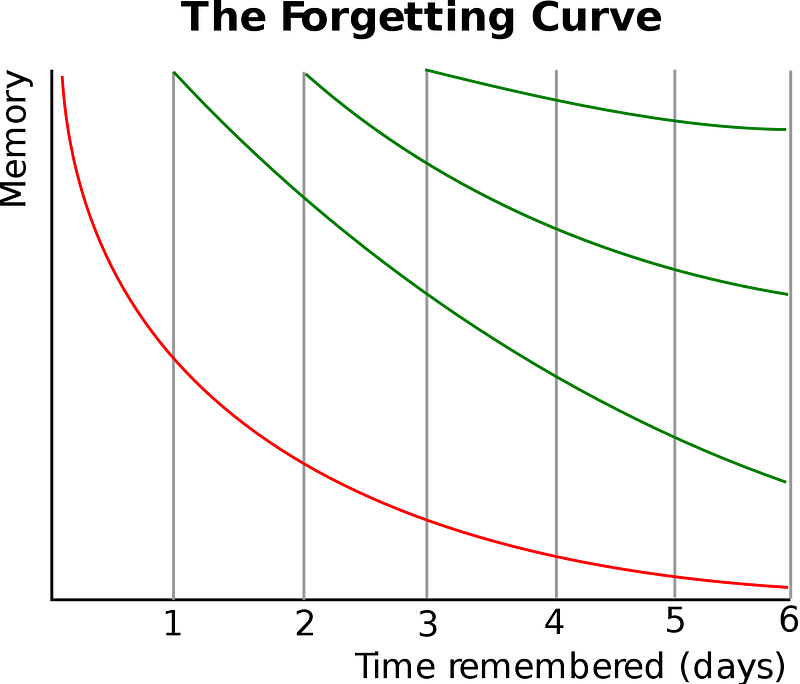
Here, the red line represents the proportion of information remembered, from 0 to 100 percent, given that no review is done on the information after it is learned.
One thing to notice is the exponential decline in retained information. What this means is that the information is not lost at a constant rate over a period of time.
It’s already bad enough that we don’t remember information that well, but on top of it, we seem to lose half of the information we’ve learned over the first day and the rest of it slowly over the week.
Meanwhile, the green lines represent the what happens after using a common technique, spaced repetition, to combat the loss of information over time.
I imagine this is part of the consolidation process for transferring short-memories into long-term ones, but I’m not certain.
In any case, the forgetting curve actually has a long history, with the first experiments being done by Ebbinghaus in the late 19th century.
The above shows that more modern studies have replicated Ebbinghaus’ results.
Searching “forgetting curve” on Medium brings up a number of great summaries on and deep dives into the topic:
Max Phillips does a great job going through and summarizing all the common points surrounding the discussion around the forgetting curve and spaced repetition, so definitely check out his article for more information!
The Principle
The principle is that to learn, you must review.
Of course, spaced repetition and making the information more salient (i.e. using more of your senses when learning) are common strategies that fall under this idea, but I see this as fitting into a broader model of human behavior.
If you don’t review and only look over something once, think of it as a signal to your brain that the knowledge is disposable.
On the other hand, if you keep going back to something many times, it is like an implicit message that this is important.
These ideas about sending signals to your body are similar to advice about consistency in working out and building a physique you want. Strength training is something that you need to do almost every day in order for your muscles to develop.
Effective learning possesses comparable qualities.
Thus, knowledge must be nurtured in order to be practical and creatively applied.
Is It Practical?
Implementing something like spaced repetition is easier said than done.
After all, you have to set a schedule for yourself about when you want to review information and you have to hold yourself accountable for making an active effort to learn and review during that time period.
If you’re starting out, I would recommend that you just make the effort to review the information twice.
I think even at that level of review, it is enough to give you a significant boost that would serve as evidence and positive reinforcement.
Another effect that often isn’t captured by studies on the impact of spaced repetition is that you might learn new information or gain a new perspective on a second read, because most spaced repetition studies focus on learning vocabulary words rather than more complex topics.
There are two steps to implementing it successfully:
- Having a focus and clear goal with respect to what you are learning. Ideally, you can write it down somewhere to look at.
- Taking small steps to review at first and doing it more often once you get a sense of how review shapes your learning process.
Finally, it’s important to be conscious and present when you learn or review as well, as this is the force that will drive you forward in the advancement of your knowledge and in its (hopefully) permanent incorporation into your skills and approaches.


