
The Science Behind Why You Forget Things So Quickly
How to combat the forgetting curve and improve your memory.
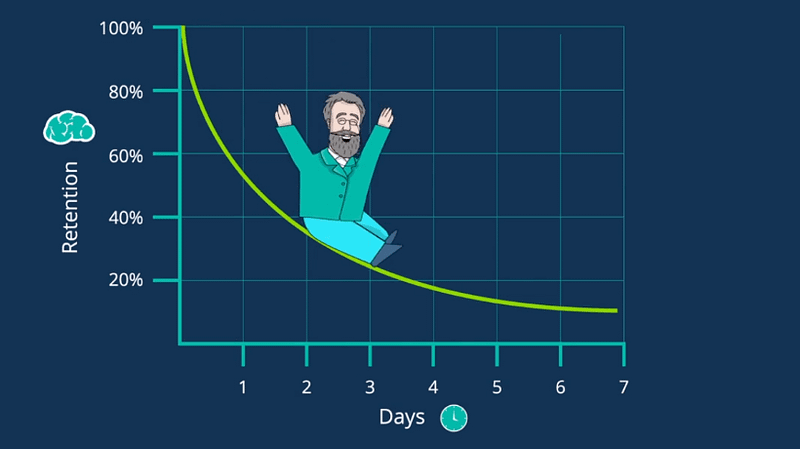
The “forgetting curve” originated in the 19th century when German psychologist Hermann Ebbinghaus tested his memory over various periods. After gathering all of his data, the results looked like the image above. As the graph suggests, you retain 100% of the information straight away, as it is still in your short-term memory. Within two days, retention drops to 40%. Afterwards, it slows down a bit, reaching 10% retention after one week.
A video from Growth Engineering nicely summarises why we forget things at such an exponential rate: “Our brains operate a strict use it or lose it policy.” Recent research by Dr. Art Kohn, Professor at Portland State University School of Business states that: “on average, 50% of information is forgotten after one hour, 70% in 24 hours and 90% of information is lost in a week.” So, it’s pretty clear we aren’t great at remembering things longer term, but why?
Well, according to Dr. Kohn, most things we remember are of “short-term importance.” Consequently, the brain needs to make room for memories of more “immediate value.”
You take in about 60 bits of information when talking with someone. To put that into context, Mihaly Csikszentmihalyi, the man who popularised the “flow state,” says the brain can take in an estimated 120 bits of information a second. So you can barely process talking to two people at once. There is so much input; you are bound to forget most of it at a rapid rate.
Moreover, the amount of information has sky-rocketed over the past few decades. Dr. Martin Hilbert of the University of Southern California calculated that over time, we receive five times more information per day than we did just over 30 years ago. As The Telegraph writes:
“Using the analogy of an 85-page newspaper, they found that in 1986 we received around 40 newspapers full of information every day, but this had rocketed to 174 in 2007.”
Each tweet, headline, random interaction or relationship status is competing with the limited space in your brain. As we receive more input, the forgetting curve hasn’t become outdated either. In 2015, a research team conducted Ebbinghaus’ original experiment and found that his theory holds up today. There is too much for us to act on — we use it then swiftly lose it. As there is so much to take in, some important stuff can slip through the cracks as well. You need to combat the forgetting curve.
How to Combat the Forgetting Curve
The primary problem is we don’t use new information quickly enough. Before you know it, the brain has deemed it unworthy. So, you need to act.
Use spaced learning
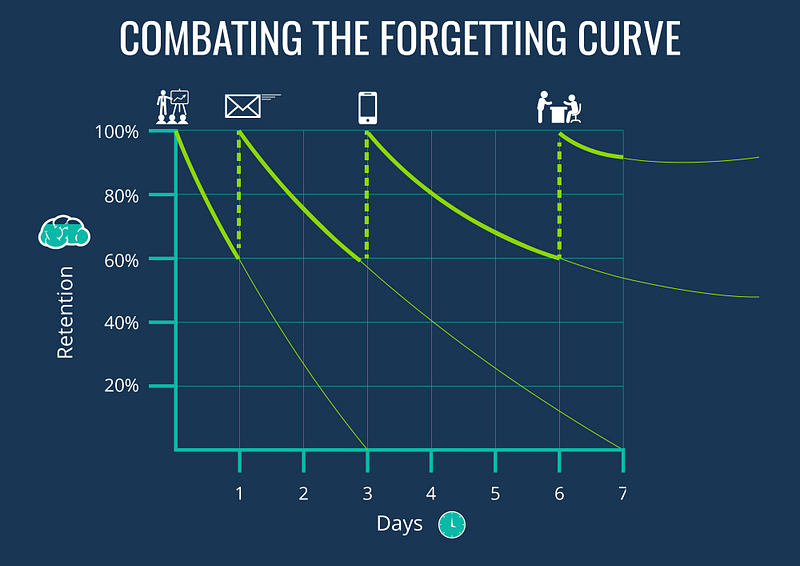
Ebbinghaus realised it is easier to remember something you already know. Every time you reinforce your learning, the information is becoming more familiar to you. This thus declines the rate of memory reduction. Regularly coming back to information will solidify it in your head.
Make it easier to learn
At university, reading from a two-inch-thick book didn’t make learning very easy. To combat this, I, like a lot of people, simplified the information. By splitting it up into sections, using spider diagrams and colour coding, I accessed some much-needed clarity.
Perhaps one of the best things I did was to write shorter copy of the text. Condensing the work means your brain has less to remember, increasing the chances it’ll remain in your head.
Challenge your memory
When you’ve come to recall what you’ve learned but realised there are some gaps in your memory, you can test yourself. According to Mind Tools, this will be better due to the “mental challenge” involved. You can do this by making it interactive — even something as simple as asking questions will help.
Other Ways to Improve Your Memory
Of course, everyone’s brain works differently. What works for you might not work for me. Even so, there are some science-backed ways you can improve your memory and fight the forgetting curve.
Use all of your senses
When you experience something highly emotional, your amygdala is activated. According to the University of Queensland Australia, this:
“Boosts memory encoding by enhancing attention and perception, and can help memory retention by triggering the release of stress hormones, such as adrenaline and cortisol, to boost arousal.”
In 2015, a research paper found that because your senses act in close connection, using all of them can help strengthen your brain. For me, a specific song will trigger wonderful memories at my favourite music festival. It becomes even more potent when combined with a Strongbow Dark Fruits can.
Implement the generation effect
The generation effect states that merely reading something is not enough to retain the new information. You need to generate it yourself. Psychology Wikia suggests a few practical ways of implementing this:
- Read a section of your book. Then, close the book and generate (and answer) questions about what you just read. For example, I recently finished Ryan Holiday’s Stillness Is Key. To remember more of the information, I would ask myself “What areas of my life could I try and be more still in?”
- If there are review questions at the end of a chapter, answer those questions without looking back at the pages.
- Use flashcards to test yourself.
Effective use of the generation effect will lead to a process called “encoding.” Psychology Dictionary describes it as “Converting sensory input into a form able to be processed and deposited in the memory.”
As our brain “operates a strict use it or lost it policy,” the generation effect forces you to act on the information. You’ve then used it and encoded it, thus decreasing the chances of falling down the steep forgetting curve.
Learn a new language
In 2012, a review by Dr Viorica Marian, and Anthony Shook proved the various cognitive benefits of bilingualism. According to Healthline, these include the following:
- Better memory.
- Improved visual-spatial skills.
- Higher levels of creativity.
- Easily switch between tasks.
- Delay age-related mental decline.
The Foreign Service Institute believes it can take 23 to 24 weeks to learn languages related to English, such as Dutch, Spanish and Italian.
Final Thoughts
Memory is important, but you don’t need me to tell you that. Chances are you’ll forget a lot of the information in this article. The moment you click off here, you begin your descent down the forgetting curve. Perhaps the easiest and most efficient way of beating the curve is through repeated, spaced learning. The more you come back to it, the more it will solidify in your brain. Simple, right?
Mind Cafe’s Reset Your Mind: A Free 10-Day Email Course
We’re offering a free course to all of our new subscribers as a thank you for your continued support. When you sign up using this link, we’ll send you tips on how to boost mental clarity and focus every two days.