avatarTodd Lankford

Free AI web copilot to create summaries, insights and extended knowledge, download it at here

2684

Abstract

wings.</p><p id="79df">Let’s investigate how getting curious can help you do this.</p><h2 id="bfe3">Getting Curious</h2><p id="25b3">Ask questions rather than giving answers. This is one of the best ways to build problem-solving skills and show team trust.</p><p id="4109" type="7">“We learn more by looking for the answer to a question and not finding it than we do from learning the answer itself.”</p><p id="b2ac" type="7">— Lloyd Alexander</p><p id="06c6">When your team member asks you for a decision, ask critical questions. This will generate a <a href="https://readmedium.com/overcoming-the-fear-of-the-incapable-team-5a097aa6b4ee">collaborative problem-solving</a> moment. It helps your team think through the problem. And their confidence increases. They realize they have the information and ability to make the decision.</p><p id="1b89">A consistent application of this technique will allow your team to take ownership. And it will create coaching moments between you and your team.</p><p id="e026">Below are some guidelines on how to do this for common decisions presented to the managers I coach.</p><figure id="9488"><img src="https://cdn-images-1.readmedium.com/v2/resize:fit:800/1*nqe9YrMcGmUCKcg2RyoEBQ.png"><figcaption>Figure A–How to Show Curiosity to Build Team Ownership</figcaption></figure><p id="9ebc">The responses that show your curiosity and support will build your team’s problem-solving confidence. If you ask questions, you allow the team to take ownership.</p><p id="eda8">But if you tell the team what to do, who has the accountability? You do. And the next time the team has a similar issue, they will not try to solve it. They will run to you for the answer. This is not the behavior you need from your team.</p><p id="517a" type="7">“It is not the answer that enlightens, but the question.”</p><p id="6cf8" type="7">— Eugene Ionesco</p><p id="9cad">Your team will be stronger if you are patient and collaborate with them on the given problem. Allow them to solve the problem. Accept this process takes longer. The investment in your people is worth it.</p><p id="26c1">Now is time to trust your team and allow them to take ownership. Ownership must be taken and not given. It is up to you to provide the environment and support necessary for them to take it.</p><p id="ef17"><i>For more content like this on my pursuit of Lean Leverage, delivered to your inbox, you can just <a href="https://mailchi.mp/c0d8e9e1608b/dt12qs95i0">join my email list</a>. Or see my other related posts below to dive even deeper.</i></p><h1 id="2534">Related Posts</h1><div id="44b4" class="link-block"> <a href="https://readmedium.com/agile-leaders-must-buil

Options

d-a-problem-solving-culture-5b0c1a629e8c"> <div> <div> <h2>Agile Leaders Must Build a Problem-Solving Culture</h2> <div><h3>As an Agile Leader, help your teams get back to their innate curiosity and build a problem-solving habit</h3></div> <div><p>medium.com</p></div> </div> <div> <div style="background-image: url(https://miro.readmedium.com/v2/resize:fit:320/1*NmHTAUgIY-1hb9__O1OFBA.jpeg)"></div> </div> </div> </a> </div><div id="e0f2" class="link-block"> <a href="https://readmedium.com/overcoming-the-fear-of-the-incapable-team-5a097aa6b4ee"> <div> <div> <h2>Overcoming the Fear of the Incapable Team</h2> <div><h3>Trust the team, and be amazed</h3></div> <div><p>medium.com</p></div> </div> <div> <div style="background-image: url(https://miro.readmedium.com/v2/resize:fit:320/1*[email protected])"></div> </div> </div> </a> </div><div id="8db5" class="link-block"> <a href="https://readmedium.com/we-need-managers-to-become-agile-leaders-63632a116e73"> <div> <div> <h2>We Need Managers to Become Agile Leaders</h2> <div><h3>We desperately need active engagement by Agile Leaders to be Agile</h3></div> <div><p>medium.com</p></div> </div> <div> <div style="background-image: url(https://miro.readmedium.com/v2/resize:fit:320/0*plc0ogwNJPLOCKat)"></div> </div> </div> </a> </div><div id="6e7e" class="link-block"> <a href="https://readmedium.com/do-we-need-a-manifesto-for-managers-526137a8cecd"> <div> <div> <h2>Do We Need a Manifesto for Managers?</h2> <div><h3>It is time to recognize managers in the Agile journey</h3></div> <div><p>medium.com</p></div> </div> <div> <div style="background-image: url(https://miro.readmedium.com/v2/resize:fit:320/1*[email protected])"></div> </div> </div> </a> </div><figure id="4711"><img src="https://cdn-images-1.readmedium.com/v2/resize:fit:800/0*y1Q-1M_8gxbtNMLi.png"><figcaption><a href="http://seriousscrum.com/invite">Do you want to write for Serious Scrum or seriously discuss Scrum?</a></figcaption></figure></article></body>

Learn How to Show Agile Leadership by Getting Curious

Questions are the answer.

Image by Arek Socha from Pixabay

Moving from being a manager to being a leader is crucial in today’s Agile environment. The success of our Agile teams depends on it. I have written about the need for Agile Leaders and the values of an Agile Leader before. But today, I have a specific scenario to dive into.

Recently, I heard this statement by a manager:

“It would be so much easier if I could tell the team what to do and how to do it.”

— Manager in an Agile Transformation

This is a typical reaction to the difficulty in supporting self-organizing behavior. While it seems appealing and less risky to direct a team on their every move, it is not. If you treat your team like robots, you will get robots. And this does not enable Agility.

When you, the manager, are in the decision-making hot seat, your team will be less effective. Every decision you make saps self-organizing behavior from the team.

When you own all decisions, the weight is on your shoulders alone. And you will not always be there with the team when they need a decision to be made. This can lead to a bottleneck.

Build projects around motivated individuals. Give them the environment and support they need, and trust them to get the job done.

— The Fifth Principle of The Agile Manifesto

The self-organizing team is a risk-reducing mechanism for decision-making. Agile Leaders recognize that many minds contributing to decision-making beats one mind.

Your team is the best equipped to make the right decision. They are closest to the problem. And the root cause is obvious to them.

Your team members are intelligent professionals. You hired them. So now it is time to trust them and enable them to spread their wings.

Let’s investigate how getting curious can help you do this.

Getting Curious

Ask questions rather than giving answers. This is one of the best ways to build problem-solving skills and show team trust.

“We learn more by looking for the answer to a question and not finding it than we do from learning the answer itself.”

— Lloyd Alexander

When your team member asks you for a decision, ask critical questions. This will generate a collaborative problem-solving moment. It helps your team think through the problem. And their confidence increases. They realize they have the information and ability to make the decision.

A consistent application of this technique will allow your team to take ownership. And it will create coaching moments between you and your team.

Below are some guidelines on how to do this for common decisions presented to the managers I coach.
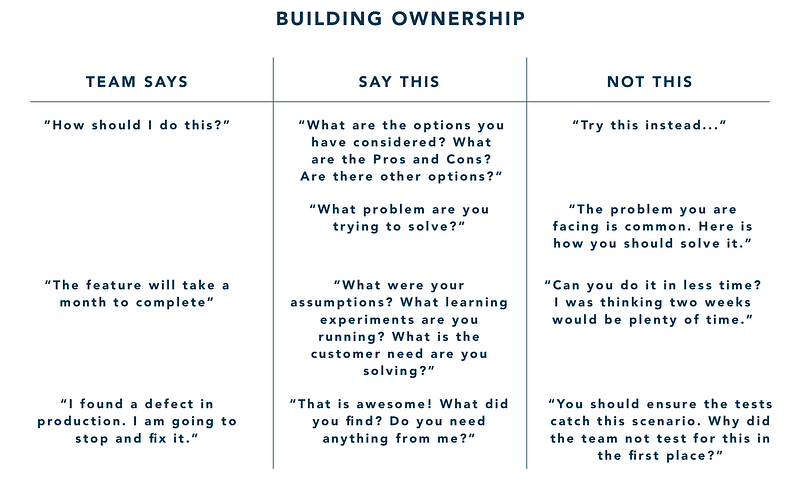
Figure A–How to Show Curiosity to Build Team Ownership

The responses that show your curiosity and support will build your team’s problem-solving confidence. If you ask questions, you allow the team to take ownership.

But if you tell the team what to do, who has the accountability? You do. And the next time the team has a similar issue, they will not try to solve it. They will run to you for the answer. This is not the behavior you need from your team.

“It is not the answer that enlightens, but the question.”

— Eugene Ionesco

Your team will be stronger if you are patient and collaborate with them on the given problem. Allow them to solve the problem. Accept this process takes longer. The investment in your people is worth it.

Now is time to trust your team and allow them to take ownership. Ownership must be taken and not given. It is up to you to provide the environment and support necessary for them to take it.

For more content like this on my pursuit of Lean Leverage, delivered to your inbox, you can just join my email list. Or see my other related posts below to dive even deeper.

Related Posts

Do you want to write for Serious Scrum or seriously discuss Scrum?
Leadership
Agile
Problem Solving
Management
Serious Scrum
Recommended from ReadMedium