
Lavalava
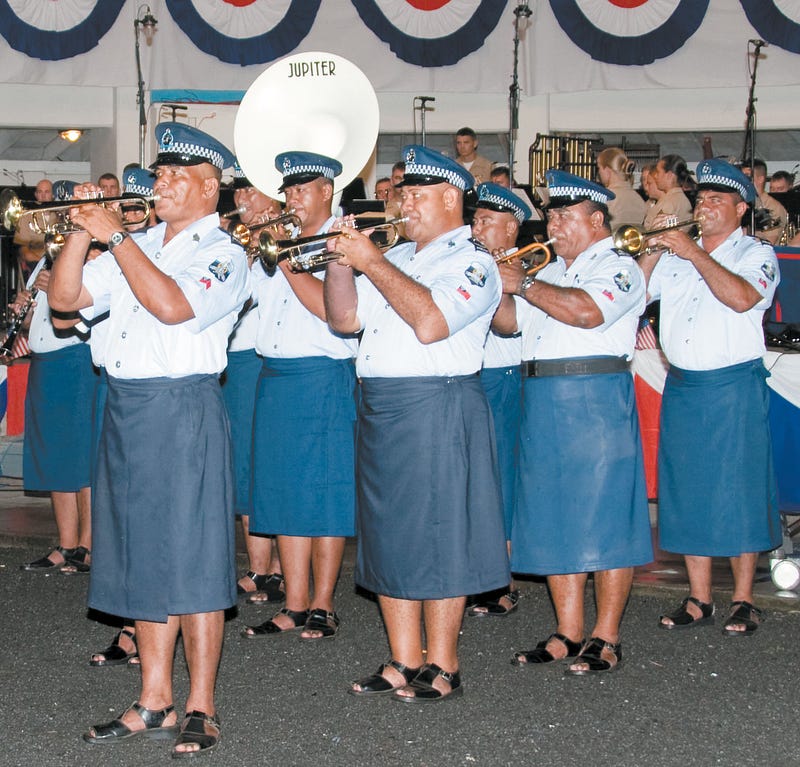
This outfit is great for hothot weather.
Today’s New York Times Spelling Bee letters:
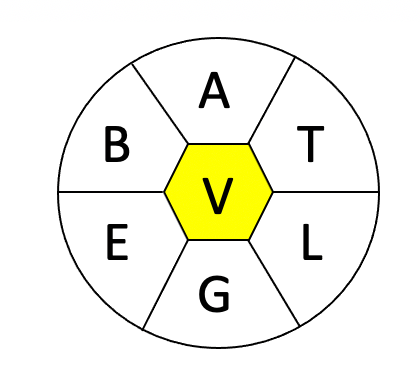
A, B, E, G, L, T, and center V (all words must include V).
Merriam-Webster says…
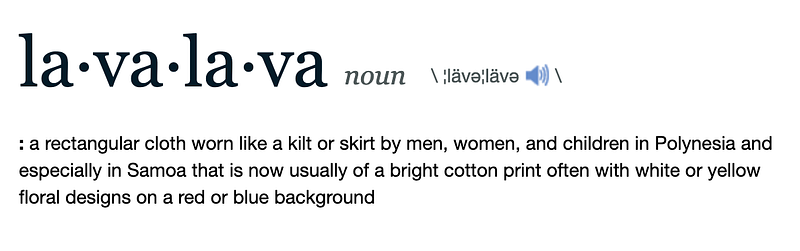
Silly little dictionary! Don’t you know lavalava can’t possibly be a word if the New York Times says it ain’t?
For further fascinating facts, check out the Spelling Bee Master.
What’s your favorite dord* from today’s puzzle?
My Two Cents
First of all, how is gevalt not a valid word for today’s puzzle? Oy, gevalt! I was even able to find the expression listed in the dictionary:
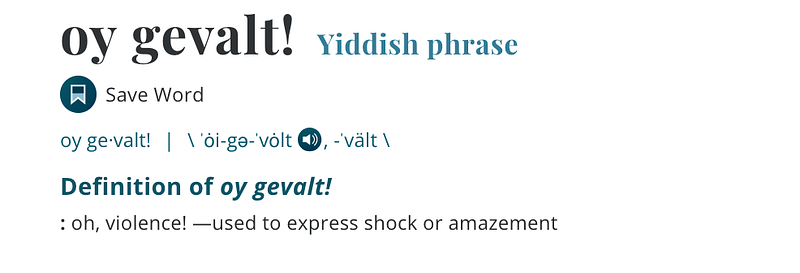
I don’t really speak Yiddish; I’ve just picked up phrases and words here and there from family and friends. And because of that, I just found out today that gevalt might mean “violence”. I never really stopped to think about what it could mean; I assumed it was somehow related to gefilte, as in gefilte fish, which means “stuffed fish”. The fact that “oh, stuffed!” didn’t make sense as an exclamation never crossed my mind.
Anyway, gevalt was not accepted, and neither was lavalava.
Lavalava is not what happens when two volcanoes erupt in stereo. It’s an article of clothing traditionally worn by Polynesians. Both men and women wear the rectangular, wraparound cloth. The term is used as both a singular and a plural by Samoans, who also refer to is an ‘ie (short for ‘ie lavalava).
Traditionally made of woven textiles made from leaves or mulberry barkcloth, lavalava are now made from calico and cotton cloth.
According to Wikipedia, “the lavalava is secured around the waist by an overhand knotting of the upper corners of the cloth; women often tuck the loose ends into the waistband, while men usually allow them to hang in front.” So, the expression “how’s it hanging” probably means something else in Tonga.
Kids wear it as part of their school uniforms, and adults sometimes combine it with a suit jacket and tie. Some linen lavalava are tailored to mid-calf and can come with pockets and buckles. These are worn by men at special occasions or to church and are always in solid colors (as opposed to the brighter patterns of lava-lava used on a daily basis).
Double the pleasure
So why is lavalava not a valid word in today’s Spelling Bee game? The puzzle rules say they don’t accept hyphenated words, but I searched near and far and couldn’t for the life of me find an alternate spelling of lavalava with a hyphen. Plus, the Spelling Bee has accepted “pompom”, which according to Merriam-Webster does carry a hyphen.
The puzzle has also included other words that consist of repeated syllables, like mama, nana, bonbon, and ratatat. Also mahimahi, if I remember correctly.
Therefore, that can’t be a reason to reject lavalava.
Invisible clothes
What about traditional clothing called by its original ethnic names? Maybe that’s too obscure for the editors of the Times? Yet… they have included kilt and sarong. Possibly also malong, from the Philippines. (Next time I get that combination of letters I’ll confirm my suspicions about malong). All three are typical dresses of their cultures.
And finally… I’m pretty sure lavalava isn’t an offensive term, which would also be a reason to bar it from the word list.
I give up. If you have any theories, please feel free to leave them in the comments section.
It’s quite possible that we may never ever find out why the editors of the Spelling Bee game refused to acknowledge the word lavalava and derided it as a dord.*
Please check out my previous entry on another dord*:
*What the heck is a dord, anyway? Here you go: