
Leet
A coded language that began with boobies
Today’s New York Times Spelling Bee letters:
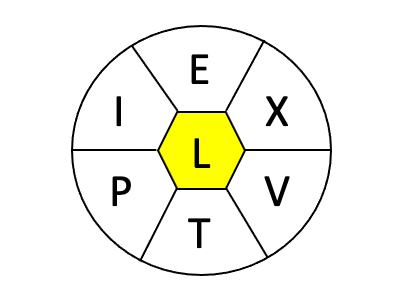
E, I, P, T, V, X, and center L (all words must include L).
Merriam-Webster says…
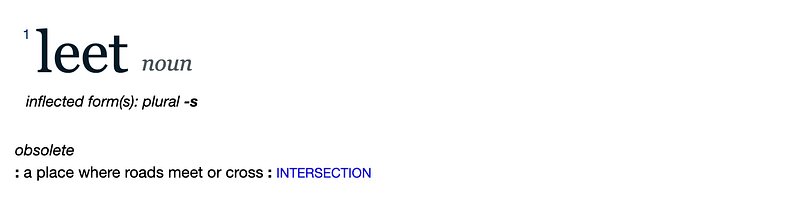
And also:
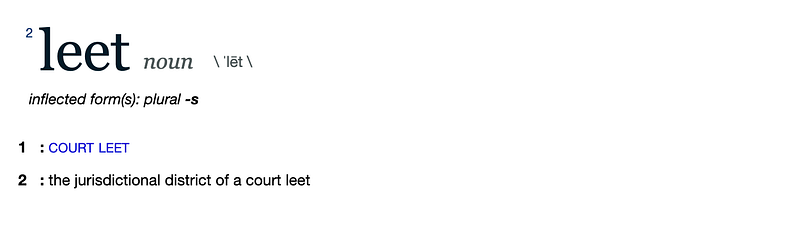
Silly little dictionary! Don’t you know leet can’t possibly be a word if the New York Times says it ain’t?
For further fascinating facts, check out the Spelling Bee Master.
What’s your favorite dord* from today’s puzzle?
My Two Cents
Apologies to my more conservative readers, but I figured if I put the word “boobies” in the subtitle, it might attract more attention to this article. You’re here, aren’t you? Also, I promise it’s not just clickbait. Just be patient…
The two definitions I screenshotted (a verb I just coined and copyrighted, by the way) say nothing about coded languages. The court leet, the dictionary explains, was “a court formerly held in England and the colonies with jurisdiction over civil matters and petty offenses and surviving in England only for ceremonial purposes.” So maybe that included a coded language of sorts: legalese mumbo-jumbo.
What I’m interested in is the more modern and still current definition of leet — and the reason that the New York Times should have accepted it for today’s puzzle — which does not appear in the dictionary.
So why did I put those screenshots of the two definitions we are not going to talk about? Mostly because I always use a dictionary screenshot. Also because it probably made you wonder what they had to do with boobies, so you kept reading. I promise we’ll get there real soon.
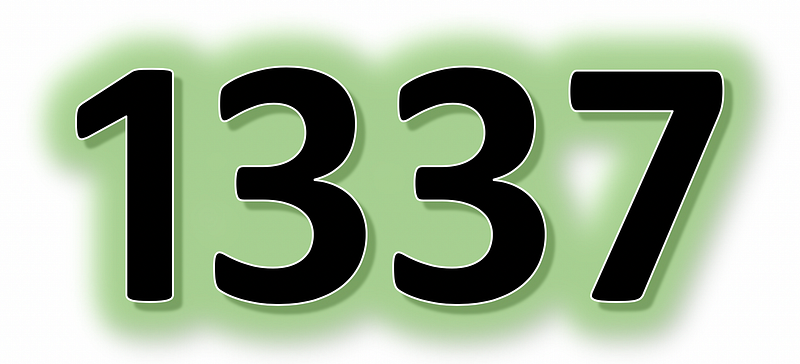
1337
Perhaps you weren’t too distracted by the word “boobies” to notice that today’s opening image is four digits. And a word. Don’t believe me? Turn your phone upside down and use the right side of your brain. If you’re reading this on a desktop computer, please don’t try turning it upside down. I don’t want any lawsuits resulting from you shattering your 27-inch, three-thousand dollar Mac.
Just open your phone’s calculator, type 1337, and flip it around.

Leet.
Leet, also known as leet speak or eleet, is a language that uses modifications in spelling to create a code that can be deciphered by those in the known, or the elites. (One of the pronunciations of leet is el-eet.) Numbers, symbols, and special suffixes are combined to create words that can be interpreted by those who “speak” the language.
Leet is especially used online in the gaming and computer hacking communities. It is supposed to have originated as early as the 1980s during the era of the Bulletin Board Systems. According to one theory, users wanted to bypass the text filters that had been created to blot out verboten words or topics.
For more casual users of leet, the primary strategy is to use symbols that resemble (to varying degrees) the letters for which they stand. Any symbol can be used as long as the reader can interpret it; otherwise communication won’t be effective.
Here’s a simple example: @ $$ (ass).
And can you figure this one out? $#!+
Below is a link to a leet translator, which lets you type in a word or phrase on the left so you can see what it looks like in leet speak.
What’s interesting is you can fiddle around with the Density control on the right to make it the sentence easier or harder to read. Using the preset phrase provided by the program, a lower density conversion into leet speak looks like this:
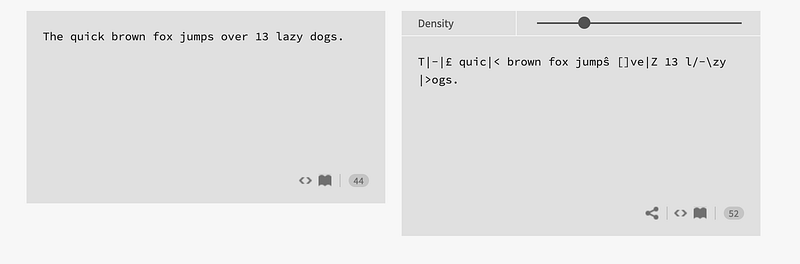
With the Density set to the highest level, you can barely make it out:
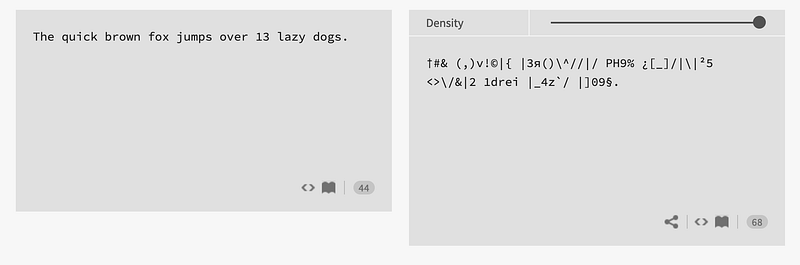
Boobies
Yes! Finally!
I was born just in time to avoid having to use a slide ruler. My dad studying engineering at the university with that marvelous piece of primitive-yet- advanced technology. I was lucky enough to have this when I was a kid:
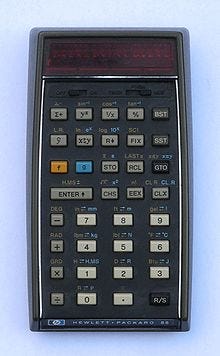
That was one of the first Hewlett-Packard calculators, the HP-55. I think this is the exact same one we had at home. This one came out in 1975, three years after the original one, the world’s first pocket calculator and scientific pocket calculator. The HP-55 cost $395, which is more than $2,500 in today’s dollars.
I have no idea how my dad afforded one, but we had it at home. Not that I was allowed to use it very often.
The display had bright red LEDs that showed numbers using the seven segment system. Picture the number 8 made up of two squares, one on top of the other. Six red dashes formed the perimeter and one red dash crossed the middle.
For some reason that HP-55 was programmed to dramatically flash the numbers when an impossible calculation was made, like dividing by zero. Which made dividing by zero exciting for an eight-year-old.
I got my own calculator in fifth grade from a bank that we visited on a class field trip. All my classmates got them. Yep, that was the swag banks handed out back then. But it was plenty fun for us, because we immediately discovered we could type numbers and turn them into words by flipping the calculators upside-down. For example:
- When you keyed in 0.7734 you got “hello”. (You had to use a decimal point for the 0 to stay on the display.)
- When you typed 37047734 you, got “hellhole”.
- 53177187714 gave you “hillbillies”.
And of course, the most awesomest cool thing for a fifth-grader to do was type 5318008, rotate the calculator, and see this:
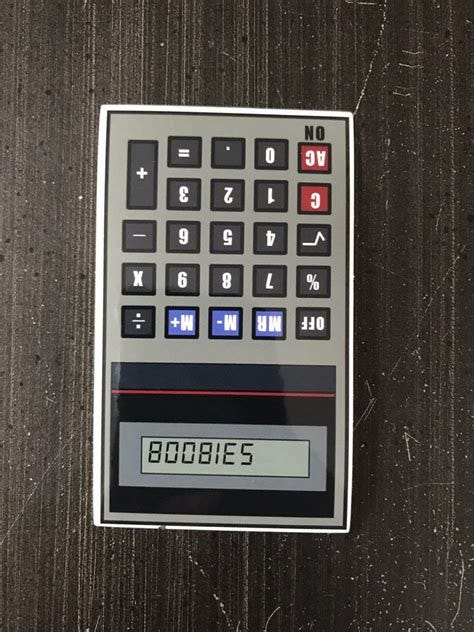
So that’s the gist of my theory. “Theory? What theory?” you ask with a puzzled expression on your face.
My theory that calculator boobies are the seed that sprouted over the decades and became the sophisticated leet speak used by hackers and gamers to make fun of n00bs like me and you.
And if you don’t really buy into the sophisticated part of it, click on the leet translator link, set the Density all the way to the right, and type in “boobies” on the left. This is what I got:
|>()°|o1€ŝ
Now, if that’s not sophisticated, I don’t know what is.
Still, despite all this evidence, the editors of the Spelling Bee game dismissed the word leet and decided that it was a dord.*
Please check out my previous entry on another dord*:
*What the heck is a dord, anyway? Here you go: