
laura
Can you guess what this lowercased name means?
Today’s New York Times Spelling Bee letters:
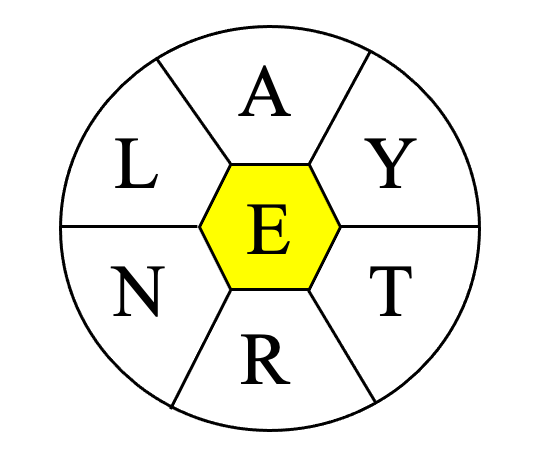
A, L, N, R, T, Y, and center U (all words must include U)
Merriam-Webster says…
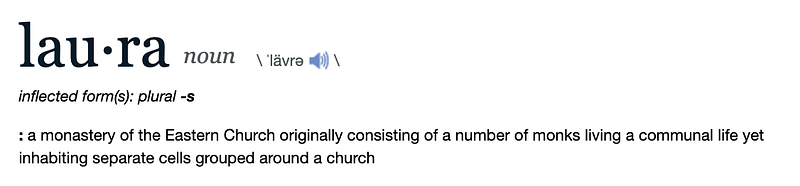
Silly little dictionary! Don’t you know that laura can’t possibly be a word if The New York Times says it ain’t?
For further fascinating facts, check out the Spelling Bee Master.
What’s your favorite dord* from today’s puzzle?
My Two Cents
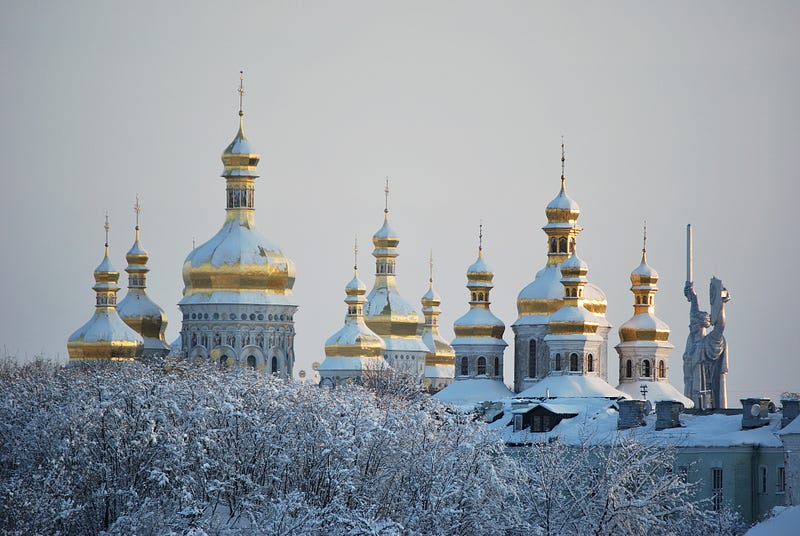
The photo at the top of today’s article shows a view of the Kyiv Pechersk Lavra, also known as the Kyiv Monastery of the Caves. This historic Eastern Orthodox Christian monastery in the capital of Ukraine was declared a UNESCO World Heritage Site in 1990. The UNESCO groups the monastery complex and the nearby Saint Sophia Cathedral as one entity for its World Heritage Program, but they are not in the same part of the city and were managed by different Ukrainian entities.
The UNESCO describes them thusly:
Saint-Sophia Cathedral, located in the historic centre of Kyiv, is one of the major monuments representing the architectural and the monumental art of the early 11th century. The Cathedral was built with the participation of local builders and Byzantine masters during the reign of the Great Prince of Kyiv, Yaroslav the Wise, as the main Christian Church of the Kyivan Rus’ capital. The Cathedral has preserved its ancient interiors and the collection of mosaics and frescoes of the 11th century is unique for its integrity. Its masterpieces include the Pantocrator, the Virgin Orans, the Communion of the Apostles, the Deisis and the Annunciation…
The Kyiv-Pechersk Lavra is an architectural ensemble of monastic buildings situated on the plateau overlooking the right bank of the Dnieper River. The ensemble was formed over many centuries in organic combination with the landscape, and acts as a general urban dominant. Founded by St. Anthony and St. Theodosy in the 11th century, the monastery became a prominent spiritual and cultural centre that made a significant contribution to the development of education, art and medicine. The architectural ensemble of Kyiv-Pechersk Lavra comprises unique surface and underground churches from the 11th to the 19th centuries, in a complex of labyrinthine caves that expands more than 600m, as well as domestic and household buildings from the 17th to the19th centuries.
Considering there’s a war going on in the Ukraine, one wonders how this laura and its monks are doing.
Monk-ey business
Our friends at Merriam-Webster tell us that laura comes from the Late Greek, from the word in ancient Greek, meaning “lane” or “alley” (akin to Old Irish līe stone), from the Greek laas (stone). In Albanian the word lerë means “rock” or “rockfall”.
This origin of this word is completely separate from that of the name Laura, which comes from the Latin laurus, meaning “bay laurel plant”. For the ancient Romans, this plants was a symbol of victory, honor or fame.
Our lowercased laura –-sometimes spelled lavra–– is a type of monastery for hermits, aspiring monks, and people who are simply fed up with society and want free room and board. Kidding. Sort of… Originally made up of caves, today many lauras simply have small buildings or rooms for their monks. There is also usually a church and a refectory, or communal dining room.
According to the Catholic Encyclopedia, in a laura “the monk lived alone though dependent on a superior, and was only bound to the common life on Saturdays and Sundays, when all met in church for the solemn Eucharistic Liturgy.”
Some of the first lauras were established in the Palestinian territories of the Byzantine Empire during the time of Emperor Constantine I, when Christianity became “legal” and started spreading across Europe and Asia. The lauras of Palestine were first established by St. Chariton, who lived in the 4th century. He founded the Laura of Pharan, to the northeast of Jerusalem, and that of Douka, northeast of Jericho.
This trend caught on, and lauras were established in what is now Jordan, and later spread across the Middle East, Egypt, Greece, and what is now known as Eastern Europe. A Byzantine monk on the 10th century by the name of Athanasius the Athonite founded the monastic community of Mount Athos. That evolved into one of the greatest centre of Eastern Orthodox monasticism in the world.
The online Britannica explains this about the lauras on Mount Athos:
Although hermits inhabited Athos before 850 ce, organized monastic life began in 963, when St. Athanasius the Athonite, with the help of his Byzantine imperial patron, Nicephorus II Phocas, founded the first monastery, the Great Laura. Despite objections by the hermits to organized community monasticism, the rule of St. Athanasius was imposed on them by the Byzantine emperor John I Tzimisces, who granted Athos its first charter (Typikon). A traditional prohibition bars women and female animals from the Holy Mountain.
(I’ve highlighted the last sentence in the paragraph above because it has to do with the content of the next section.)
Although Mount Athos is legally part of Greece, the monastic institutions have their own constitution from 1924 –-guaranteed by the Greek constitution of 1975–– and thus a special jurisdiction which has remained in place even after Greece joined the European Community (before it became the current European Union) in 1981. Mount Athos has been on the UNESCO’s list of World Heritage Sites since 1988.
Eveless Adam
Very, very recently (this morning, to be precise), I saw this article posted yesterday on Caveman Circus. I asked my assistant to screenshot the alleged news clipping, for which I claim fair use.
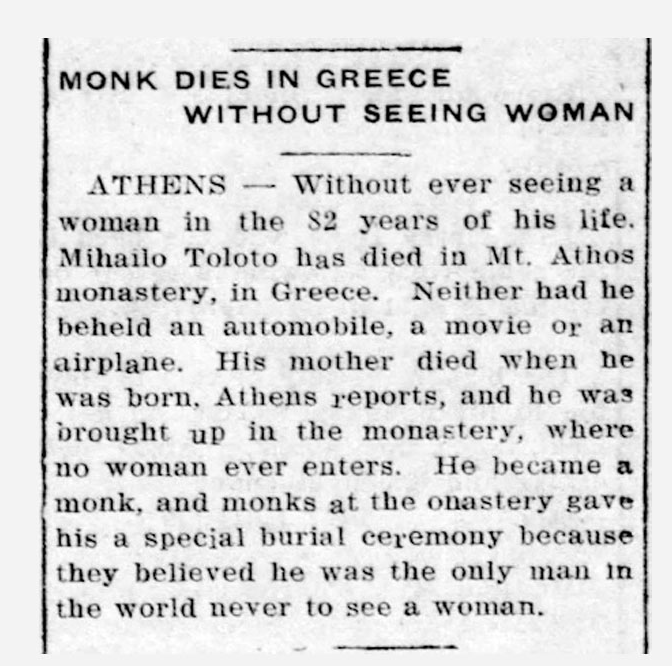
Now, the above article isn’t dated, but according to the website, it “was published in an Athens newspaper on October 29th, 1938.” You might be suspicious because the text is in English, but that’s what not caught my eye. (I grew up in Venezuela, where there was an English-language newspaper published daily for over six decades.)
Firstly, as I mentioned, there is no date in the clipping. That could be because the article was published in the middle of the page. But it seems odd the scan or picture would not have included it for authenticity. The name of the newspaper is also conveniently left out, so no one can try to search said newspapers archives. Then there’s the matter of the typesetting: the off-centered letters like the “a” in “airplane” or the “r” in “ceremony”; and the onastery typo in the fourth line from the bottom. They make it seem as though there was a purposeful intent to make the news article seem authentically old.
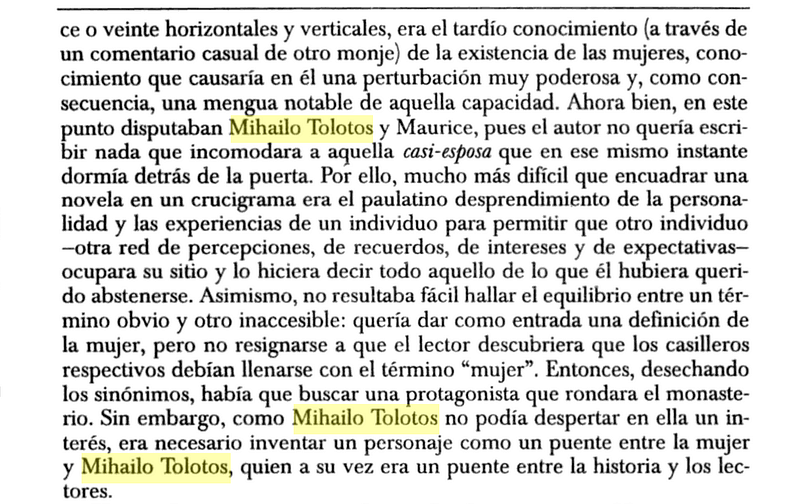
When I searched online for “Mihailo Toloto”, all I found were references to the same article and basic information –-a baby whose mother died at birth was squirreled away to a Greek monastery where women aren’t allowed, so he never saw one during his entire lifetime––, without any reputable sources offering additional details. The earliest reference I found was in December of 2014. I also found a fictional character named Mihailo Tolotos (with an “s”) in the Spanish-language novel Jardín errante by Alberto Vital Díaz. The book was published in 1998, which makes one wonder…
The newspaper story about the monk who never saw a woman has appeared in several online forums, including Reddit, of course. One reader made this interesting comment: “He died in 1938 at the age of 82, meaning he was born in 1856. I would have thought that in that time period they would have needed a wet nurse for him (as the first baby formula wasn’t invented until 1865).”
Another pointed out that during Mihailo Toloto’s lifetime, a few women did manage to slip through the monastery’s ban. The monastery itself is the factual, verifiable part of the story, which lends the article an ounce of credibility.
In any case, I’ve asked Snopes for help, and will update this column if I find or receive any additional information. If you happen to have any, please feel free to share it with us in the comments section.
Now you know. If you ever manage to score an entry pass to Mount Athos, please make sure to ask the monks about the myth of Mihailo Toloto. Then you can tell people all about it on Reddit and become the hero who confirmed the urban legend. Just don’t mention you were at a laura… because the editors of the Spelling Bee decided that laura is a dord*.
You can check out my previous entry on another dord* here:
*What the heck is a dord, you ask? Here’s the answer: