
Chiminea
Chim Chim Cher-ee
Today’s New York Times Spelling Bee letters:
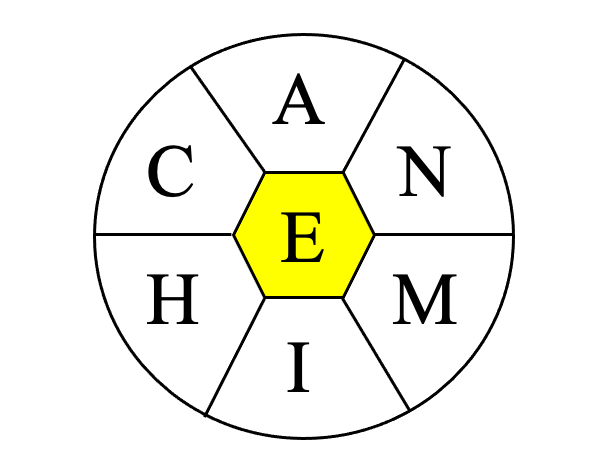
A, C, H, I, M, N, and center E (all words must include E)
Merriam-Webster says…
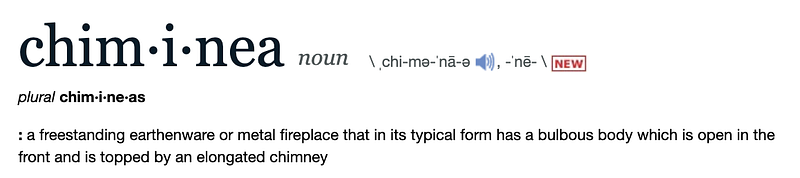
Silly little dictionary! Don’t you know that chiminea can’t possibly be a word if The New York Times says it ain’t?
For further fascinating facts, check out the Spelling Bee Master.
What’s your favorite dord* from today’s puzzle?
My Two Cents
Our daily dord*, chiminea, is a pangram, which in Spelling Bee lingo refers to a word that contains all seven letters of the puzzle at least once. Every Spelling Bee game has at least one pangram, although there can be more. Today’s puzzle has two, for example, while Friday’s had five! It’s a shame chiminea wasn’t included, as pangrams offer 7 bonus points.
One wonders why the word was rejected. It’s not capitalized or hyphenated (two big no-nos in the Spelling Bee rules). It’s also not offensive, like for example, Chinamen, which can also be made using all seven letters in today’s game. (Interestingly, chinaman with a lowercase “c” is an archaic term that means “a dealer in or manufacturer of porcelain”, according to the dictionary.)
As far as chiminea being obscure, well, it seems that The New York Times knows that this type of fireplace has been trending, judging by the number of articles that have mentioned it since 2000, when the first one appeared. This piece from 2015 discusses post-wedding gifts,; the chiminea they and a 2007 story talks about how some urban hotel were using them on their rooftops. In the latter, the writer describes chimineas as “portable, wood-burning clay stoves”.
Perhaps today’s article can convince the editors of the Spelling Bee to include this word the next time today’s combination of letters is used. But I won’t hold my breath…
A chimney is a chiminea is a chimenea
Our friends at Merriam-Webster tell us that chiminea was borrowed from the Spanish chimenea (note the different spelling), meaning “fireplace, hearth, chimney,” itself borrowed from the Middle French cheminée. It’s first known use was in 1981, and I wish the dictionary had included the original source. The example sentence they provide is from twenty-two years later, though.
Basically, a chiminea is a freestanding, front-loading fireplace or oven, usually placed outdoors in a home. It has a bulbous body and a vertical smoke vent… or chimney.
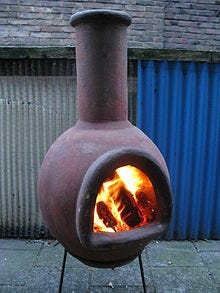
Wikipedia claims that traditional chiminea designs can be traced to Spain and its influence on Mexico, and that the first use of fireplaces-ovens with this design appeared around 400 years ago. But they don’t provide any sources. I found an article on chimineas by Lisa Hallett Taylor in The Spruce, and she also says they have been around for centuries. Hallet Taylor also explains this:
Basically, a chiminea is the same concept as an old-fashioned potbelly stove, which is a cast-iron wood-burning stove. In Eastern European countries, a similar type of stove, called a kotao, is fed with wood and used for cooking many popular dishes. Large, round cooking pans are placed on the kotao. Unlike a wider, more open fire pit, a chiminea is contained. Aromatic woods like cedar, hickory, mesquite, or pinon wood are popular choices, which will blow smoke up and out. After igniting, chimineas can reach full burn in 15 minutes, giving off a great deal of heat. The fire can be controlled like any wood-burning outdoor fire pit or fireplace.
Because of their design, chimineas can be used in the rain without fear of the fire getting extinguished. Which is good in case you plan a barbecue and a thunderstorm shows up along with your guests. Chimineas are also more practical than the fire pits that became popular two decades or so ago. Again, the rain won’t put out the flames, plus you can use them to cook, which I think is harder to do with fire pits. I encourage you to read Hallet Taylor’s article if you plan to buy a chiminea, as it briefly describes what features to look for, how to use it, and how to care and maintain it.
Popping Mary
I’m sure there are plenty of people who, when they hear the word chimney, immediately think of Santa Claus. I’m Jewish and grew up in Venezuela, which means chimney makes me think of… Santa Claus. I mean, I attended an American school and was a kid in the 1970s and 80s, by which time the myth of Old St. Nick had already permeated a good chunk of Venezuelan society. You see, in many Latin American countries it was (and still is) Baby Jesus who traditionally delivered presents to kids. Being a tropical country, people would decorate manger dioramas instead of trees in their homes.
If you’re thinking Santa Claus became popular in Venezuela because Coca-Cola created the image we now associate with this wintertime socialist gift-giver, you’re wrong on two counts. First of all, that Coca-Cola origin story has been debunked; Snopes has a thorough piece about it. And secondly, until the end of the 20th century, Venezuela was one of the few countries in which Pepsi-Cola outsold Coke by a large margin. In fact, Pepsi was so popular that it became an adjective. As in “Hey, give me a Pepsi-flavored soda!”
In any case, Santa Claus had to find creative ways to get into Venezuelan homes, as most did not have fireplaces or chimneys. Again, that whole tropical weather thing I mentioned earlier.
Okay, enough Christmas talk in July. The other thing chimneys bring to my mind is Mary Poppins ––the original 1964 Disney movie featuring Julie Andrews, Dick van Dyke, and some animated penguins. It was the top-grossing movie in America that year, and was nominated for 13 Oscars in 1965. Among the nominations was “Best Picture” –-the only occasion in which a Disney film received that honor during Walt’s lifetime––, which it did not win, and “Best Original Song”, which it did.
That song was “Chim Chim-cher-ee”, writtten by Robert B. Sherman & Richard M. Sherman (the “Sherman Brothers) and sung by Dick Van Dyke. The two-and-half minute ditty wafts from cheery to melancholic and back again, mentuoning the good life of a chimney sweep and how shaking hands with one brings people luck. This last part coming from ancient British folklore. Here is the snippet from the movie, in case you never saw it or want to reminisce.
The tune has been covered a plethora of times since, by legends such as John Coltrane, Duke Ellington, (who covered the entire soundtrack), and more recently by American bassist Esperanza Spalding, in a gorgeous rendition.
Now you know. Next time you’re invited to a fancy friend’s fancy house, and in their fancy back yard you see a fancy, freestanding, front-loading fireplace with a bulbous body and a vertical smoke vent… you can compliment your friend on their chiminea. Don’t be surprised if they don’t know that fancy term, though… because the editors of the Spelling Bee decided that chiminea is a dord*.
You can check out my previous entry on another dord* here:
*What the heck is a dord, you ask? Here’s the answer: