
Latest Election Tactics: Rejecting Ballots, Intimidating Voters
Trump supporters using new laws, door-to-door interrogations
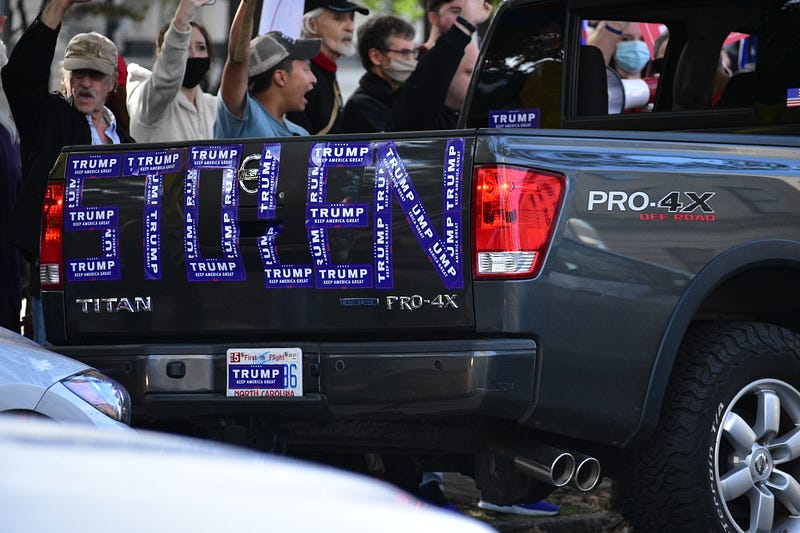
With the launch of the primary season, the “Big Lie” of a stolen 2020 election is having real consequences for voters, including high numbers of rejected mail-in ballots in Texas and door-to-door intimidation across several states.
They are reminders that, in addition to the failed big schemes to overturn the last election, the coup launched by former President Donald Trump is ongoing. And it is only going to get worse as the election season proceeds.
Texas was a leader among 19 GOP-controlled states that passed 33 restrictive voting laws in 2021. They did so, despite The Trump Justice Department, court rulings, and state audits finding no evidence of significant election fraud. Lawmakers insisted the new laws would make voting easier and fairer.
Yet various analyses of the March 1 primary showed a dramatic increase in rejected mail-in ballots because of confusing changes in the law and new hurdles to ensure ballots are counted. The Texas secretary of state’s office reported that one in every eight ballots was rejected.
An Associated Press analysis found that in Harris County, which includes populous Houston, officials rejected 19 percent of the mail ballots, compared to 0.3 percent in the 2018 primary.
In that county, areas with large Black populations were 44 percent more likely to have ballots rejected than heavily white areas, according to The New York Times analysis of voting and census data.
Under the new law, voters have to provide a partial Social Security number or driver’s license number on the mail-ballot application — as well as on the return envelope. Many voters overlooked the ID field, located under the envelope flap. And the ID number had to match what’s on their voter registration record, which could be from decades ago.
Texas elections officials say they will do a better job of educating mail-in voters, who are mostly elderly and disabled, about the new process and how they can fix rejected ballots or vote in person.
But Hani Mirza of the Texas Civil Rights Project, makes a valid point that the sheer number of rejected ballots undermines democracy.
“You can’t throw out that many ballots based on a technicality that was a part of a very convoluted process and say that the process was democratic,” he told National Public Radio.
Civil rights and voting rights groups in Colorado last month sued to stop an organization of election deniers — sometimes armed and carrying fake government badges — from interrogating voters.
Meanwhile, right-wing activists have organized in several states to search out or prevent election fraud, in mostly minority communities. Many of the efforts have been financed by My Pillow owner and conspiracy promoter Mike Lindell and encouraged by podcaster Steve Bannon, a Trump strategist.
Civil rights and voting rights groups in Colorado last month sued to stop an organization of election deniers — sometimes armed and carrying fake government badges — from interrogating residents about their voting histories.
The suit against the U.S. Election Integrity Plan, whose “County & Local Organizing Playbook” instructs members to “undertake citizen audit activities to either refute or confirm serious allegations of election malfeasance.”
The lawsuit — filed by the NAACP, League of Women Voters, and Mi Familia Vota — relies in part on the Ku Klux Klan Act, passed after the Civil War to prevent white vigilantes from trying to stop Black people from voting.
“It’s extremely scary,” Portia Prescott, president of the NAACP of Colorado, Wyoming, and Montana told the Associated Press. “You feel like a target, they know how you vote. Will you vote the next time? Probably not.”
The Election Integrity group has plans to expand to other states such as Arizona, Georgia, and New Hampshire. Its materials have been used by conspiracy theorists going door-to-door in Utah, according to the Salt Lake Tribune.
Over the past six months, similar door-to-door efforts have been reported in New Mexico, Nebraska, and Pennsylvania.
A March 31 ruling permanently blocked many of Florida’s new voter suppression laws — the first time a federal court had struck down elements of the GOP voting laws.
Some positive developments
Although Congress has not assumed its responsibility to stop state-level voting suppression, two recent court decisions offer some encouragement.
The Arizona Supreme Court on April 6 denied a request by the state Republican Party to outlaw early voting, a practice used by 90 percent of the state’s voters. The lawsuit argued that early voting was unconstitutional and it also asked the court to eliminate ballot drop boxes or ban ballot counting prior to Election Day.
The seven judges on the court, all appointed by Republican governors, ruled that the GOP did not have standing to take its case directly to the high court. It’s not clear if the GOP plans to file the case in Superior Court.
Although the decision was based on a technicality, state election officials and civil rights officials embraced it as a victory. It was reinforced when the Arizona attorney general, a Republican running for U.S. Senate, recently concluded that President Joe Biden’s narrow win in the state was not fraudulent.
More legally significant: A federal judge’s March 31 ruling permanently blocked many of Florida’s new voter suppression laws from going into effect.
The 288-page order, issued by Chief U.S. District Judge Mark E. Walker, was the first time a federal court had struck down major elements of the GOP voting laws.
Walker, appointed by President Barack Obama, agreed with the League of Women Voters of Florida and the NAACP that the law unfairly and unconstitutionally violated minorities’ voting rights by restricting ballot drop boxes, registration drives, and giving water and snacks to voters in long lines.
Walker also ordered that Florida should receive regular scrutiny of its election laws as required by the Voting Rights Act. And he criticized the U.S. Supreme Court for its rulings undermining that landmark voting law.
There is a strong chance that his order could be overturned by the conservative 11th U.S. Circuit Court of Appeals. But since so many of the new election laws were duplicated across the states, his ruling perfectly summed up the situation facing voters this election year.
The Florida law, he said, “runs roughshod over the right to vote, unnecessarily making voting harder … unduly burdening disabled voters, and intentionally targeting minority voters — all to improve the electoral prospects of the party in power.”


